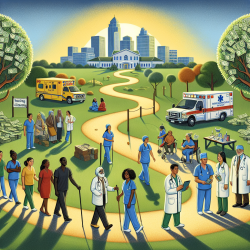
Why Pathway Programs Matter: A Workforce Problem with Two Root Causes
Health professions pathway programs have existed for decades, but the urgency behind them has intensified as states confront persistent shortages across clinical roles. The literature review by Jack Ringhand (April 2024), developed in support of the Arizona Center for Rural Health and the Arizona Health Improvement Plan, synthesizes evidence on pathway programs designed to strengthen the health workforce by supporting students who are underrepresented, underserved, or from rural communities.
The review emphasizes that workforce shortages are not only a matter of “not enough clinicians.” They are also driven by:
Maldistribution: providers are unevenly spread across communities, leaving many rural and some urban areas underserved.
Mismatch in representation: the socio-economic, racial, ethnic, cultural, and linguistic diversity of the workforce does not reflect the population it serves.
In Arizona, these dynamics are particularly visible. Rural towns can have dramatically fewer primary care physicians per capita than urban areas, and communities of color remain underrepresented in physician workforces relative to their share of the population. The National Academy of Medicine has also linked greater representation in the health professions with improved access, patient satisfaction, and communication—factors that can influence outcomes and equity.
What the Literature Review Examined (and What It Did Not)
The report is a literature review of U.S.-based pathway programs published in 2010 or later. The inclusion criteria were intentionally specific: programs had to be administered in higher education settings, support primary care medical or dental professions, and serve underrepresented, underserved, or rural students. Studies focused on K–12 programs and those outside the U.S. were excluded.
Importantly, the review did not attempt to declare a single “best” program model. Outcomes across studies were heterogeneous—ranging from matriculation rates to self-efficacy gains—so the report focused on identifying common practices and notable design features rather than conducting a systematic effectiveness comparison.
A Practical Typology: Program Length as a Design Signal
One of the most useful contributions of the review is its organizing framework: pathway programs often cluster into three duration categories, and duration frequently shapes what a program can realistically provide.
Short-term programs (less than three months): often summer-based and well suited to immersion experiences such as shadowing, workshops, seminars, and focused test preparation.
One-year programs (about 11–12 months): commonly post-baccalaureate or master’s programs emphasizing academic readiness and admissions competitiveness.
Longitudinal programs (one to four years): typically integrated into undergraduate timelines and able to scaffold supports over time (mentoring, research roles, coursework, professional development).
This duration-based lens helps administrators align program structure with goals. For example, a short-term program may build motivation and exposure, while a longer program may be better positioned to strengthen academic preparation and sustained advising.
The Core Toolkit: Common Supports Used by Pathway Programs
Across the 26 articles included, pathway programs repeatedly relied on a relatively consistent set of instructional and financial supports. The report summarizes these as the most common “building blocks.”
Instructional Supports
Academic enrichment: science courses, lecture series, or seminars that strengthen foundational knowledge and academic confidence.
Mentorship and shadowing: peer, faculty, or clinician mentoring; observational experiences that clarify career pathways and professional expectations.
Clinical or practical skill development: clinical rotations, simulation workshops, or hands-on skill sessions that make health careers tangible and attainable.
Admissions preparation: test preparation (e.g., MCAT/DAT), tutoring, application workshops, mock interviews, and personal statement support.
Financial Supports
Stipends and scholarships: often used to offset housing, travel, food, tuition and fees, textbooks, exam preparation costs, and application fees.
A key insight is that financial support is not merely “nice to have.” In many pathway contexts, it is the mechanism that makes participation feasible—especially for students balancing work, family responsibilities, and the high costs of preparation and applications.
Notable Program Features: Where Design Choices Become Strategy
Beyond the common toolkit, the review highlights distinctive features that illustrate how programs tailor design to mission and context.
Recruitment that Matches the Goal
Some programs broaden recruitment channels to reach students who may be overlooked by traditional pipelines. For example, Taylor et al. (2019) describe recruitment that includes community college students alongside four-year university students—an approach that can expand access for first-generation and working learners.
Other programs define eligibility in ways that directly support workforce distribution goals. Kallail and McCurdy (2010) describe a program that accepts only students who have lived in rural communities, reflecting evidence that rural-origin trainees are more likely to practice rurally.
Admitting “Promising” Students, Not Only the Already Competitive
Upshur et al. (2018) describe a program that intentionally admits students with promising but not yet competitive GPAs—on the premise that these students may benefit most from structured supports. This is a meaningful shift away from a “select the best prepared” model toward a “develop the potential” model, which may better align with equity goals.
Paid Roles Instead of Traditional Stipends
Bliss et al. (2020) describe a longitudinal model where students receive paid mentorship and research positions rather than (or in addition to) stipends and scholarships. This design can normalize professional participation, build resumes, and reduce the opportunity cost of time spent in program activities.
Assured Admissions Agreements
Some programs increase certainty and reduce risk by establishing agreements with professional schools. Cestone et al. (2018) and Kallail and McCurdy (2010) describe programs that assure medical school admission contingent on performance. While not feasible everywhere, these agreements can be powerful for retention and motivation—especially for students navigating opaque admissions processes.
Implications for Schools and Student Support Organizations (Including Teletherapy Providers)
Although the reviewed programs focus on health professions education pipelines, the underlying logic translates well to school-based workforce challenges more broadly: access improves when supports are structured, sustained, and financially feasible.
For organizations like TinyEYE that provide online therapy services to schools, the pathway program literature offers practical parallels:
Pipeline thinking applies to allied health, too: shortages in school-based services (including speech-language pathology, occupational therapy, and mental health supports) are influenced by geography, training access, and financial barriers—similar dynamics to those described in the review.
Mentorship and exposure reduce “career invisibility”: many students do not understand what therapy roles in schools look like day-to-day. Structured shadowing (including virtual observation where appropriate), guest lectures, and mentorship can demystify these careers.
Financial barriers shape who can persist: application fees, exam preparation, unpaid practicums, and relocation costs can quietly filter out talented candidates. Programs that offer stipends, paid roles, or tuition support may improve retention and diversity.
Design should reflect local needs: rural and underserved urban communities may require different recruitment strategies, partnerships, and supports. The review repeatedly shows that “one size fits all” pathway design is uncommon and often ineffective.
In short, pathway programs succeed when they treat workforce development as a system: recruitment, preparation, mentorship, experiential learning, and financial feasibility must work together.
Conclusion: A Flexible Model for an Evolving Workforce
The literature review underscores a central point: pathway programs remain a critical strategy for addressing workforce shortages, improving distribution, and strengthening representation in health professions. While common supports—academic enrichment, mentorship, clinical skill development, admissions preparation, and financial assistance—appear across many models, the most effective designs often align tightly with local goals and student realities.
For states like Arizona, and for institutions and partners working to expand access to care in rural and underserved communities, the implication is clear: pathway programs are not simply educational add-ons. They are workforce infrastructure.
For more information, please follow this link.