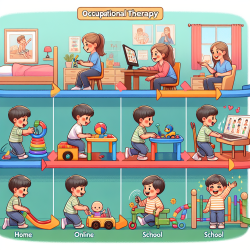
One of the first questions families ask when starting occupational therapy (OT) is simple and completely reasonable: how long does occupational therapy take? The honest answer is that OT is not a one-size-fits-all service. Timelines vary because occupational therapy is designed to meet an individual child’s needs, build functional skills step-by-step, and support carryover into daily routines.
As a company that provides online therapy services to schools, TinyEYE Therapy Services also understands the real-life pressures families face: busy schedules, limited local provider availability, and the need for consistent support that fits into home and school life. TinyEYE’s private therapy options can help families access occupational therapy services in a way that is structured, measurable, and flexible.
What Occupational Therapy Is (and What It Typically Works On)
Occupational therapy helps children and youth participate more successfully in everyday activities—at school, at home, and in the community. In pediatric settings, OT often focuses on skills that support learning, independence, and regulation.
Depending on the child, OT may address:
- Fine motor skills (pencil grasp, cutting, manipulating small objects)
- Visual-motor integration (copying shapes/letters, spacing, alignment)
- Handwriting and written output endurance
- Sensory processing and self-regulation (attention, coping strategies, transitions)
- Executive functioning supports (planning, organization, task initiation)
- Self-care skills (dressing, feeding, hygiene routines)
- Play skills and participation (especially for younger children)
- Assistive technology or adaptive tools (as needed)
Because these areas develop over time and depend on consistent practice, OT is often best understood as a process rather than a quick fix.
So, How Long Does Occupational Therapy Take?
Occupational therapy timelines typically fall into three broad categories. These are not strict rules, but they can help families set realistic expectations.
Short-Term OT (Approximately 6–12 Weeks)
Short-term therapy may be appropriate when a child has a specific, well-defined goal and the barriers are relatively narrow. For example, a child may need targeted support to learn a particular handwriting strategy, improve scissor skills, or establish a workable sensory routine for a specific part of the school day.
Short-term OT often includes:
- A focused evaluation and goal plan
- Weekly or biweekly sessions
- Home and/or school strategies for practice between sessions
- Progress monitoring with clear criteria for success
Medium-Term OT (Approximately 3–6 Months)
Many children fall into this range, especially when goals involve building foundational skills that require repetition and gradual strengthening. For example, improving fine motor coordination, increasing independence with self-care routines, or developing a set of self-regulation strategies that work across settings.
In medium-term OT, you may see progress in “layers.” A child might show improvement in the therapy session first, then begin using the skill at home, and later generalize it to school (or vice versa). That generalization phase is often what takes time—and it is also what makes therapy meaningful.
Longer-Term OT (6+ Months and Sometimes Ongoing)
Longer-term therapy may be needed when:
- There are multiple areas of need (motor, regulation, executive functioning)
- Skills are significantly delayed compared to peers
- There are complex learning needs or developmental differences
- Progress is impacted by fatigue, anxiety, attention challenges, or inconsistent routines
- The child benefits from periodic “booster” sessions during transitions (new grade, new expectations)
Longer-term OT does not necessarily mean a child will be in therapy at the same intensity forever. Often, therapy shifts over time—from direct sessions to consultation, caregiver coaching, or periodic check-ins as independence grows.
What Factors Influence OT Duration?
Several variables affect how long occupational therapy takes. Understanding these factors can help families feel more informed and less surprised by the process.
1) The Child’s Starting Point and the Complexity of Goals
A single, measurable goal (for example, using a functional pencil grasp for short writing tasks) may take less time than a goal involving multiple underlying skills (such as completing a full written assignment with legible handwriting, appropriate spacing, and sustained attention).
2) Frequency and Consistency of Sessions
In general, consistent therapy supports faster progress. A child seen weekly may progress differently than a child seen monthly. That said, the “right” frequency depends on the child’s needs, stamina, and the family’s ability to practice strategies between sessions.
3) Carryover Between Sessions
OT is most effective when strategies are used outside the session. This does not mean families need to run “therapy school” at home. It means small, realistic routines matter—like using a visual schedule, practicing a grip strategy during homework, or doing a short sensory warm-up before writing.
4) The Environment: Home and School Demands
Sometimes a child can perform a skill in a calm setting but struggles in a busy classroom. Therapy duration may increase when the goal is not just skill acquisition, but skill use under real-world conditions.
5) Motivation, Confidence, and Regulation
Progress is not only physical; it is emotional and behavioral too. A child who feels capable, safe, and understood is more likely to attempt challenging tasks. Occupational therapists often work on building confidence and reducing frustration alongside skill development.
What Progress in OT Often Looks Like (Realistically)
Families sometimes expect progress to be linear: session by session, everything improves. In reality, OT progress is often uneven—especially when children are tired, stressed, or facing new demands at school.
Common signs of meaningful progress include:
- Improved willingness to try difficult tasks
- Fewer meltdowns or shutdowns during challenging routines
- Better endurance for writing or self-care tasks
- More independence with fewer prompts
- Using strategies (like movement breaks or checklists) without being reminded
- Skills showing up in multiple settings, not just in therapy
How TinyEYE’s Online Private OT Can Support Families
TinyEYE Therapy Services is known for delivering online therapy services to schools, and that same commitment to accessible, high-quality care can extend to families seeking private therapy support. Online OT can be a strong option for families who need consistency, flexibility, and collaboration without the travel time and scheduling barriers that often come with in-person services.
Here is how TinyEYE’s approach can connect to the question of “how long will this take?” in a practical way:
Clear Goals and Measurable Planning
When goals are specific and functional, it becomes easier to estimate timelines and track progress. TinyEYE’s online model supports structured sessions and ongoing monitoring so families can see what is changing and why.
Family-Friendly Strategies That Fit Real Life
Occupational therapy is most effective when strategies are realistic. Online private therapy can make it easier to include caregivers in the process—so home routines, school expectations, and therapy goals align.
Consistency That Supports Momentum
Because OT relies on practice and repetition, consistent scheduling matters. Online therapy can reduce missed sessions due to transportation, weather, or long commutes, helping children maintain momentum over time.
Collaboration Across Settings
Children do best when the adults around them share strategies and expectations. TinyEYE’s experience partnering with schools supports a team-based mindset—helping families connect therapy goals to classroom participation and daily functioning.
Questions to Ask When Starting Occupational Therapy
If you are considering private OT services, these questions can help you better understand the expected timeline and what will be required to make progress:
- What are the top 2–3 functional goals, and how will progress be measured?
- How often should sessions occur to meet these goals?
- What strategies should we use between sessions, and how much time will they take?
- What will therapy look like if progress is faster or slower than expected?
- How will we plan for generalization to school and home routines?
A Helpful Bottom Line
Occupational therapy can be short-term, medium-term, or longer-term depending on the child’s needs, the complexity of goals, and the consistency of practice across environments. Many families find that once the “right” strategies are in place, daily routines become smoother, school participation improves, and children feel more confident—often well before every goal is fully mastered.
When families have access to consistent, goal-driven support, OT becomes less about “How long will this take?” and more about “What meaningful changes are we seeing, and what is our next step?” TinyEYE Therapy Services’ online private therapy can help families take those steps with clarity and structure.
For more information, please follow this link.