
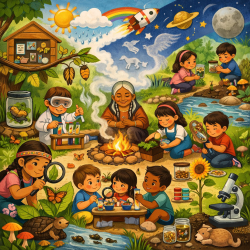
As a district Special Education Director, I spend a lot of time in conversations about access: access to instruction, access to specialized supports, and access to meaningful participation for every learner. Kindergarten science is a powerful place to start because it is naturally hands-on, language-rich, and rooted in children’s curiosity. It is also a place where schools can intentionally build inclusive routines that support communication, self-regulation, and engagement.
This “science curriculum at a glance” for Grade K highlights big ideas (enduring understandings), global competencies, and practical skills that help students explain phenomena, work together, and connect learning to their own lives. Below is an easy-to-read walkthrough of the strands and what they can look like in classrooms—especially when schools are balancing staffing shortages and looking for flexible service delivery options like online therapy supports.
Big Picture: What Kindergarten Science Is Really About
Across the document, several themes repeat in developmentally appropriate ways:
- Curiosity and inquiry: Students ask questions like “What is matter?” and “What patterns can we see in the sky?”
- Belonging and identity: Students learn that everyone can do science and contribute to scientific thinking.
- Practical skills: Students observe, sort, compare, measure, and communicate what they notice.
- Connections to community and culture: Students consider how science and technology affect people and the environment, and how Indigenous ways of knowing contribute to understanding the natural world.
For school teams, this is helpful because it frames science as more than content. It’s also language development, social learning, and participation—areas where speech-language pathologists, occupational therapists, and educational teams can align supports without “pulling students away” from core learning.
Potential Inquiry Questions: A Simple Planning Anchor
The curriculum highlights three inquiry questions that can guide units, centers, and outdoor learning:
- What is matter?
- What patterns can we see in the sky?
- What are living things like?
These questions are ideal for Kindergarten because they invite observation, play-based exploration, and repeated practice with vocabulary (e.g., heavy/light, rough/smooth, living/non-living). They also create natural opportunities for visuals, gestures, and structured communication supports.
Strand A: Indigenous Peoples within the Natural World
Guiding question: What contributions do Indigenous ways of knowing, being, and doing make to science?
This strand emphasizes exploring First Nations, Métis, and Inuit ways of knowing in relationship with land and the natural world. The curriculum points to approaches that are wholistic, reciprocal, interconnected, and sustainable, and it encourages land-based and outdoor learning while recognizing intersections with Western science.
In practice, schools can support this strand by:
- Inviting an Elder, Knowledge Holder, or Knowledge Keeper to share teachings connected to seasons, plants, sky patterns, or respectful relationships with land and water.
- Using local context: what students can observe on the school grounds, in nearby parks, or in the community.
- Teaching observation as a respectful practice: noticing carefully, documenting thoughtfully, and considering impact (e.g., not disturbing habitats).
From a compliance and inclusion standpoint, this is also a reminder to ensure learning experiences are respectful and accurate, and that consultation and community partnerships are approached appropriately.
Strand B: Science Identity
Guiding question: How do I engage in science?
This strand is about agency, identity, and belonging in science. Kindergarten students build a personal connection to nature, link science concepts to personal experience, and learn that everyone can contribute.
For many students—especially those with speech-language needs, sensory needs, or anxiety—science identity grows when adults intentionally structure success. Helpful classroom practices include:
- Predictable routines for experiments (look, touch, smell only when safe, describe, draw, share).
- Sentence starters and visuals (e.g., “I notice…,” “I wonder…,” “It feels…,” “It is heavier than…”).
- Choice-making (which tool to use, which object to measure, which way to record observations).
- Multiple ways to communicate (pointing, using picture supports, verbal responses, drawing, acting it out).
This is also an area where online therapy can be a practical support. When in-person staffing is tight, virtual SLP or OT services can help teachers embed communication and self-regulation strategies into science routines rather than treating them as separate activities.
Strand C: Practical Science (STSE, Measurement, Practices, Tools, Careers)
Guiding questions: How do science and our world interact? How do we measure scientifically? How can we do science? How do we use tools in science? Where is science found in our lives?
SCI.K.C.1: Science, Technology, Society, and Environment (STSE)
Students build awareness of how science and technology interact with society and the environment and how decisions can support a sustainable future. Examples include recycling, seasonal changes, planting and harvesting, conservation, and the significance of celestial bodies in various cultures.
Kindergarten-friendly ways to approach STSE include:
- Sorting lunch waste and discussing what can be reused or recycled.
- Observing seasonal changes and connecting them to clothing choices, animal behavior, or plant growth.
- Talking about “helpers in the community” and the tools they use (e.g., firefighters, farmers, doctors).
SCI.K.C.2: Measurement Foundations
This outcome introduces measurement using senses, non-standard tools (hands, paper clips, coins), and time tools like calendars and clocks. Students compare and sequence based on a single attribute such as length, mass, volume, or time.
Simple measurement tasks that support both math and language development include:
- Comparing objects as longer/shorter using hands or paper clips.
- Comparing items as heavier/lighter by holding one in each hand.
- Sequencing events by time: what takes longer/shorter (washing hands, putting on boots, reading a story).
SCI.K.C.3: Doing Science Safely and Actively
Students participate in inquiry, experimentation, observation, data analysis (at an introductory level), measurement, debate and scientific argumentation, communication, and designing/building.
Examples in the document include observing shadows as the Sun moves, recording characteristics of plants and animals, and using terminology others understand. This is a strong reminder that Kindergarten science is also about learning to communicate clearly—an essential skill for classroom participation.
SCI.K.C.4: Scientific Instruments and Materials
Students learn the purpose and function of tools (like magnifying glasses) and how to use materials safely, including craft and recycled materials and items from nature.
From a risk-management and accessibility lens, schools should ensure:
- Clear safety procedures (what goes in mouths, what stays on tables, handwashing after outdoor exploration).
- Adapted tools as needed (larger-handled magnifiers, stabilized trays, visual step cards).
SCI.K.C.5: Careers, Hobbies, and Activities
Students connect science ideas to careers and hobbies such as geologist, farmer, firefighter, astronomer, biologist, gardening, birdwatching, stargazing, and Indigenous storytelling related to seasons and life.
This outcome is a wonderful bridge to family engagement. Sending home a “science at home” prompt (e.g., look for the Moon shape tonight, notice a plant growing, sort recyclables) can strengthen school-home connections without requiring expensive materials.
Strand D: Nature of Science
Guiding questions: How is science done? How is science used?
Two key understandings are highlighted:
- Everyone can ask questions about the world and try to explain what is happening.
- Technologies are created by people to provide things that are needed or useful.
In Kindergarten, this can look like normalizing “noticing” and “wondering,” and helping students see that tools and inventions are designed to solve problems. A simple design challenge (build a shelter for a toy animal, create a tool to pick up small objects, design a way to keep an ice cube from melting) makes this concrete.
Strand E: Scientific Knowledge (Matter, Space Science, Life Science)
This strand includes the core content many adults think of as “science,” taught through exploration and language:
- Matter: All “stuff” is made of matter, including air, water, soil, objects, and materials.
- Properties of matter: Matter can be described by properties such as color, soft/hard, smooth/rough, heavy/light.
- Patterns in the sky: The Sun’s position changes across the day; the Moon’s shape changes over time.
- Living vs. non-living: Living things eat, sleep, grow, breathe, react to stimuli, reproduce, and move.
- Variety of organisms: There are many different organisms on Earth.
For inclusive instruction, the key is repeated exposure and consistent vocabulary. Students benefit when teachers use real objects, photos, and outdoor observations, and when adults model precise words (e.g., “rough” rather than “bumpy,” “heavier” rather than “bigger”).
How Online Therapy Can Support Kindergarten Science Instruction
At TinyEYE, we often partner with schools that are working through therapist staffing shortages or scheduling constraints. Kindergarten science provides an authentic context for therapy goals without taking students away from instruction. Examples include:
- Speech-language support: building vocabulary for properties (smooth/rough), sentence structures (“I notice…,” “It is heavier than…”), and narrative skills (retelling an experiment).
- Occupational therapy support: tool use (magnifier, scissors for craft materials), sensory strategies for outdoor learning, fine-motor tasks for recording observations.
- Collaboration with teachers: co-planning simple data collection (pictures, checklists) that supports both learning and documentation.
When these supports are integrated, students experience science as something they can do—regardless of learning profile—and teams can maintain service consistency even when hiring is challenging.
For more information, please follow this link.
