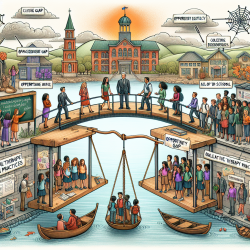
Learning loss is often talked about as a number: months behind, points dropped, or a score that didn’t grow the way we hoped. But anyone working in schools knows the real story is more complicated. Students didn’t just “miss content.” Many lost routines, confidence, language practice, peer interaction, and the day-to-day support that helps them stay regulated and ready to learn.
A 2023 conference paper by Abdalla Mohamed proposes a helpful way to make sense of learning loss and, more importantly, to recover from it: Education Value Chain Analysis (EVCA). Instead of looking only at test results, EVCA asks schools to look at the full system that creates learning—what goes in, what happens during instruction and support, and what outcomes come out.
At TinyEYE, we partner with schools to provide online therapy services. What we appreciate about EVCA is that it fits the real world of student support: learning recovery is not one program, one assessment, or one department. It is a coordinated set of actions across a chain of activities—academic, behavioral, communication, and social-emotional.
Why traditional “learning loss” approaches can miss the mark
Mohamed notes that many learning loss frameworks have been criticized for being too narrow. Schools may be pushed toward what is easiest to measure (like time in school or reading/math scores) instead of what is most important to rebuild (like quality instruction, engagement, and social-emotional skills).
The paper describes three common approaches used to measure and respond to learning loss:
Psychometric framing: predicts skill deficits based on reduced time in school and connects those deficits to long-term workforce and economic outcomes.
Commercial framing: emphasizes large-scale testing and assessment programs.
Economic framing: often focuses on reading and math results and may be influenced by the tools and services being marketed.
These approaches can be useful, but they can also lead to a “single-lens” view. If we only measure what’s easiest, we risk missing root causes and overlooking the supports students need to access learning—especially students with disabilities, multilingual learners, and students experiencing stress or trauma.
EVCA in plain language: learning is created through a chain
EVCA borrows a concept from business management: the “value chain,” popularized by Michael Porter. In business, a value chain maps the activities that turn inputs into a finished product or service. Mohamed’s key idea is that education works the same way: the system takes inputs (resources, staff, curriculum, students’ readiness), runs them through processes (teaching, services, delivery), and produces outcomes (skills, knowledge, attitudes, graduation, readiness for work and life).
When learning loss happens, EVCA helps schools answer three practical questions:
Where in the education system is the loss showing up (input, process, or outcome)?
Why is it happening (root causes and contributing factors)?
What should we do next (interventions, alignment, and monitoring)?
The four pillars of the EVCA learning recovery framework
Mohamed proposes an integrated framework with four connected phases (or pillars). Think of these as steps schools can cycle through—especially as needs shift across the year.
Pillar 1: Education Value Chain Analysis (map the system)
This phase is about identifying what level you’re focusing on (district, school, grade, or group) and mapping the core and support activities that create learning.
In the paper, the education value creation process includes core activities such as:
Curriculum or course development
Admission and registration
Content and materials production
Distribution or dissemination of materials
Teaching and learning (delivery)
Assessment and evaluation
It also includes support activities such as:
Information technology (I.T.)
Human resources (H.R.)
Finance and infrastructure (systems that keep the work running)
In school terms, this is the moment to stop blaming “students fell behind” and instead ask: which parts of our system were disrupted, and which supports were stretched thin?
Pillar 2: Learning loss and gap analysis (find the “where” and “why”)
Once the value chain is mapped, the next step is to determine:
Type and size of learning loss and gaps
Position of the loss in the value chain (where it appears in K–12 and across activities)
Root causes and the stakeholders connected to those causes
Priorities (what to address first)
This pillar is where schools can widen the lens beyond academics. For example, if students are struggling with reading comprehension, EVCA encourages teams to ask whether the root cause is purely instructional—or whether it includes language development, attention, working memory, hearing/vision access, attendance, or stress and emotional regulation.
This is also where specialized services matter. Speech-language therapy, occupational therapy, counseling supports, and behavior services can be key “process” supports that help students access instruction. If those services were interrupted or delayed, the learning impact can be cumulative.
Pillar 3: Interventions, initiatives, and alignment (choose actions that match the cause)
After identifying what is happening and why, pillar 3 focuses on selecting and aligning interventions. The paper notes that learning recovery efforts may include:
Remedial supports
Catch-up programs
Accelerated learning approaches
Bridging programs
What makes EVCA especially practical is the emphasis on alignment: interventions should connect to the value chain and address root causes, not just symptoms.
Here are school-friendly examples of what “alignment” can look like:
If the root cause is access to instruction (process issue): strengthen consistent service delivery, scheduling, and classroom supports.
If the root cause is a skills gap in communication (input and process issue): provide targeted speech-language intervention tied to classroom tasks (vocabulary, narrative skills, comprehension strategies).
If the root cause is inconsistent implementation (support activity issue): invest in staff training, coaching, and clear routines.
If the root cause is engagement and regulation (process issue): integrate social-emotional supports and predictable structures that reduce cognitive load.
This is a natural fit for how many districts already think about MTSS: match intensity and type of support to student need, then adjust based on data.
Pillar 4: Monitoring and implementation (make it doable and measurable)
The final pillar focuses on turning plans into action through:
Key performance indicators (KPIs)
Resource allocation
Scheduling and timelines
Monitoring, reporting, and feedback loops
In other words: if we can’t implement it consistently, it won’t be effective—no matter how strong it looks on paper.
For student support services, monitoring might include:
Service minutes delivered vs. scheduled
Student attendance and participation
Progress monitoring toward functional goals (communication, self-regulation, classroom participation)
Teacher and caregiver feedback on carryover
Because TinyEYE provides online therapy services, we often see how implementation improves when schools have dependable staffing, clear schedules, and consistent documentation. EVCA reinforces that these “support activities” (like I.T., staffing, and infrastructure) are not side issues—they are part of the learning value chain.
What EVCA adds that schools can use right away
Mohamed argues EVCA is “superior” to many existing approaches because it is more comprehensive and better at identifying root causes. The framework is designed to:
Cover the full education system (not just test outcomes)
Estimate learning loss at multiple levels (student, grade, school, region, national)
Capture cumulative effects over time
Reflect quality, not just quantity
Include socioemotional skills and attitudes
Support cost-effectiveness and cost-benefit thinking without reducing education to dollars
That balance matters. Schools are accountable for results, but students are not spreadsheets. EVCA gives leaders a way to use data while still honoring the complexity of learning and development.
A simple way to start using EVCA in your district
If you want a practical entry point, try this three-part team activity:
Map the chain: List your core learning activities (curriculum, instruction, assessment) and your support activities (staffing, I.T., scheduling, related services).
Circle breakdown points: Where did disruptions occur most often—inputs, processes, or outcomes? Be specific (example: “inconsistent Tier 2 delivery,” “limited progress monitoring,” “service provider vacancies”).
Match interventions to causes: Choose 1–3 high-leverage fixes and define KPIs that tell you if the fix is working.
When schools take this approach, learning recovery becomes less about chasing a single score and more about rebuilding a system that reliably produces learning—academically, socially, and emotionally.
For more information, please follow this link.