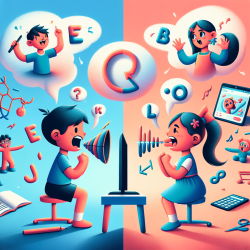
Expressive language is the ability to communicate thoughts, needs, and ideas through spoken words, gestures, signs, or alternative communication systems. When a child has an expressive language delay, they understand more than they can express. This difference can be easy to miss at first—especially when a student is bright, social, and eager to participate. Yet expressive language challenges can affect academic performance, social relationships, and behavior if they are not identified and supported early.
Schools are often the first setting where expressive language delays become clearly visible. Classroom routines require students to explain their thinking, retell events, ask for help, and use precise vocabulary. When those skills are difficult, students may appear “quiet,” “off task,” or “not trying,” when the real issue is that expressing language is hard work.
This article outlines common expressive language delay symptoms, how they may present in school and at home, and how online therapy services—such as TinyEYE’s school-based teletherapy—can help students build communication skills in a consistent, accessible way.
Expressive Language Delay: What It Is (and What It Is Not)
An expressive language delay refers to difficulty using language to communicate. Students may struggle with:
- Vocabulary (word knowledge and word retrieval)
- Sentence structure (grammar and syntax)
- Narrative skills (telling stories, explaining events)
- Pragmatics (using language appropriately in social contexts)
- Organization of ideas (sequencing, clarity, detail)
Expressive language delay is not the same as a speech sound disorder (articulation). A child may pronounce sounds clearly but still have difficulty putting words together, using age-appropriate grammar, or expressing complex ideas. Some students experience both speech and language needs, while others have only expressive language challenges.
Common Expressive Language Delay Symptoms
Symptoms vary by age and individual profile, but the following patterns are often seen across early childhood and school-age years.
1) Limited Vocabulary or “Word-Finding” Difficulties
Students may use general words such as “thing,” “stuff,” “that,” or “it,” even when they know what they mean. They may pause frequently, substitute incorrect words, or say, “I can’t think of the word.”
- Uses fewer words than peers
- Relies on vague terms instead of specific vocabulary
- Has difficulty naming familiar objects or concepts quickly
- Struggles to learn and use curriculum vocabulary
2) Short or Simplified Sentences
Some students speak in shorter sentences than expected for their age or omit key grammatical markers. Their message may be understandable but lacks detail and complexity.
- Uses short phrases rather than full sentences
- Omits word endings (for example, “He walk” instead of “He walks”)
- Has difficulty using past tense (“Yesterday I go”)
- Struggles with pronouns, plurals, or prepositions
3) Difficulty Retelling Events or Explaining Ideas
Narrative language is essential in school: students must summarize stories, explain math reasoning, and describe science processes. Expressive language delays often show up when students are asked to “tell what happened” or “explain your thinking.”
- Retells are out of order or missing key details
- Stories are hard to follow
- Has trouble answering open-ended questions
- Gives minimal responses (for example, “I don’t know” or “fine”)
4) Difficulty Following Classroom Language Demands (Even When Understanding Seems Strong)
Many students with expressive language delays understand directions and content but struggle to demonstrate knowledge through spoken or written language. This can lead to underestimation of ability.
- Knows the answer but cannot explain it
- Participates less in discussions
- May appear shy or disengaged during oral tasks
- Performs better on multiple-choice than short-answer responses
5) Frustration, Avoidance, or Behavioral Signals
When expressing language is difficult, students may avoid tasks that require talking or writing. Some children internalize the struggle (withdrawal), while others externalize it (acting out). These behaviors are often communication-based.
- Becomes upset when asked to talk about their day or explain work
- Avoids speaking in groups
- Uses humor, off-topic comments, or refusal to shift attention away from language demands
- Shows increased behavior during writing tasks or oral presentations
6) Social Communication Challenges
Expressive language delays can affect peer interactions. Students may have difficulty joining play, negotiating, or repairing misunderstandings.
- Has trouble starting or maintaining conversations
- Difficulty telling peers what they need or want
- Misunderstandings occur because messages are unclear
- May rely on others to “speak for them”
How Expressive Language Delays Can Impact Learning
Expressive language is closely tied to academic success. Even when students understand content, they may struggle to show what they know. Common school impacts include:
- Reading comprehension: Difficulty summarizing, predicting, and discussing text
- Writing: Short, disorganized sentences; limited detail; difficulty with grammar
- Math: Trouble explaining reasoning and understanding word problems
- Science and social studies: Difficulty using precise vocabulary and describing processes
- Participation: Reduced classroom engagement, fewer opportunities for feedback and growth
Importantly, expressive language delays can also affect self-esteem. When students feel they “can’t get the words out,” they may begin to see themselves as less capable—even when their thinking is strong.
When to Seek Support: Practical School and Family Observations
Because expressive language delays can be subtle, it helps to look for patterns across settings. Consider seeking a speech-language evaluation when:
- Concerns persist over time (not just during a short adjustment period)
- Multiple adults notice similar communication challenges
- The student’s expressive skills interfere with learning or relationships
- Frustration or avoidance increases as language demands rise
Families can also note whether a child:
- Has difficulty telling about their day in sequence
- Uses fewer words than peers to describe feelings or events
- Struggles to find words during conversation
- Becomes upset when asked open-ended questions
How Therapy Helps: What Expressive Language Support Often Targets
Speech-language therapy for expressive language delays is not just “talking practice.” Effective intervention is structured, individualized, and tied to functional goals. Depending on the student, therapy may focus on:
- Building vocabulary and word retrieval strategies
- Developing sentence structure and grammar
- Improving narrative skills (beginning, middle, end; key details; sequencing)
- Strengthening social communication and conversational skills
- Supporting classroom language (explaining, summarizing, asking for help)
- Using visual supports, sentence frames, and explicit instruction to reduce cognitive load
For some students, expressive language support may also include augmentative and alternative communication (AAC), such as picture-based systems or speech-generating devices, to ensure the child can communicate effectively while speech and language skills develop.
Connecting Support to Schools: TinyEYE Online Therapy Services
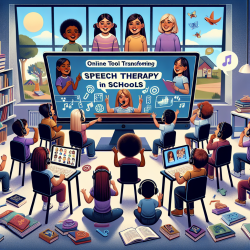
Schools face real barriers when addressing speech and language needs: staffing shortages, scheduling constraints, and the challenge of providing consistent services across multiple buildings. TinyEYE Therapy Services helps schools deliver speech-language therapy through secure, school-based online sessions designed to fit educational environments.
When expressive language delays affect classroom performance, timely access to therapy matters. Online therapy can support students by offering:
- Improved access: Services can be delivered even when local providers are limited
- Consistency: Regular sessions that support steady progress over time
- School-based relevance: Goals can align with classroom expectations such as retelling, explaining, and using curriculum vocabulary
- Engaging delivery: Interactive digital tools can motivate students and support practice
- Collaboration: Therapy can be coordinated with school teams to reinforce strategies across settings
For many students, the most meaningful gains happen when therapy strategies carry over into daily routines. In practice, this might include using sentence starters in class, visual organizers for retells, or targeted vocabulary practice connected to current units. When schools and therapy providers work together, students are more likely to generalize skills beyond the therapy session.
What Educators Can Do Today
While therapy is an important support, classroom strategies also make a significant difference. Educators can help by:
- Providing wait time after asking questions
- Offering sentence frames (for example, “First…, then…, finally…”) for retells and explanations
- Pre-teaching key vocabulary and revisiting it often
- Allowing multiple ways to respond (oral, written, visuals)
- Using graphic organizers for sequencing and story structure
- Checking in privately with students who avoid speaking in groups
These supports are not “extra”—they are effective instructional practices that reduce barriers and help students show what they know.
Moving Forward with Clarity and Support
Expressive language delays can influence nearly every part of a student’s school day, from participating in discussions to completing writing assignments and navigating peer relationships. The good news is that expressive language skills are teachable. With early identification, targeted intervention, and consistent practice, students can make meaningful progress in how they communicate and how confidently they participate.
TinyEYE Therapy Services partners with schools to provide accessible online speech-language therapy that supports students where they learn. When expressive language challenges are addressed thoughtfully and early, students gain more than words—they gain tools for learning, connection, and self-advocacy.
For more information, please follow this link.