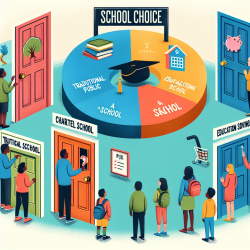
School choice can feel like a big, confusing topic. Families may hear words like “vouchers,” “private schools,” “charter schools,” or “open enrollment,” and wonder what it all means for their child. School leaders may wonder how choice affects funding, staffing, and student needs. And communities may ask a bigger question: does school choice improve learning for everyone, or does it create new gaps?
The OECD (Organisation for Economic Co-operation and Development) looked closely at these questions using international data, including results from PISA (a large global assessment of 15-year-old students). Their overall message is refreshingly practical: school choice is not automatically “good” or “bad.” Outcomes depend on how choice is designed, funded, and regulated.
Below is an easy-to-read breakdown of key insights from the OECD perspective, along with what these insights can mean for schools supporting diverse learners.
1) What is “school choice,” really?
School choice policies make it easier for families to choose a school other than their assigned neighborhood school. Choice can include:
Choosing among public schools (for example, magnet programs or open enrollment across zones)
Choosing publicly funded private schools (sometimes called government-dependent private schools)
Choosing fully independent private schools (often with less public funding)
Using vouchers or voucher-like funding that follows the student
The OECD emphasizes that choice only creates benefits when it is “real, relevant, and meaningful.” In plain terms, families need more than a list of schools. They need access to options that genuinely differ in helpful ways (like teaching approaches, supports, climate, and programs), and schools need the flexibility to serve different student needs well.
2) How common is school choice?
Across OECD countries with PISA 2015 data, parents of about 64% of students reported they had at least one other school option available.
But access is not evenly distributed. Families in rural areas and families connected to disadvantaged schools reported less choice. This matters because “choice” can sound fair in theory while being limited in practice by transportation, time, costs, and available seats.
3) What do parents care about when choosing a school?
When parents were asked what mattered most, they often prioritized:
A safe school environment
A good reputation
A pleasant, active school climate
Interestingly, these factors were often rated as more important than a school’s test scores.
The OECD also found a pattern worth noticing: parents who placed high importance on distance and low expenses tended to have children with lower PISA science scores, even after accounting for socio-economic background. This does not mean those parents made “bad choices.” It suggests that constraints (like transportation and affordability) can limit access to higher-performing options. In other words, some families are choosing based on what is possible, not what is ideal.
4) Autonomy matters: choice works differently when schools can adapt
One of the OECD’s strongest points is that choice tends to function better when schools have meaningful autonomy, especially around curriculum and instruction.
In systems where principals and teachers have more responsibility for curriculum decisions, students tended to score higher in science. By contrast, systems where national authorities held more responsibility for curriculum were associated with lower science performance.
From a special education lens, autonomy can be a double-edged sword:
When used well, autonomy can support flexible scheduling, inclusive practices, and innovative service delivery.
When used poorly, autonomy can lead to inconsistent supports, unclear accountability, or uneven access to services across schools.
5) Public vs. private schools: what does the data actually say?
The OECD highlights that the “public vs. private” conversation is often oversimplified.
Private schools are not one single category
Government-dependent private schools receive more than 50% of their core funding from government sources.
Independent private schools receive less than 50% of their core funding from government sources.
In many places, schools can be “legally private, functionally public.” That means they may be privately run but still follow national curriculum expectations and serve public education goals.
Is a higher share of private schools linked to better national performance?
At the country level, the OECD found no meaningful relationship between the share of private schools and PISA science performance among OECD countries. In other words, simply having more private schools does not predict higher achievement.
Do private schools outperform public schools within a country?
Before adjusting for socio-economic status, private school students often scored higher. But after accounting for socio-economic status, the pattern frequently flips: in many systems, public school students score as well as or better than private school students.
This is a crucial equity reminder: differences in outcomes often reflect who attends which schools, not necessarily which sector is “better.”
6) Does school choice increase segregation and inequality?
The OECD takes this concern seriously. Critics argue that school choice can increase social and cultural segregation if more advantaged families are better positioned to act on choice.
The data shows that increased private school prevalence is not automatically linked to greater between-school variation in PISA performance at the country level. But the OECD also stresses that segregation risk depends heavily on “framework conditions,” including:
Admissions rules (can schools select students?)
Tuition fees or add-on fees (do families have to pay extra?)
Application complexity and information access (can all families navigate the process?)
Rules around expulsion and discipline (are some students pushed out?)
From a disability and inclusion perspective, these conditions matter even more. Subtle barriers—like complicated paperwork, unclear service guarantees, or limited specialized supports—can quietly reduce access for students who need services most.
7) Funding and vouchers: the design details change everything
School choice often connects to how schools are funded. The OECD notes that privately managed schools receive widely varying levels of public funding across countries.
They also discuss voucher systems, where public funds follow the student. The key distinction:
Universal vouchers: available to all students
Targeted vouchers: aimed at disadvantaged students
The OECD analysis suggests targeted vouchers can better support equity. When comparing systems with similar public funding levels, socio-economic differences between public and private schools were about twice as large in systems using universal vouchers compared to targeted vouchers.
The OECD also points to strategies that can reduce harmful side effects:
Regulating admissions so schools cannot compete by exclusivity
Restricting or eliminating tuition add-on fees that deter lower-income families
Weighted student funding so students with greater needs bring additional resources
8) Country lessons: what we can learn from different approaches
The OECD highlights real-world examples to show how policy choices play out.
Flemish Community of Belgium: High performance and wide school variety, but also large between-school differences. Strong oversight, regulated fees, and limits on student selection help protect fairness.
The Netherlands: A highly diversified system with many publicly funded private schools and strong accountability structures. Equity is supported through funding mechanisms tied to student disadvantage.
Estonia: Public funding follows students across state, municipal, and private schools. The OECD notes the need for ongoing monitoring so expansion does not increase costs without improving outcomes.
Denmark: A long tradition of choice and subsidized private schools. The OECD notes the risk of segregation and recommends clear, comparable school-quality information for all parents.
Chile (pre-reform): A voucher system with limited regulation contributed to sorting and inequity. Newer reforms aimed to reduce selection and profit incentives.
Sweden: Rapid growth of publicly funded independent schools. The OECD points to the importance of strong oversight and coherent system-level strategy.
9) What this means for schools serving diverse learners
As an online therapy provider partnering with schools, TinyEYE sees a practical truth behind the OECD findings: systems work best when access and accountability are clear.
When school choice expands, schools often experience shifts in enrollment, student needs, and staffing patterns. That can create pressure on special education and related services. To protect students, strong systems typically include:
Clear service obligations for any school receiving public funds
Transparent information for families about supports (not just test scores)
Equitable funding that reflects student needs, including disability-related needs
Accountability mechanisms that monitor both outcomes and access
Capacity-building for families so choice is usable, not just theoretical
In other words, the goal is not simply “more options.” The goal is a system where every option is responsible for serving students well.
10) The big takeaway: smart guardrails make choice safer and more effective
The OECD’s conclusion is balanced and actionable: school choice can support innovation and responsiveness, but only when paired with strong public policy. The more flexibility a system allows, the more important it becomes to have clear guidelines, meaningful oversight, and a strategic vision that protects equity.
For more information, please follow this link.