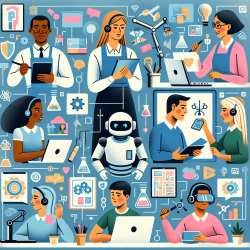
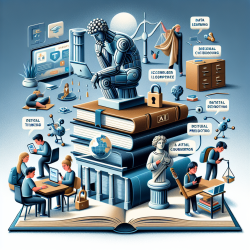
Artificial intelligence (AI) tools are now embedded in everyday school life. Students use chatbots to get instant explanations. Teachers use AI to draft lesson plans, create quizzes, and speed up grading. On the surface, it looks like a productivity win for everyone.
But a growing body of research—including J. Yunus Basha’s 2024 paper in the International Journal of Social Sciences and Commerce—raises a serious concern: when AI becomes a shortcut instead of a support, students can lose the very skills school is meant to build.
For schools partnering with TinyEYE for online therapy services, this conversation matters. AI-related learning habits can intersect with student wellbeing, motivation, attention, anxiety, communication, and independence. The goal isn’t to ban AI—it’s to use it responsibly, protect students, and preserve human development.
Why AI tools feel so helpful (and why students gravitate to them)
AI tools bring real benefits in academic settings. Basha (2024) notes that students can access vast amounts of information quickly, receive immediate feedback, and learn in more personalized ways. Other studies in the literature review echo similar advantages—like 24/7 support, reduced pressure when asking questions, and adaptive practice.
In practice, that can look like:
- Students getting quick explanations when a teacher isn’t available
- Personalized practice questions based on skill level
- Writing support tools improving grammar and clarity
- Teachers saving time on repetitive tasks and focusing more on instruction
So what’s the problem? The problem begins when “help” turns into “dependency.”
The hidden academic downside: when AI weakens learning instead of strengthening it
Basha’s central warning is straightforward: excessive reliance on AI tools can reduce foundational skills, critical thinking, and active engagement. Students may still submit assignments on time, but the learning underneath can become shallow.
Key negative academic impacts highlighted across the research include:
- Declining critical thinking and independent reasoning: If AI provides the answer immediately, students may skip the struggle that builds understanding.
- Reduced foundational skill development: Overuse can weaken essential skills like writing fluency, memorization, and math problem-solving.
- “Copy-paste learning” and superficial engagement: Students may use AI-generated text without fully understanding it, limiting real comprehension.
- Inaccurate or biased information: AI can produce confident but incorrect outputs, and can reflect biased training data.
- Academic integrity and plagiarism risks: Studies cited in the paper discuss gray areas where students may not view AI assistance as dishonesty, even when it undermines authentic work.
From a school perspective, this can create a confusing situation: grades may not reflect skill. A student might appear proficient on paper while struggling with real tasks in class discussions, tests, or hands-on activities.
The real-life impact is even bigger: problem-solving, communication, resilience
Basha (2024) also emphasizes that AI overreliance doesn’t stop at academics—it can affect real-life performance. This is especially important for K-12 students, because school is not only about content mastery. It’s also where students learn how to think, relate, persist, and regulate emotions.
Some of the most concerning real-world impacts include:
- Weaker problem-solving and decision-making: If students default to AI for solutions, they may struggle when faced with messy, real-world problems that require judgment.
- Reduced social interaction and communication practice: Heavy AI use can replace peer discussion and teacher-student interaction—key environments for building communication skills.
- Lower patience and persistence: Instant answers can reduce tolerance for frustration. Real learning (and real life) often requires sustained effort.
- Reduced resilience: When tasks become “effortless,” students may have fewer chances to build coping strategies for challenge and failure.
These are not just “soft skills.” They directly affect classroom behavior, peer relationships, and long-term readiness for work and life.
Ethics and privacy: the risk schools can’t afford to ignore
Multiple sources in the literature review raise ethical concerns: student data privacy, surveillance-like data collection, and biased algorithms that can reinforce inequity. Basha (2024) highlights the possibility that AI tools collect student information without clear consent or understanding, creating risk of misuse.
Schools should treat AI governance like any other student safety issue. That includes:
- Clear policies on what tools are allowed and for what purpose
- Transparency about what data is collected and where it goes
- Age-appropriate guidance for students on safe use
- Equity checks so AI doesn’t widen gaps for under-resourced students
The best path forward: balance AI with traditional learning (not replacement)
The most consistent recommendation across Basha’s paper is balance. AI can be a supplementary resource, but it shouldn’t replace traditional learning methods that build human capability: face-to-face discussion, group work, hands-on practice, and guided struggle.
Traditional learning supports:
- Critical thinking and deeper understanding
- Social-emotional growth through interaction
- Communication skills and teamwork
- Values, discipline, and responsibility
When schools blend AI thoughtfully with human teaching, students can benefit from efficiency without losing the developmental gains that come from real engagement.
Practical strategies schools can implement now
1) What educators can do
- Monitor for overdependence: Watch for sudden shifts in writing voice, unusually advanced responses, or inability to explain submitted work.
- Design “AI-resistant” learning tasks: Use reflections, oral explanations, process journals, and project-based learning that requires personal thinking.
- Teach AI literacy and ethics: Explain bias, hallucinations, privacy, and what counts as acceptable assistance.
- Keep human interaction central: Build in discussion, debate, peer feedback, and collaborative work.
2) What students can do
- Set boundaries: Use AI for brainstorming or checking understanding—not as the first step for every task.
- Practice self-control: Try solving first, then use AI to compare approaches.
- Diversify learning sources: Use textbooks, teacher support, reputable websites, and peer discussion.
- Stay informed: Learn what AI can’t do well (context, nuance, lived experience, values-based decisions).
3) What parents can do
- Observe usage patterns: How long is your child using AI tools, and for what kinds of tasks?
- Talk openly: Discuss when AI is helpful versus when it becomes a shortcut.
- Support productive struggle: When homework is hard, guide thinking rather than defaulting to AI answers.
- Encourage independent thinking: Ask children to explain their reasoning out loud.
Where TinyEYE fits: supporting the “human skills” AI can’t replace
AI can generate text, but it can’t replace the human development students need to thrive—especially in communication, self-regulation, confidence, and social connection.
In schools, online therapy services can complement academic efforts by helping students strengthen skills that may be indirectly impacted by overreliance on AI, such as:
- Expressive and receptive communication
- Pragmatic language and social interaction
- Self-advocacy and independence
- Emotional regulation and coping with frustration
- Confidence in problem-solving without shortcuts
The big takeaway from the research is not “AI is bad.” It’s that students need guidance, structure, and strong human support systems so AI remains a tool—not a substitute for thinking and learning.
For more information, please follow this link.