
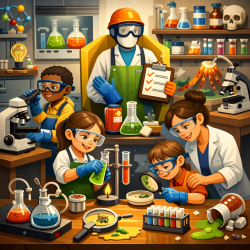
Hands-On Science Is Powerful (and It Needs a Safety Plan)
Hands-on activities are a cornerstone of science learning. When students touch, test, build, measure, and observe, science becomes real—and that “realness” is exactly what helps concepts stick. But hands-on learning also introduces risk, especially as investigations become more complex over time.
In schools, the goal is not to reduce science to worksheets. The goal is to keep science active and engaging while ensuring students and staff can participate safely and confidently. That balance—meaningful learning plus safe practice—is the heart of good science programming.
Why Hands-On Learning Matters in Every Grade
Science learning often begins with exploration. In the Early Years, students learn through direct interaction with materials. These exploratory experiences are not “extra”—they are one of the key starting points for building concepts and skills.
As students progress through grades, investigations naturally become more sophisticated. Over time, students learn:
- How to design and carry out controlled investigations
- How to experiment responsibly and accurately
- How to develop scientific inquiry and problem-solving skills through practice
Well-designed laboratory activities also help students understand something bigger than the topic of the day: the nature of science itself. Students learn that science is creative, that there are many valid ways to investigate questions, and that evidence and theory work together. In other words, labs can teach both “what we know” and “how we come to know it.”
The Real Challenge: Educational, Valid, and Safe—All at Once
Schools face a three-part challenge when offering science activities. Activities must be:
- Educationally rewarding (students learn something meaningful)
- Philosophically valid (activities reflect authentic scientific thinking and practice)
- Safe (risks are identified and managed appropriately)
It’s easy to focus on only one of these. For example, an activity might be exciting but poorly controlled, or it might be safe but not truly investigative. Strong science programs aim for all three outcomes at the same time.
Science Safety Is a Team Sport
One of the most important ideas in science safety is that it cannot rest on one person’s shoulders. Safe and effective science learning requires a coordinated effort involving everyone who influences what happens in the classroom and lab.
That includes:
- Administrators who set and administer school policies
- Planners and decision-makers who shape programs, schedules, and resources
- Teachers who plan and deliver science lessons
- Support staff who help maintain learning environments and assist with materials
When these groups work in alignment, safety becomes part of the culture—not just a checklist.
What a K–12 Science Safety Resource Is Designed to Do
The purpose of a K–12 science safety resource is to bring together the information school teams need to make sound decisions. Instead of relying on informal habits (“this is how we’ve always done it”), a safety resource helps schools build consistent practices based on recognized guidance.
In practical terms, a strong safety resource supports schools by:
- Identifying key areas where decisions and actions are needed
- Supporting planning at multiple levels (classroom, school, and division/district)
- Providing information related to safety legislation and standards
- Highlighting safety hazards that may arise in school science
- Offering examples of procedures that eliminate or minimize hazards
This matters because science activities vary widely—from simple material exploration to more advanced experiments. A resource helps teams think ahead and plan for what students will do, what materials will be used, and what safety steps are needed.
How Safety Supports Better Learning (Not Less Learning)
Safety is sometimes misunderstood as a barrier to “fun” science. In reality, safety planning often makes learning stronger. When procedures are clear and risks are managed, teachers can focus on instruction and students can focus on inquiry.
Safe science environments also help students build lifelong skills, such as:
- Following multi-step procedures carefully
- Using tools and materials responsibly
- Recognizing hazards and making thoughtful choices
- Working collaboratively and respectfully in shared spaces
These habits support success in science and beyond—especially as students move into higher grades where investigations require more independence.
Building a Culture of Safety: Practical Ways Schools Can Align
While every school context is different, safety planning is strongest when it is intentional and shared. Here are practical ways school teams can support safe, hands-on science learning:
- Clarify roles and responsibilities: Identify who is responsible for policies, training, materials preparation, storage, and supervision.
- Plan procedures before investigations: Decide how students will use materials, how movement will be managed, and how clean-up will occur.
- Review learning spaces regularly: Safety depends on the condition of the environment, not just the lesson plan.
- Support consistent routines: Predictable expectations help students participate safely, especially during exciting hands-on tasks.
- Use examples and guidance documents: Established resources can help schools avoid gaps and improve consistency.
Most importantly, safety should be treated as part of instructional design—not an afterthought added five minutes before the lab begins.
A Helpful Reminder: Safety Resources Guide Good Practice, Not Every Scenario
Science safety resources are compiled from sources believed to be reliable and aligned with current thinking. They are designed to inform planning and support good practice. However, they may not include every technical detail a specific situation requires, and they cannot anticipate every circumstance where safety may become a factor.
This is why professional judgment and local context matter. Schools may need to consult additional guidance, training, or expertise depending on the activity, materials, student needs, or facility conditions.
Where TinyEYE Fits In: Supporting Schools So Students Can Thrive
At TinyEYE, we work with schools every day, and we understand that student success depends on strong systems—clear procedures, supportive teams, and learning environments where students feel secure. While TinyEYE provides online therapy services to schools, we share the same goal as educators and administrators: helping students participate fully in learning.
When schools build safe, well-planned learning experiences—especially in hands-on subjects like science—students are better positioned to engage, communicate, and develop confidence. A strong safety culture also supports staff by reducing uncertainty and helping everyone operate with shared expectations.
For more information, please follow this link.
