
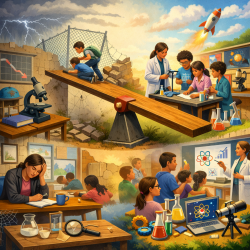
Why Science Education Became More Urgent—and Less Accessible
The COVID-19 pandemic did more than disrupt school schedules. It exposed how essential science literacy is for public health and how fragile access to quality science learning can be when systems are stressed. The nation depends on strong K-12 science education to develop future virologists, immunologists, engineers, and health professionals. Just as importantly, a solid grasp of science helps students evaluate claims, resist misinformation, and make informed decisions in moments of crisis.
Yet when school buildings closed in spring 2020, many students lost access to the very elements that make science “stick”: labs, equipment, hands-on investigations, and structured inquiry. The Education Commission of the States (ECS) report Reinvigorating K-12 Science Education (Dec 2021) uses 2019 NAEP science results as a baseline—capturing what was happening right before the pandemic—and then explores how COVID-era disruptions likely deepened existing inequities.
What the 2019 NAEP Baseline Revealed (Before the Pandemic Hit)
The 2019 National Assessment of Educational Progress (NAEP) in science offered a mixed picture. While states had been working to modernize science standards and instruction, student outcomes and learning opportunities did not consistently reflect those ambitions.
Scores were flat in grades 8 and 12 (2015–2019), while grade 4 scores declined, reversing or halting earlier gains.
Access to inquiry-based learning was limited: at least 40% of students at each grade level lacked inquiry-based opportunities or instruction focused on the scientific method.
Hands-on projects were even scarcer than inquiry-based instruction—suggesting that many students experienced science as reading and recall rather than investigation and reasoning.
This matters because modern science standards emphasize more than facts. They prioritize practices like asking questions, modeling, analyzing data, and explaining phenomena—skills that translate into problem solving and critical thinking across subjects.
Standards Changed—But Classroom Experiences Didn’t Always Catch Up
Since 2013, a major shift has been underway. Twenty states and the District of Columbia adopted the Next Generation Science Standards (NGSS), and another 24 states adopted standards based on the National Research Council’s Framework for K-12 Science Education. These approaches emphasize:
Scientific inquiry and sensemaking
Engineering design processes
Communication, collaboration, and problem solving
Connections between science, technology, and real-world applications
NAEP surveys suggested schools were responding in some ways. Teachers at NAEP-tested grade levels were devoting more time to engineering, and students were more likely to have access to extracurricular science clubs. But the core goal—consistent, inquiry-rich science learning for all students—remained out of reach for many.
The Equity Alarm: Who Had the Fewest Science Opportunities?
The report highlights a troubling pattern: the students who most needed strong instructional support were often the least likely to receive it.
NAEP and related survey data showed persistent inequities tied to race, ethnicity, and income. Students who were Indigenous, Black, or of Latin descent were least likely to have access to inquiry-based learning opportunities. Students from low-income households also faced reduced access to resources that support science learning.
Resource gaps: Students eligible for free or subsidized lunch were less likely to have access to lab spaces, lab stations, measurement tools, safety equipment, and materials.
Opportunity gaps: Students with lower science scores were less likely to be exposed to scientific inquiry and less likely to attend schools offering advanced science courses.
Advanced course gaps: Access to AP science courses increased overall, but Indigenous, Black, and Latin descent students and students from low-income households remained least likely to attend schools offering them.
These patterns can create a cycle: fewer resources and fewer high-quality learning experiences contribute to lower performance, which then limits access to advanced coursework that could accelerate learning.
Elementary Science: The “Time Crunch” That Comes With a Cost
One of the most actionable findings is about time—especially in grade 4. Declines in grade 4 science performance coincided with declines in the time teachers spent on science instruction. In 2019, most fourth graders received less than three hours of science per week, and the share receiving less than two hours rose significantly between 2015 and 2019.
When science time shrinks, students lose early chances to build curiosity, vocabulary, and foundational reasoning skills. And when science becomes “optional” in the schedule, the students who already have fewer enrichment opportunities outside school are hit hardest.
Teacher Preparation: A Quiet Barrier With Big Consequences
Teacher confidence and preparation emerged as another major issue—particularly in elementary grades. According to the 2018 National Survey of Science and Mathematics Education (NSSME):
Only 31% of elementary teachers felt well prepared to teach science.
Preparation to teach engineering was even lower: only 3% of elementary teachers felt very well prepared.
Teachers were less likely to receive effective professional development in science than in math.
Teachers serving underrepresented students of color and students with lower prior achievement were least likely to receive 35+ hours of professional development over three years.
This is not a critique of teachers—it’s a systems issue. When standards ask educators to teach inquiry, engineering, and technology integration, professional learning must match that expectation.
COVID-19 Didn’t Create the Problems—It Intensified Them
Early evidence suggests the pandemic further restricted access to hands-on learning, inquiry, and investigation. For example, a 2021 survey of California middle school teachers found:
88% said students spent less time on science during remote learning.
60% said it was much more difficult to engage students in science and engineering practices.
Other reports found that many students—especially those from low-income families—experienced interruptions in advanced coursework (including AP physics). Several states that released 2020–21 science assessment results reported significant score drops since 2019, though participation changes make year-to-year comparisons imperfect.
What States Can Do Next: Practical Policy Levers That Schools Feel
ECS outlines several state policy strategies to rebuild and accelerate science education reforms. The most effective approaches tend to be multi-pronged, not piecemeal.
1) Make Elementary Science Count
States can recommend minimum instructional time for science and increase accountability by assessing science more than once in grades K–5. Some states already do this (e.g., Arkansas, Louisiana, South Carolina, Tennessee, and Utah administer science tests in more than one elementary grade).
Importantly, the National Academies caution against assessments that only measure rote learning, advocating for multiple and varied assessments that capture conceptual understanding and science practices.
2) Strengthen Teacher Preparation and Professional Development
Examples include New Mexico’s “Making Sense of SCIENCE” professional development model, which has evidence of improving instructional practice and increasing time spent on science. States have also expanded engineering programs like Project Lead the Way, often pairing implementation with teacher training.
3) Expand Access to Vetted, High-Quality Science Curriculum
States can help districts select effective materials rather than leaving schools to navigate a crowded marketplace alone. Rhode Island’s approach—requiring adoption of standards-aligned, high-quality instructional materials and working with independent reviewers—illustrates how states can raise the floor for curriculum quality.
4) Invest in Equipment, Materials, and Modern Alternatives
Grants and lending libraries can reduce resource inequities. Massachusetts has supported equipment purchases through a state-funded grant program, while Utah and Idaho maintain STEM equipment libraries. The pandemic also accelerated the use of virtual labs and simulations, which may remain valuable for schools that lack facilities.
5) Broaden Access to Advanced Courses (AP, IB, Dual Enrollment)
Policies that guarantee course availability, subsidize exam fees, support teacher training, and incentivize participation can expand access. Dual enrollment programs can also deliver strong benefits, particularly for students of color and students from low-income households—when designed to remove barriers rather than reinforce them.
Where TinyEYE Fits: Supporting Schools as They Rebuild Learning
Science education recovery isn’t only about standards and materials—it’s also about student readiness to learn. Many students are navigating ongoing challenges that affect engagement, communication, confidence, and classroom participation. As schools work to restore inquiry-based learning and expand access to rigorous coursework, student support services can help ensure more learners can fully participate.
TinyEYE partners with schools to provide online therapy services that can support student access and success—especially when staffing shortages or scheduling constraints make in-person services difficult. When students receive the supports they need, they are better positioned to engage in discussion, collaboration, problem solving, and the communication demands of modern science instruction.
Final Takeaway: Rebuild Science Education With Equity at the Center
The 2019 NAEP science results showed stalled progress and persistent gaps even before COVID-19. The pandemic likely widened those gaps by limiting hands-on learning and reducing time spent on science. The path forward is not simply returning to old routines—it’s using recovery efforts to strengthen elementary science time, improve teacher preparation, expand access to quality curriculum and materials, and ensure advanced pathways are truly open to all students.
For more information, please follow this link.
