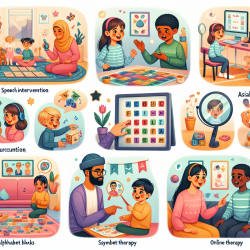
Vocabulary is more than a list of words a child can repeat. It is the foundation for understanding directions, joining conversations, learning to read, and showing what they know in the classroom. For kids with language delays, vocabulary growth can feel slower and more effortful—but it is absolutely possible with the right supports, consistent practice, and a team approach.
At TinyEYE, we partner with schools to provide online therapy services that help students build functional, meaningful language skills. Vocabulary development is often a key part of that work because it touches every school day: circle time, story time, math word problems, science experiments, social interactions, and classroom routines.
What vocabulary delays can look like at school
Vocabulary delays do not always show up as “not talking.” Many children communicate, but their word knowledge may be limited, less precise, or harder to retrieve when they need it. In school settings, that can look like:
- Using general words like “thing,” “stuff,” or “that” instead of specific nouns
- Struggling to name common objects, actions, or categories
- Difficulty following directions that include unfamiliar words (for example, “underline,” “compare,” “predict”)
- Limited use of describing words (colors, sizes, feelings, textures)
- Challenges answering questions about stories or lessons because key words are missing
- Frustration or behavior changes when communication demands increase
These challenges can affect confidence and participation. The good news is that vocabulary is teachable—and children can make strong gains when instruction is explicit, repeated, and connected to real experiences.
Why vocabulary building matters (especially for kids with delays)
Vocabulary is closely tied to:
- Comprehension: Children understand more when they know the words being used.
- Expression: Word knowledge helps kids share ideas, ask for help, and advocate for themselves.
- Literacy: Vocabulary supports phonological awareness, reading comprehension, and writing.
- Social connection: Knowing words for feelings, play themes, and conversation topics supports friendships.
When vocabulary is strengthened early and consistently, children are better equipped to access the curriculum and participate fully in school life.
How kids learn new words: the “multiple meaningful exposures” rule
Many children with language delays need more repetitions and more varied practice to truly learn a word. Hearing a word once in a story is rarely enough. Effective vocabulary teaching includes:
- Hearing the word in different contexts
- Seeing it (pictures, objects, gestures, written word when appropriate)
- Saying it
- Using it in play, conversation, and classroom tasks
- Connecting it to what the child already knows
This is one reason school-based therapy can be so powerful: vocabulary can be targeted in ways that connect directly to classroom routines and academic themes.
High-impact strategies for vocabulary building (that work at school and at home)
1) Teach words in categories, not in isolation
Grouping words helps children organize language in their minds. Instead of teaching “apple” alone, teach it within a category like “fruit,” and compare it with “banana,” “orange,” and “grapes.”
- Try categories like foods, clothing, school supplies, animals, transportation, and community helpers.
- Use “same/different” to deepen understanding (an apple is a fruit; it is round; it can be red or green).
2) Focus on “power words” that unlock participation
Some words show up everywhere in school. Prioritizing these can reduce frustration quickly.
- Action words: cut, glue, open, close, build, draw, share
- Concept words: first/next/last, more/less, before/after, under/behind
- Social words: turn, wait, help, stop, mine, yours
- Feeling words: worried, excited, frustrated, proud
3) Use child-friendly definitions and quick examples
Instead of giving a dictionary definition, keep it simple and concrete.
- “Predict means you guess what will happen next.”
- “Gigantic means really, really big—bigger than big.”
- “Fragile means it can break easily, like an egg.”
Then use the word in two or three sentences across the day to reinforce it.
4) Build vocabulary through books, but make it interactive
Shared reading is one of the best vocabulary tools—when it is active.
- Pause and point to pictures
- Ask simple questions (“Where is the ladder?” “What is he doing?”)
- Act out action words (jump, tiptoe, crash)
- Connect to the child’s life (“We saw a firefighter too—remember?”)
For children with delays, shorter books read multiple times can be more effective than a new book every day.
5) Strengthen word retrieval with cues
Some kids “know” a word but cannot find it quickly. Cueing helps without taking over.
- Give the first sound: “It starts with /b/…”
- Give a category: “It’s an animal…”
- Describe: “It’s big and gray and has a trunk…”
- Offer choices: “Is it elephant or giraffe?”
Over time, these cues teach children how to search for words independently.
6) Use visuals and routines to make words stick
Visual supports can reduce language load and increase success. In classrooms, visuals also help all learners.
- Picture schedules for routines (line up, wash hands, snack)
- Choice boards for play and activities
- Anchor charts for theme vocabulary (weather, community, seasons)
- Simple “word of the week” visuals posted where kids can see them
7) Practice “describe it” to deepen word knowledge
Knowing a word includes knowing what it means, how it is used, and what it is related to. Try the “describe it” routine:
- What is it?
- What does it do?
- What does it look like?
- Where do you find it?
- What group does it belong to?
This supports both vocabulary and later reading comprehension.
How TinyEYE supports vocabulary building through online therapy services
Vocabulary growth is most effective when it is consistent, measurable, and connected to the student’s real school demands. TinyEYE’s online therapy services are designed to support schools in doing exactly that.
School-based, student-centered support
TinyEYE clinicians work with students on goals that matter for school success—like understanding classroom language, using new words in conversation, and explaining ideas clearly. Therapy can target:
- Receptive vocabulary (understanding words)
- Expressive vocabulary (using words)
- Concept development (size, time, location, quantity)
- Word relationships (categories, synonyms, antonyms)
- Narrative language (telling and retelling stories with key vocabulary)
Engaging sessions that promote practice
Online therapy can be highly interactive. With the right tools and a skilled therapist, students can practice vocabulary through visuals, games, stories, and structured conversation—while receiving immediate feedback and supportive cueing.
Collaboration with educators and families
Vocabulary grows fastest when the adults around a child use the same target words and strategies across settings. TinyEYE supports collaboration by aligning therapy with classroom themes and sharing practical carryover ideas that fit real school days.
Data-informed progress monitoring
For students with delays, it is important to track not only whether a child can say a word in therapy, but whether they can use it in new situations. TinyEYE clinicians monitor growth and adjust targets so vocabulary becomes functional, flexible, and lasting.
A simple weekly vocabulary plan schools can use
If you want a practical starting point, here is a school-friendly structure that supports repetition without feeling repetitive:
- Pick 3–5 target words tied to a classroom theme or routine.
- Introduce with visuals and child-friendly definitions.
- Practice daily in short bursts (1–3 minutes) across activities.
- Use the words in sentences and encourage students to do the same.
- Review at the end of the week with a quick game, story retell, or “show me” activity.
Consistency matters more than complexity. A few well-chosen words practiced often can create noticeable change.
Final thoughts: vocabulary is a bridge to belonging
When children gain vocabulary, they gain access—to learning, to friendships, and to the confidence that comes from being understood. Kids with delays may need more time, more repetition, and more intentional teaching, but their progress can be remarkable when the adults around them work as a team.
TinyEYE is proud to support schools with online therapy services that help students build the language they need for today’s classroom and tomorrow’s opportunities.
For more information, please follow this link.