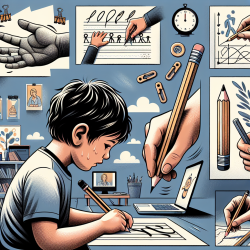
Handwriting can feel like a small skill—until it becomes the reason a child avoids schoolwork, falls behind on written assignments, or melts down at the sight of a blank page. As an occupational therapy (OT) concern, handwriting is rarely “just messy.” It’s often a sign that a child is working much harder than their peers to do the same task.
At TinyEYE, we support schools with online therapy services, including OT strategies that help students build the underlying skills for functional handwriting. Whether your child is reversing letters, pressing too hard, writing too lightly, or tiring quickly, the good news is that there are practical, evidence-informed ways to help.
Why handwriting is hard for some kids (and it’s not about effort)
Handwriting is a complex task that requires multiple systems to work together at once. A child must:
- Maintain a stable seated posture
- Use shoulder, elbow, wrist, and finger control together
- Coordinate both hands (one writes, one stabilizes the paper)
- Integrate vision and movement (visual-motor integration)
- Remember letter forms and where they go on the line
- Manage attention, pacing, and endurance
When any one of these areas is underdeveloped, handwriting can look rushed, shaky, oversized, cramped, inconsistent, or extremely slow. OT focuses on identifying what’s getting in the way and building the foundation—not just correcting the final product.
Common signs your child may benefit from OT-informed handwriting support
- Complains that writing hurts or avoids writing tasks
- Writes very slowly or cannot finish written work on time
- Has messy or inconsistent letter size and spacing
- Uses an awkward pencil grasp that seems tiring
- Presses too hard (tears paper) or too lightly (hard to read)
- Reverses letters/numbers beyond the expected age range
- Struggles to copy from the board or from a model
- Has difficulty staying on the line or using margins
Many of these concerns can be improved with targeted supports and practice that feels achievable, not punishing.
Start with the “hidden” skills: posture and stability
Before focusing on letter formation, check the body setup. A stable body supports controlled hands.
Quick posture checklist
- Feet supported (on the floor or a footrest)
- Hips and knees bent around 90 degrees
- Back supported as needed
- Desk/table at a comfortable height (forearms can rest)
If a child is perched, kneeling, or dangling their feet, they may “hold” their body with their writing hand—reducing fine motor control. A simple chair adjustment can sometimes make handwriting noticeably smoother.
Pencil grasp: aim for functional, not perfect
Families often worry about pencil grasp. OT looks for a grasp that is efficient, comfortable, and allows finger movement. Some children use a less mature grasp because their hands fatigue quickly or because they have not developed enough finger strength and separation.
OT-friendly ways to support grasp (without constant reminders)
- Use short pencils or broken crayons to encourage a more natural finger grasp
- Try a pencil grip if it improves comfort and control (not all grips help all kids)
- Encourage “helper hand” use to hold the paper steady
- Build hand strength through play (see ideas below)
Tip: If correcting grasp leads to frustration, step back. A child can make progress in legibility and speed even while grasp develops gradually.
Build fine motor strength through play (the OT way)
Handwriting improves faster when practice includes the skills underneath writing. Short, playful activities can build endurance and control.
5–10 minute fine motor boosters
- Play dough: roll “snakes,” pinch, poke, and make letters
- Tweezers or tongs: pick up small items and sort by color
- Clothespins: clip onto a container edge or card
- Beading: string beads or pasta for bilateral coordination
- Vertical drawing: color on a wall easel or taped paper to strengthen shoulder stability
These activities support the hand and arm muscles needed for smoother writing and better control.
Letter formation: fewer letters, better practice
When kids struggle, adults often respond with more worksheets. OT tends to do the opposite: less volume, higher quality, and clearer feedback.
What helps letter formation stick
- Teach letters in consistent “families” (letters that start the same way)
- Use multisensory practice (trace in sand, form with dough, write with markers)
- Practice a small number of letters at a time until they are automatic
- Use a model the child can see (not just verbal directions)
Also consider whether the child is being asked to write in cursive or print before they are ready. Matching expectations to developmental readiness matters.
Spacing and line use: make the invisible visible
Many children don’t naturally “see” spaces or baseline alignment. Visual supports can reduce cognitive load so the child can focus on forming letters.
Simple tools that often help
- Highlighted or raised-line paper for baseline awareness
- A “spacer” tool (a popsicle stick or finger spacing cue)
- Graph paper to support sizing and alignment
- Writing on paper with clear margins
OT often teaches students to self-check with a quick routine: “Are my letters sitting on the line? Can I see spaces? Are tall letters tall and small letters small?”
Handwriting endurance: reduce fatigue without lowering expectations
Some students can write neatly for one sentence and then fall apart by the third. That’s often endurance, not motivation.
Strategies to build stamina
- Use short writing bursts (2–5 minutes) with a quick movement break
- Allow a warm-up (drawing shapes, writing their name, quick pattern lines)
- Reduce copying demands when possible (provide notes, use fill-in supports)
- Teach pacing: “slow enough to be readable, fast enough to finish”
In school settings, accommodations may be appropriate while skills develop, such as reduced written output, access to speech-to-text, or alternative ways to show learning.
When technology is part of the solution
Handwriting is important, but it should not be the barrier that blocks learning. For some students, especially those with significant motor or processing challenges, typing and assistive technology can be a bridge to success.
OT can help determine when to:
- Continue handwriting intervention as the primary focus
- Use a combined approach (handwriting plus typing instruction)
- Introduce accommodations so the child can demonstrate knowledge without being limited by handwriting
How school-based OT support helps (including online therapy)
In schools, OT support is most effective when it connects directly to classroom demands. That might include:
- Screening and identifying underlying skill needs
- Targeted interventions for grasp, formation, spacing, and endurance
- Classroom strategies teachers can use daily
- Home practice plans that are realistic and brief
- Collaboration with educators to align expectations and supports
With online therapy services, schools can access consistent OT expertise, reduce service gaps, and support students in a timely way—especially when in-person staffing is limited. The goal is functional handwriting that supports participation, confidence, and academic progress.
A practical next step: try one change for two weeks
If you’re not sure where to start, choose one focus area and try it consistently for two weeks:
- Improve seating and desk setup
- Add a 5-minute fine motor play routine
- Use highlighted paper and a spacing tool
- Practice 3 letters only, using multisensory methods
Small, steady changes often produce more progress than long, stressful writing sessions.
For more information, please follow this link.