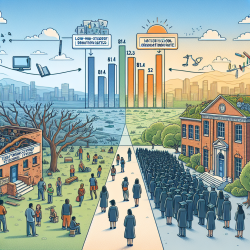
School leaders are often asked to do two things at once: raise overall student achievement and reduce persistent, predictable gaps in performance. That’s not a small ask—it’s a policy puzzle with real human consequences. When achievement differs systematically by income, race, and ethnicity, the impact doesn’t stop at graduation. It shapes college access, job opportunities, and lifetime earnings, reinforcing cycles of disadvantage across generations.
In the United States, the challenge is intensified by a complex history of segregated schooling, ongoing residential patterns that concentrate poverty, and a steady influx of immigrant families navigating new systems. And because these forces tend to cluster in a relatively small number of districts, the pressure on those schools can be immense.
At TinyEYE, we work with schools every day to strengthen student support systems through online therapy services. While therapy services alone are not “the” solution to the achievement gap, they can be an important part of the multi-policy approach research suggests is necessary—especially when schools are trying to remove barriers to learning, improve access, and support early development.
What We Mean by “Achievement Gap” (And Why It Matters)
The achievement gap refers to consistent differences in academic performance between groups of students—most often discussed in relation to family income, race, and ethnicity. These differences show up in test scores, course outcomes, graduation rates, and college completion.
Why does this matter so much? Because educational outcomes are strongly linked to later outcomes in the labor market. When certain groups experience lower achievement due to systemic factors, it increases the likelihood of intergenerational poverty—children inheriting economic hardship not because of ability, but because of unequal opportunity and access.
What the Data Says: Progress in Some Areas, Deep Gaps in Others
There has been real progress in some educational attainment measures. For example, high school completion rates have improved and gaps have narrowed over time.
- In 1980: 89% of White students completed high school, compared to 77% of Black students and 58% of Hispanic students.
- By 2012: completion rose to 95% (White), 89% (Black), and 75% (Hispanic).
But another trend moves in the opposite direction: college completion has diverged.
- In 2012: 40% of Whites completed a bachelor’s degree or more.
- In contrast: 23% of Blacks and 15% of Hispanics reached that level.
This divergence is especially significant because the economic “return” on college has increased substantially over the past two decades. When access to and completion of higher education separates by subgroup, the long-term economic consequences widen.
Even more striking are the gaps in measured academic achievement. The National Assessment of Educational Progress (NAEP) has tracked student performance across decades, providing one of the clearest pictures of persistent differences. By age 17—right before students transition to college or the workforce—the disparities remain substantial.
One example highlighted in the research: in 2011, the Black-White gap in math placed the average Black student at the 19th percentile of the White distribution. The Hispanic-White gap placed the average Hispanic student at the 26th percentile of the White distribution. These are not small differences; they represent large, life-shaping gaps in opportunity.
Why Do These Gaps Persist? What Research Can (and Can’t) Prove
Researchers have invested enormous effort into understanding the causes of achievement gaps. One of the earliest and most influential studies was the 1966 Coleman Report (Equality of Educational Opportunity). It was widely interpreted as suggesting family background and peer influences mattered most, while schools mattered less.
However, that conclusion has been heavily criticized, in part because the study lacked strong measures of school quality and family background. And that problem still echoes today: it is extremely difficult to isolate which factors “cause” gaps because so many variables overlap—housing patterns, income, school resources, peer composition, language exposure, health, and more.
What we can say with more confidence is this: closing achievement gaps rarely happens through a single policy or program. It requires multiple coordinated strategies that address both learning conditions and learning opportunities.
Three Levers That Research Points To
1) Racial Segregation and Concentrated Enrollment Patterns
The U.S. has a long history of racial segregation in schools, including de jure segregation (by law) prior to Brown v. Board of Education (1954). While legal segregation was dismantled, de facto segregation persists in many places due to residential patterns and school assignment policies.
Research examining peer racial composition suggests that Black achievement can be harmed in schools with higher concentrations of Black students. (The same pattern is not consistently found for Hispanic students.)
Here’s the hard part: many policy options are limited. Because segregation often reflects district boundary lines and housing patterns, there are fewer legal and practical tools available—especially given court limitations on interdistrict remedies and restrictions on race-conscious assignment plans.
2) Teacher Quality (Measured by Impact, Not Credentials)
One of the strongest findings in recent education research is that teacher quality matters—significantly. But “quality” isn’t well captured by typical inputs like years of experience, degrees, or training type.
Instead, researchers increasingly focus on outcomes-based measures (often called value-added analysis): a strong teacher is one who consistently produces higher student growth, even after accounting for prior achievement and other influences.
The magnitude of teacher impact can be large. Research cited in the provided material suggests that having a teacher at the 75th percentile of effectiveness versus the 25th percentile could move a student from the middle of the achievement distribution to the 58th percentile in a single academic year.
That matters because it implies that improving access to highly effective teaching—especially for disadvantaged students—could meaningfully reduce achievement gaps.
3) Early Childhood Education (Because Earlier Is Easier)
Early childhood is a powerful point of intervention, especially for students who start school already behind. The research highlights major differences in early language exposure. One striking example: by age 3, more advantaged children may have vocabularies four times as large as disadvantaged peers, alongside major differences in the quality of parent-child communication.
Those early differences can cascade into later outcomes: reading comprehension, writing, classroom participation, and confidence. Nobel laureate James Heckman and colleagues have argued that early investments in human capital make later learning more effective—essentially, early gains compound over time.
Well-known programs like Perry Preschool and Abecedarian provide evidence that high-quality preschool can improve outcomes. At the same time, the research cautions that scaling programs is complex, and design matters—especially when considering which models work best across different student populations.
So Where Do Online Therapy Services Fit In?
Achievement gaps are shaped by academic instruction, but also by access to the supports that make instruction usable. From a special education lens, we often see students who are capable of learning but blocked by unmet needs—communication challenges, language delays, executive functioning weaknesses, anxiety, or difficulty engaging in the classroom environment.
Online therapy services can help schools strengthen the “learning readiness” layer that sits underneath academic performance. For example, when students receive timely support for speech-language needs, they may better access phonological skills, vocabulary development, comprehension, and classroom discourse. When occupational therapy supports self-regulation and fine motor skills, students may participate more fully in writing tasks and independent work. When mental health supports are accessible, attendance and engagement can improve.
Just as importantly, online delivery can reduce common access barriers—staffing shortages, travel time between buildings, and gaps in service coverage—helping districts deliver consistent support even in hard-to-staff areas.
What Schools Can Take Away: A Practical, Multi-Policy Mindset
The research points to a clear conclusion: persistent achievement gaps conflict with widely held beliefs about equity, and they represent lost human potential. But solving them is difficult because schools are trying to raise outcomes for all students while also closing gaps—without triggering political and practical conflicts around “redistribution” of opportunity.
A realistic approach is to focus on strategies that improve outcomes for disadvantaged students without harming others, such as:
- Investing in early childhood programs that strengthen school readiness
- Improving access to effective teaching and using better measures of instructional impact
- Reducing barriers created by concentrated disadvantage where policy options exist
- Building strong, reliable student support systems (including special education and related services) so students can access instruction
In other words, closing the achievement gap isn’t about finding one magic program. It’s about building a coordinated set of supports that address both academic growth and the conditions that make growth possible.
For more information, please follow this link.