Polarization Isn’t Just “Out There”—It Walks Into Class Every Day
Schools don’t need to look far to see the effects of political polarization. It shows up in hallway conversations, family dinner stories students bring to class, and the way young people learn (or avoid learning) how to disagree. When polarization rises, the hardest skill to practice isn’t speaking—it’s listening well enough to be changed by what you hear.
A 2019 research study from the University at Albany and the University of Wisconsin–Madison explored a hopeful idea: education can reduce polarization, not by telling students what to think, but by building the habits that make open-minded civic life possible.
The researchers focused on something they call open-minded political engagement (OMPE): a person’s willingness to explore and participate in political life while staying open to revising their views. In other words, it’s not just “be engaged” and not just “be tolerant.” It’s both—together.
The Big Question: Can Schools Teach Students to Engage Without Becoming More Rigid?
Prior research has often found a discouraging pattern: people who are highly politically engaged can become more partisan and less open-minded. That creates a real dilemma for educators. If you successfully motivate students to care about public issues, do you accidentally push them toward “my side vs. your side” thinking?
This study suggests the answer can be “no”—if the learning environment is designed carefully.
What the Researchers Studied (And Why It Matters)
The study compared three high school settings:
- Standard High (87 students): a traditional government course with lectures, readings, and occasional activities.
- Green High (224 students) and Gomez High (94 students): both used a program called Legislative Semester (LS), an extended political simulation where students research, debate, and vote on controversial issues.
Across all sites, researchers used surveys (beginning and end of semester), interviews with students and teachers, and classroom observations. They measured political interest, political efficacy (internal and external), expected future participation, frequency of political discussion, and political open-mindedness.
What Is the “Legislative Semester,” Exactly?
Legislative Semester is built around repeated practice with civic skills—especially discussion, debate, and decision-making. Students do not just learn about government structures; they simulate the work of governing.
Key activities included:
- Learning and practicing parliamentary procedure
- Debating current issues early in the term
- Forming groups to write bills on issues students care about
- Preparing arguments and counterarguments
- Presenting bills in committee hearings
- Participating in a “Full Session” with large-group debate and mock voting
Issues debated ranged widely—minimum wage, death penalty, net neutrality, same-sex marriage, welfare reform, and more.
The Headline Finding: The Simulation Boosted Engagement and Open-Mindedness
Students in Legislative Semester became more politically engaged than students in the traditional government course. They showed gains in:
- Political interest (caring about issues and wanting to learn more)
- Internal political efficacy (confidence in understanding issues and making arguments)
- Expected future participation (likelihood of voting, volunteering, protesting, discussing politics, etc.)
- Out-of-class political discussion (talking about politics with friends and family)
Just as importantly, LS students also became more open-minded than students in the traditional course. The repeated exposure to diverse viewpoints—paired with structured discussion—helped students become more willing to consider reasons behind opposing views and revise their own beliefs.
Why It Worked: Practice, Repetition, and Real “Issue Work”
One of the clearest insights from the qualitative interviews was that students felt their political confidence grew because they repeatedly did the work of politics:
- They researched issues and learned to evaluate sources.
- They had to speak publicly and defend ideas with evidence.
- They encountered disagreement as a normal part of learning, not a crisis to avoid.
This matters because confidence fuels engagement. When students feel capable of understanding and discussing issues, they’re more likely to keep paying attention outside of class—and to see themselves as someone whose voice belongs in civic life.
The “Safety Factor”: Open-Mindedness Needs an Emotionally Safe Classroom
The study also reinforces a key point educators often sense intuitively: students are more willing to consider opposing ideas when they feel socially safe. In classrooms with an “open climate,” students were more comfortable sharing minority viewpoints and less likely to shut down.
Teachers supported this by:
- Setting norms for respectful discourse
- Encouraging careful listening (not just “polite hearing”)
- Making room for minority or unpopular perspectives
- Keeping discussions substantive rather than personal
When students believe they’ll be mocked or socially punished for speaking, they may either stay silent or become more defensive. Neither outcome builds OMPE.
A Surprising Warning: Too Much Partisanship Can Backfire
Not all Legislative Semester classrooms produced the same open-mindedness gains. One of the most practical findings is that encouraging partisanship reduced growth in open-mindedness.
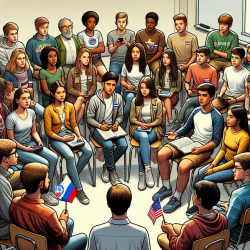
For example, at Green High, some classes emphasized party identity strongly—students sat by party, held frequent caucuses, and sometimes framed debate as “winning.” In that environment, some students described becoming more stereotyped in how they viewed the other side.
At Gomez High, teachers were more likely to de-emphasize party uniformity and use strategies like playing devil’s advocate to ensure multiple perspectives were considered. Gomez students showed stronger gains in open-mindedness.
The takeaway for schools is not “avoid politics.” It’s more precise: avoid turning civic learning into team sports.
What This Means for Schools Right Now
Even if a school can’t adopt a full semester simulation, the study points to practical design principles that can be applied in many settings:
- Make discussion frequent, not occasional. One “big debate day” isn’t enough to build habits.
- Center issues, evidence, and reasoning. Students need practice building arguments, not just stating opinions.
- Structure for viewpoint diversity. Plan for multiple perspectives to be voiced and explored.
- Protect emotional safety. Students can’t practice open-mindedness if they’re bracing for ridicule.
- De-emphasize partisan uniformity. Encourage independent thinking and cross-cutting ideas.
Where TinyEYE Fits: Communication Skills Are the Hidden Infrastructure of Civic Learning
At TinyEYE, we work with schools every day to support students through online therapy services. While this research focuses on civic education, it highlights something broader: classrooms thrive when students have the communication and self-regulation skills to participate fully.
Open-minded engagement depends on foundational abilities many students are still developing, such as:
- Expressing ideas clearly under social pressure
- Listening for meaning (not just waiting to respond)
- Managing frustration, anxiety, or defensiveness during disagreement
- Using pragmatic language skills to disagree respectfully
When schools strengthen these underlying skills—especially for students who struggle with communication or emotional regulation—they make it easier for all learners to benefit from discussion-rich instruction. In that sense, supporting student communication isn’t separate from civic learning; it helps make it possible.
Bottom Line: Education Can Reduce Polarization—If It Teaches Students How to Disagree Well
This study offers evidence that well-designed civic learning experiences can increase both political engagement and open-mindedness. The strongest results came when students repeatedly explored controversial issues, heard diverse perspectives, and did so in classrooms that were emotionally safe and not overly partisan.
In a time when many communities feel stuck in “talking past each other,” that’s not a small win. It’s a blueprint schools can build on.
For more information, please follow this link.