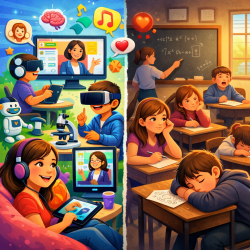
Schools are under constant pressure to “use more technology,” “increase engagement,” and “meet every learner’s needs”—often all at once. But adding tools doesn’t automatically improve learning. In fact, piling on apps, platforms, and digital activities can create the opposite effect: confusion, uneven participation, and widening gaps between students who thrive in one format and students who need another.
That’s why Anthony G. Picciano’s “Blending with Purpose: The Multimodal Model” is so useful. It offers a clear, practical idea that many schools intuitively believe but don’t always operationalize: the goal is not to blend for the sake of blending. The goal is to match learning objectives to the right mix of modalities—so more students can access learning in ways that fit them, while still being challenged to grow.
For organizations like TinyEYE that support schools through online therapy services, this model is especially relevant. Therapy, like instruction, works best when it’s intentionally designed around outcomes and delivered through methods that fit the student—not the other way around.
What “blended learning” really means (and why definitions matter)
One reason blended learning can feel messy is that it’s defined differently across institutions. Picciano highlights a long-running challenge: without a shared definition or taxonomy, “blended” can mean anything from a traditional class that uses a learning management system to a program where online and in-person experiences are deeply interwoven.
A widely cited working definition that emerged from Sloan Foundation workshops describes blended learning as:
Planned integration of online and face-to-face activities in a pedagogically valuable way
Replacement of some portion of face-to-face “seat time” with online activity (as defined by the institution)
The key word is planned. Blended learning is not a loose collection of online add-ons. It’s a design choice.
Why a multimodal approach is no longer optional
Picciano’s model starts from a reality every educator recognizes: students are not the same. They differ by:
Generation and comfort with technology
Personality (for example, extroversion vs. introversion)
Learning preferences and strengths (including Gardner’s multiple intelligences)
Context (time, pace, home supports, stress, motivation)
Even the “digital natives” narrative can be misleading. Yes, many younger students use technology constantly—but that doesn’t guarantee they use it effectively for learning. Meanwhile, older or “non-traditional” learners remain a significant part of the overall student population in many settings, reinforcing the need to design for a wide range of needs rather than a single “typical” learner.
In K–12, the diversity is just as real: students vary in language background, attention and executive functioning, sensory needs, confidence, and access to quiet spaces. A multimodal approach creates multiple pathways into the same learning goal.
The core idea: objectives drive modalities (not the other way around)
The most important principle in “Blending with Purpose” is straightforward: academic goals and objectives should drive the pedagogical approaches and technologies used.
In other words:
Don’t start with “We bought a tool—how do we use it?”
Start with “What do students need to learn or be able to do—and what mix of approaches will get us there?”
This is the same logic effective therapy follows. In school-based online therapy, the question isn’t “How do we do therapy online?” It’s “What outcomes are we targeting (communication, participation, regulation, access), and what delivery approach best supports those outcomes for this student in this environment?”
Picciano’s six modalities: a practical blueprint schools can use
Picciano’s multimodal model outlines six instructional objectives/activities and suggests modalities that can support each one. You don’t need every component in every course or plan. The point is to choose intentionally.
1) Content delivery
Content is often the starting point: readings, videos, demonstrations, examples, and explanations. Course management systems can deliver text, audio, and video, and newer environments (like simulations) can extend learning further.
Practical takeaway for schools:
Use multiple media formats so students can access content in more than one way.
Keep content delivery clean and predictable so students spend time learning—not hunting.
2) Social and emotional support
One of the most important reminders in the model is that learning is not purely academic. Students often need encouragement, connection, reassurance, and coaching—especially when tasks are difficult or when they feel behind.
Practical takeaway for schools:
Plan for relationship-building and support as a real part of the learning design.
Recognize that some support is best delivered through direct human interaction, which may be face-to-face or synchronous online depending on context.
This is also where online therapy services can align powerfully with school goals: targeted, student-specific support that helps learners access instruction, participate, and build confidence.
3) Dialectic and questioning (structured discussion)
Questioning and dialogue—think Socratic method—helps teachers check understanding and push thinking. Picciano notes that threaded discussion boards can be highly effective because they make the “shape” of a discussion visible over time.
Practical takeaway for schools:
Use structured prompts and clear expectations to avoid “everyone says anything” discussions.
Leverage asynchronous discussion to give reflective students time to process and respond.
4) Reflection
Reflection helps students consolidate learning and develop metacognition. Blogs and journaling tools can support reflection privately or socially, depending on how they’re used.
Practical takeaway for schools:
Build in short reflection routines (what I learned, what I’m stuck on, what I’ll try next).
Consider how reflection can inform support services (academic and therapeutic) by revealing barriers students may not voice aloud.
5) Collaboration
Collaboration is valuable, but it can be logistically hard. Online tools (email, shared documents, wikis) reduce friction and allow work to persist beyond a single class period.
Practical takeaway for schools:
Use collaboration when it serves the objective—not as a default.
Provide roles, timelines, and examples so collaboration doesn’t become unequal participation.
6) Synthesis, evaluation, and assessment
Assessment isn’t only tests. It includes projects, portfolios, presentations, and ongoing evidence of progress. Online tools create records that can be reviewed over time—useful for both student growth and instructional improvement.
Practical takeaway for schools:
Use varied assessment formats (writing, audio/video, projects) to capture what students know in different ways.
Use the “record” created by digital learning (discussion posts, drafts, reflections) as real evidence of growth.
What this means for schools trying to serve every learner
Picciano’s model is not a checklist—it’s a decision-making framework. It helps school leaders and educators move from “blended learning as a trend” to “blended learning as a strategy.”
When schools apply the model well, they tend to see clearer alignment between:
Student needs and the learning experience
Teacher intent and student outcomes
Technology use and actual instructional value
And importantly, it supports a balanced mindset: students should be able to learn in ways that feel accessible, but they should also be nudged to develop skills in less-preferred modalities (for example, a student who avoids speaking can gradually build confidence through structured discussion, rehearsal, and supportive feedback).
How TinyEYE fits into a “blending with purpose” approach
Online therapy in schools works best when it is integrated with purpose—connected to educational goals and delivered in ways that reflect how students actually learn and participate.
In a multimodal framework, online therapy can support schools by:
Providing consistent access to specialized services regardless of geography
Supporting social-emotional and communication needs that directly impact classroom learning
Complementing classroom modalities with targeted, individualized intervention
Documenting progress over time with clear records that support collaboration among educators and families
Ultimately, “blending with purpose” is a reminder that the best learning environments are designed—not assembled. When modalities are chosen intentionally, students get more than convenience. They get access, engagement, and a better chance to succeed.
For more information, please follow this link.