
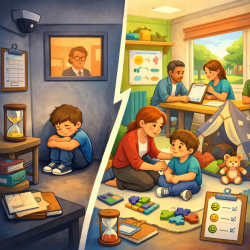
In many schools, “time-out” is still misunderstood. It can be treated like a consequence, a removal, or a reaction to behaviour that already escalated. But the most effective time-out intervention looks very different: it’s proactive, planned, communicated, and designed to help a student regain control in a safe, predictable environment.
At TinyEYE, we support schools with online therapy services that fit into broader student support systems. While time-out intervention is not therapy, it often intersects with the same goals our clinicians work on every day: self-regulation, coping skills, emotional awareness, and safe participation in learning. When time-out is implemented correctly, it can be a supportive tool within a student’s Behaviour Management Plan (BMP)—not a punishment.
What “Time-Out Intervention” Actually Means (and What It Doesn’t)
According to the Guidelines for Time-out Intervention (2014), a time-out intervention is a proactive strategy designed to support self-calming. It is used to assist a student to regulate and/or control behaviour and may be part of a student’s BMP. It provides an opportunity for the student to reflect on actions within a safe and predictable environment, ideally before behaviour escalates.
Most importantly, time-out intervention is not a punishment or a reaction to inappropriate behaviour. That single distinction changes everything—from how staff introduce it, to how students experience it, to how consistently it works.
Program Planning: Where Effective Time-Out Starts
Time-out works best when it is planned, not improvised. The guidelines specify that the decision to use a time-out intervention is made by the student’s program planning team. This matters because time-out should be individualized, developmentally appropriate, and aligned with the student’s needs—not based on a one-size-fits-all classroom rule.
Who needs to understand the plan?
Procedures must be communicated to the student, parents/guardian, and school staff. And “school staff” means everyone who may interact with the student during the day, including:
- Teachers (including substitutes)
- Educational assistants
- Staff on supervision duty
- Bus drivers and other transportation staff
- Any staff supporting the student’s BMP
When only a few people know the plan, time-out can become inconsistent—leading to confusion, power struggles, and avoidable escalation.
Individual factors must be considered
Any use of time-out must take into account the student’s:
- Age
- Cultural background
- Individual needs
- Developmental level
This is a critical equity and safety point. A strategy that supports one student may feel threatening, shaming, or ineffective for another. The planning team’s role is to ensure time-out is supportive, not harmful.
What Should a Time-Out Procedure Include?
The guidelines call for clearly articulated steps. If your school is using time-out (or considering it), your procedure should answer these questions in plain language:
- Where is the time-out space located?
- How will the need for time-out be communicated student-to-staff and staff-to-student?
- How will the student move to the time-out space?
- What happens if the student does not comply?
- What happens if time-out does not successfully calm the student enough to return safely and productively to the classroom?
These details prevent staff from “making it up in the moment,” which is when time-out is most likely to drift into punishment or become unsafe.
Staff training and readiness
The guidelines also emphasize that direction should be provided to staff involved in the BMP on appropriate implementation. In addition, Nonviolent Crisis Intervention Training should be considered to equip staff with behaviour management skills to manage anxious or violent behaviour.
In practice, this means schools should not rely on time-out without ensuring staff have the tools to:
- Recognize early signs of escalation
- Use less intrusive strategies first
- Communicate calmly and consistently
- Maintain supervision safely
- Document accurately and objectively
Review is not optional
Regularly scheduled review of the BMP is essential. If time-out is being used frequently, lasting longer than expected, or not helping the student return to learning, the plan needs to be revisited. Time-out should never become the default response.
Implementation: The “How” That Protects Students and Staff
The guidelines provide several key implementation expectations that schools can use as a practical checklist.
1) Time-out can be student-selected or teacher-directed
Student-selected time-out can be especially powerful because it builds self-awareness and self-advocacy. Teacher-directed time-out may be appropriate when a student is struggling to regulate and needs structured support—but it should still be delivered as a supportive strategy, not a consequence.
2) Use less intrusive interventions first
School staff should only direct a student to the time-out space after less intrusive interventions have not been successful in managing the behaviour. All interventions should be documented.
This protects students from unnecessary removal and helps teams identify what works. It also creates a clearer picture of patterns: what triggers the behaviour, what de-escalates it, and what supports are missing.
3) Keep time-out as brief as possible
Time-out should be used only for the minimum period needed to facilitate self-regulation. The guidelines provide examples:
- Approximately 2–3 minutes for younger children
- Up to a maximum of 30 minutes for older students demonstrating aggressive behaviours
Long or open-ended time-outs can feel isolating, increase distress, and reduce trust—especially if the student doesn’t understand the purpose or the exit criteria.
4) Students move voluntarily
Students will voluntarily move to the time-out space. This is a major safety and ethical standard. If a student is not moving voluntarily, the team needs to reassess the plan, the communication approach, the environment, and the supports—rather than escalating the situation.
5) Supervision is required at all times
Students will be supervised at all times. This is non-negotiable. It protects the student, protects staff, and ensures time-out remains a supportive strategy rather than a removal or exclusion.
Documentation: The Backbone of Safe, Accountable Practice
Documentation is not “extra paperwork”—it’s how schools ensure time-out is being used appropriately, consistently, and effectively.
- The principal must ensure parents/guardians are notified when a time-out space is being used with their child.
- Documentation to record time-out space usage is required (for example, a sign-in form).
- Regularly scheduled review of the BMP by the Program Planning Team is essential.
Good documentation supports better decision-making. It helps teams see whether time-out is decreasing over time (a positive sign), staying the same (a signal to adjust), or increasing (a clear call for review and additional supports).
Time-Out Space: What “Safe and Predictable” Looks Like
The environment matters. A dedicated time-out space may be an area in the classroom or a separate room with a door and observation window. Regardless of the setup, the guidelines specify that the space must meet key requirements.
A dedicated time-out space must:
- Be comfortable and pleasant
- Have adequate space for the student and a staff member
- Be conducive to self-quieting behaviours
- Have an observation window
- Not be locked, latched, or secured in any way that would prevent exit in an emergency
- Not contain items or fixtures that could be harmful to a student or staff member
- Be supervised at all times, with the supervisor remaining in the space unless there is high risk to personal safety (in which case the student is monitored through the observation window)
If a space is uncomfortable, cluttered, isolating, or feels like confinement, it undermines the entire purpose of time-out as a self-calming strategy.
How TinyEYE Supports the Bigger Picture
Time-out is one tool within a broader system of student support. When schools pair clear time-out procedures with skill-building supports, students are more likely to learn what to do instead of escalating.
TinyEYE’s online therapy services can complement school-based planning by supporting underlying needs that often show up as behaviour—such as communication challenges, emotional regulation difficulties, and coping skill gaps—while schools maintain their own policies and program planning processes.
For more information, please follow this link.