Four studies, four very different claims about what VR can do
If you search "virtual reality therapy autism" or "VR ADHD school participation," you will find enthusiasm that outpaces the evidence supporting it. Four studies, spanning 2013 to 2026, illustrate exactly how uneven that evidence is. One tested whether virtual reality could improve how children with autism process objects in context. One tested whether children with autism could learn to judge when it is safe to cross a street after immersive VR training, with mastery assessed in both the VR simulation and the real street. One described eye-gaze patterns during a single VR social-skills session. And one, the largest by far, randomized 92 children with ADHD to an 8-week immersive VR program or no additional therapy and measured school participation. These are not four data points on the same question. They are four different questions, answered with four very different levels of rigor, and treating them as one undifferentiated pile of "VR evidence" does a disservice to the families and IEP teams asking you whether this modality is worth trying.
Mapping the evidence: what was actually measured, in how many children, for how long
Before ranking these studies by strength, it helps to lay out exactly what each one did:
- Contextual processing (2013): 4 children with autism, single-subject multiple-baseline design, VR-cognitive rehabilitation intervention, outcome measured on contextual-processing and cognitive-flexibility tasks, plus a separate control test and context-related behavior ratings. Read the study: Using the Virtual Reality-Cognitive Rehabilitation Approach to Improve Contextual Processing in Children with Autism.
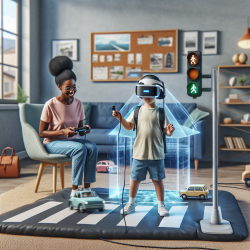
- Pedestrian safety (2019): 3 children with autism, single-case evaluation, immersive VR training on judging when it is safe to cross the street, with mastery criteria tested in both VR and the natural environment after the training environment was modified. Read the study: Evaluation of an Immersive Virtual Reality Safety Training Used to Teach Pedestrian Skills to Children With Autism Spectrum Disorder.
- Social-skills gaze patterns (2022): 10 children and youth with autism, one IVR social-skills session, a purely descriptive pilot measuring gaze fixation and visual search, with no pre/post outcome comparison. Read the study: Gaze Fixation and Visual Searching Behaviors during an Immersive Virtual Reality Social Skills Training Experience for Children and Youth with Autism Spectrum Disorder: A Pilot Study.
- School participation (2026): 92 children with ADHD ages 7-12, randomized controlled trial, intervention group (n=46) received IVR twice weekly for 8 weeks versus a control group (n=46) that received no additional therapy, outcome measured with the School Participation Questionnaire and Bruininks-Oseretsky motor test. Read the study: Exploring Immersive Virtual Reality as an Approach to Improve School Participation-Related Constructs in Children With ADHD.
Laid out this way, the differences in what these studies can actually support become obvious before you even get to the results.
Where the evidence is strongest: pedestrian safety and school participation
Two of the four studies give you something you could reasonably describe to a family or an IEP team as trial-level or generalization evidence, though both come with real limits worth stating up front. The pedestrian safety study is small, only 3 participants, with no control condition, and it did not test real-world injury prevention directly. It tested a narrower, well-defined skill: whether a child could judge when it was safe to cross the street. After the researchers modified the VR training environment, all three children reached mastery criteria for that judgment, in both the virtual environment and the natural, real-world street. That is a genuine generalization finding for one specific skill in one specific setting, and it is more than most single-case VR studies of this size can claim. But the study's own authors describe their finding in hedged terms, concluding only that immersive VR is "a promising medium" for delivering safety-skills training, not a proven way to reduce real-world injury risk. It is also worth noting plainly that the VR environment did not work as designed on the first attempt; it needed modification before any child reached mastery.
The ADHD school participation study is the strongest evidence in this set by a wide margin, simply because of its design. With 92 children randomized into intervention and control groups, baseline equivalence confirmed on both the School Participation Questionnaire and a motor proficiency test, and an 8-week, twice-weekly dosage, this is a real randomized controlled trial, not a pilot. The intervention group improved significantly across all four SPQ domains (doing, being, symptoms, and environment), with a large effect size for the total score (d = 0.978) and effect sizes ranging from 0.452 to 0.910 across subdomains. The control group, which received no additional therapy during the study period, showed no improvement and, in some subdomains, decline. Between-group comparisons favored the intervention group with large effect sizes (d = 0.878-1.165) and strong statistical significance (p < 0.001). If you are looking for the one study in this set that could justify a school-based VR pilot program to an administrator, this is it, though it is worth noting the outcome measure was teacher-rated, not an independent observational measure, and the material available here reports results from a single trial at a single site, in children ages 7 to 12 specifically.
Where the evidence is still exploratory: contextual processing and social skills
The other two studies are honest pilots, and they should be described that way, not upgraded into proof of concept. The contextual processing study enrolled 4 children with autism in a single-subject design. All four children showed statistically significant improvement in contextual processing and cognitive flexibility, which is a real and specific finding worth citing accurately. The study reports mixed results on a separate control test and on context-related behaviors outside those tasks, and its authors explicitly call for larger-scale studies before drawing conclusions about effectiveness in comprehensive educational programs. That caveat came from the researchers themselves, not from skepticism about VR generally.
The social-skills gaze study is a different kind of preliminary. Ten participants completed one IVR social-skills session, and researchers described how gaze fixation and visual search patterns differed among participants with mild, moderate, and severe autism. That is a genuinely interesting descriptive finding, and the authors suggest it might eventually serve as an objective metric for tracking intervention effectiveness. But the study's own stated objective was descriptive rather than evaluative: it measured gaze and visual-search behavior during a single session, and it was not designed to test whether any social skill changed over time. If a vendor or colleague cites this study as evidence that VR "improves social skills" in autism, that is a misreading of what was actually measured.
Why sample size and design, not the headset itself, explain the difference in confidence
It's tempting to conclude that VR is more effective for safety training and school participation than for cognitive or social skills. That may eventually turn out to be true, but these four studies alone don't establish it, because the studies aren't matched in rigor. The ADHD trial had 92 children, randomization, and a control group; the contextual processing and gaze studies had 4 and 10 children respectively, with no control group in either case. A single-subject or descriptive pilot with 4 or 10 children can generate hypotheses and demonstrate feasibility, but it cannot tell you what will happen for the next child in your caseload with any confidence. The pedestrian safety study complicates a simple sample-size story: with only 3 children and no control condition, it is far smaller than the ADHD trial, but it tested generalization to a real-world environment directly rather than relying on a proxy measure inside the headset, which is why its narrow finding is worth taking seriously even at that size. Its own authors, notably, call the result "promising" rather than proven, which is the right level of confidence for a single-case design this small. Design and outcome measurement, not the sample size number alone, are what should shape how much weight you put on any of these findings.
What this means if you're recommending VR to a family or IEP team today
You can accurately tell a family that, in one small study with no control condition (n=3), children with autism reached mastery in judging when it was safe to cross the street, in both a VR simulation and the real street, after the training environment was modified — a genuine but narrow finding about one safety skill in one setting. You can separately tell an IEP team that, in one randomized controlled trial at one site (n=92, ages 7-12), an 8-week immersive VR program produced large effect sizes on teacher-rated school participation compared with a no-additional-therapy control group. Both of those statements are accurate and specific. What you should not do is generalize either one: the safety finding does not establish reduced real-world injury risk, and the ADHD finding does not establish that VR will produce similar results for a different age range, a different outcome measure, or a different site. You should also not tell a family that VR is a validated treatment for contextual processing deficits or social skills in autism, because the studies behind those applications are single-digit-n pilots that either produced mixed results or didn't test a change in outcome at all. Frame each recommendation to the specific skill, the specific sample, and the specific study behind it, not to VR as a category.
Questions to ask before choosing a VR protocol, and what to track
Before adopting any VR product or protocol, ask the same questions this evidence map raises, study by study. Was generalization tested outside the headset, as in the 2019 street-crossing study, or only measured inside it, as in the 2022 gaze-pattern pilot? Was there random assignment and a control group, as in the 2026 ADHD trial, or a single-subject or no-control design, as in the 2013 contextual-processing study and the 2019 safety study? Was the outcome measured with a validated, independent tool like the School Participation Questionnaire, or a proxy measure like gaze duration that hasn't yet been validated against a treatment outcome? And did the VR environment work as designed, or, as in the safety study, did it require modification before children reached mastery — a sign that off-the-shelf VR products may need clinician-guided customization rather than working straight out of the box? Then, regardless of the answers, start collecting your own outcome data from day one: baseline and post-intervention measures on the specific skill you're targeting, using a validated tool where one exists, so that if you're one of the early clinicians using this modality, your caseload data becomes part of the evidence base rather than an untracked anecdote.