Across the United States, public school enrollment has been trending downward for years. But after COVID-19, what was expected to be a gradual shift became a disruptive jolt—one that is still reshaping staffing, budgets, and student services. For school leaders and educators, the most important question isn’t just “Where did the students go?” It’s also: “How do we keep essential supports strong for the students who are here—and for the students who may return?”
As a company that provides online therapy services to schools, TinyEYE pays close attention to the real-world effects of enrollment changes. When enrollment drops, districts often face immediate financial pressure. And when budgets tighten, student support services can be among the first areas that feel strain—even though student needs don’t disappear just because a district serves fewer students.
Enrollment was already slowing—then the pandemic changed the pace
Researchers anticipated an enrollment slowdown even before COVID-19. Between 2012 and 2019, public school enrollment increased only about 2%, hovering near 50 million students. At the same time, the U.S. fertility rate fell to 1.71 births per woman—below replacement level—signaling smaller school-age cohorts ahead.
Then COVID-19 hit, and the slow decline became a sudden shock. Multiple state-level studies documented steep losses after 2020, and national research found similar patterns—especially in urban and high-poverty districts. Families explored new schooling options, including homeschooling and private schooling. Yet even with those shifts, a striking number of children appear to be “missing” from formal enrollment records.
“Traditional public school” share is shrinking—and the “missing” category grew
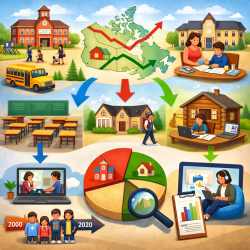
The Brookings report synthesizes several federal datasets to track how students moved across schooling settings. Before the pandemic, the share of students in traditional public schools stayed fairly steady at around 85% (from 2016-17 through 2019-20). After 2020, the mix changed.
Charter schools grew steadily (from 5.0% of enrollment in 2016-17 to 6.0% in 2023-24).
Alternative public schools increased slightly (1.3% to 1.5%).
Virtual schools nearly doubled during the pandemic and stayed elevated (0.7% in 2019-20 to 1.2% in 2020-21, remaining higher than pre-COVID levels).
Private school enrollment stayed relatively stable around 8.8% across 2016-17 to 2023-24.
The most concerning change is what happened outside the public-school sector. When researchers combined private school enrollment with children who could not be matched to public enrollment files, the share of children outside public schools rose from a pre-COVID average of 9.7% to 12.6% in 2023-24. Because private school enrollment was relatively stable, the report suggests the increase may be driven largely by students who are not showing up in federal datasets at all.
That matters for schools because “missing” doesn’t mean “no needs.” It may mean students are homeschooling, moving frequently, disengaging, or facing barriers that keep them from consistent enrollment. In special education and related services, these disruptions can translate into delayed identification, interrupted therapy, and uneven access to supports.
Enrollment shifts aren’t evenly distributed: geography, race/ethnicity, and poverty matter
Geography: some states show larger “gaps” than others
The report maps the share of school-age children who do not appear in either public or private enrollment records. In 2021-22, the estimated “missing” share ranged from 0% in places like Florida, Delaware, and D.C., up to about 12% in Oregon. The median state (Wisconsin) had 5.5% unaccounted for. Larger gaps were more common in parts of the far West and northern tier, plus Kentucky and West Virginia.
Race/ethnicity: patterns differ by district composition
Using districts where one racial/ethnic group made up at least 90% of enrollment (to approximate group-specific patterns), the report finds that districts serving mostly Black students had the highest and fastest-growing share of students outside traditional public schools—rising from 25.4% in 2015-16 to 34.1% in 2023-24. Predominantly Hispanic districts rose notably after 2020, reaching 17.6% in 2023-24. Predominantly white districts were stable pre-pandemic, then increased to 17.5% in 2023-24.
For educators committed to equity, this is a flashing signal. When enrollment shifts happen unevenly, they can intensify long-standing concerns about re-segregation and resource inequality—especially if higher-need communities experience greater churn and fewer stable supports.
Poverty: high-poverty districts see the largest share outside traditional public schools
Across every year studied, high-poverty districts had the largest share of students outside the traditional public-school sector. After 2020, that share accelerated, reaching 26.0% in 2023-24. Medium-poverty districts rose to 19.9%. Low-poverty districts dipped slightly pre-pandemic, then climbed to 15.9% in 2023-24.
Even when families have fewer resources for private tuition or homeschooling, high-poverty districts still experienced the largest absolute increase in students leaving traditional public schools. That creates a tough combination: higher levels of student need alongside shrinking per-pupil funding.
Why declining enrollment quickly becomes a student-services issue
Most state and federal funding is allocated on a per-pupil basis. When headcount drops, budgets tighten—often before fixed costs (buildings, transportation, specialized programs) can adjust. District leaders may consider redistricting, consolidations, or school closures, all of which can be politically and emotionally charged.
The Brookings report also finds evidence that steeper enrollment losses measurably raise the odds of permanent school closure. While closures are influenced by many factors (facility costs, proximity of other schools, politics, competition, accountability rules), sharp declines increase risk.
From a special education lens, these transitions can be especially disruptive. Students with disabilities and students receiving related services often rely on predictable routines, consistent relationships, and coordinated teams. When schools consolidate or staffing changes rapidly, service delivery can become harder to maintain unless districts plan proactively.
Looking ahead to 2050: fewer students overall, plus uncertainty about “market share”
Using Census projections, the report describes a school-age population expected to decline most sharply between 2025 and 2035, then stabilize in the 2040s. But demographics are only part of the story. The other big variable is whether families return to traditional public schools or continue choosing alternatives at higher rates.
In 2023-24, traditional public schools enrolled 43.06 million students out of 54.32 million school-age children. By 2050, the report projects traditional public school enrollment could fall to between 34.57 million and 40.84 million—meaning districts could see roughly 2.91 to 6.59 million fewer students over the next quarter century (depending on the scenario).
That range matters because it affects everything from staffing models to building use to the availability of specialized services. When districts are forced to plan under uncertainty, flexibility becomes a protective factor.
What districts can do now: protect continuity, equity, and capacity
Enrollment decline can feel like a problem that happens to districts. But there are practical steps leaders can take to reduce disruption and safeguard student supports—especially for students who need speech-language therapy, occupational therapy, mental health supports, and other related services.
Plan for variability, not just averages. If student mobility is rising, service delivery needs systems that can absorb mid-year changes without long gaps in support.
Protect early identification and early intervention. The report notes sharp drops in kindergarten enrollment for Black and low-income children in particular. When early grades are disrupted, screening and intervention can be delayed—raising the likelihood of later academic and behavioral challenges.
Use flexible staffing models for specialized roles. Hard-to-fill positions (including many related service providers) can become even harder to sustain when budgets tighten. Flexible models can help districts maintain compliance and continuity even when headcount shifts.
Strengthen family communication and re-engagement. If students are “missing,” outreach matters. Clear pathways back into services—especially for students with IEPs—can reduce learning and developmental gaps.
Monitor equity impacts. Because enrollment shifts differ by race/ethnicity and poverty level, districts should examine whether program cuts or consolidations disproportionately affect high-need communities.
How online therapy supports stability during enrollment shifts
Online therapy is not a cure-all for demographic change, but it can be a stabilizing tool when districts are navigating uncertainty. When implemented thoughtfully, teletherapy can help schools:
Maintain service continuity during staffing shortages, leaves, or turnover
Reduce wait times for evaluations and ongoing therapy
Expand access for rural or hard-to-staff schools
Support consistent documentation and scheduling across buildings and changing caseloads
Most importantly, it helps keep the focus where it belongs: on student progress. Whether enrollment declines are temporary or long-lasting, students still deserve timely, high-quality support—especially those who rely on related services to access learning.
For more information, please follow this link.