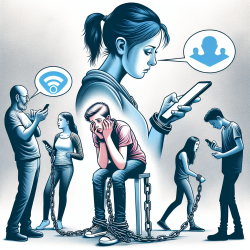
In schools, we often see the “big feelings” first: a student who shuts down, a student who snaps quickly, or a student who seems to stop asking for help altogether. As educators and related service providers, we’re trained to look at skills, environments, and supports. But there is one environment we can’t ignore because it follows students into the classroom every day: the home microsystem.
New longitudinal research published in 2025 explored a modern family dynamic that many children quietly manage: a parent using a smartphone during conversations with their child. The study focused on how often this happens, how kids feel and respond in the moment, and how those patterns connect to children’s overall well-being over time.
What is “technoference” (and why does it matter)?
Researchers use the word technoference to describe technology-based interruptions in face-to-face interactions. In everyday life, it can look small:
- A parent glances at notifications while a child is talking.
- A parent answers a call mid-conversation.
- A parent holds a phone and checks it “just for a second” during a meaningful moment.
These interruptions are often brief and sometimes automatic (habit-based checking). But for children—especially when they’re trying to share something important—those moments can carry a powerful message: “You’re not as important as what’s on the screen right now.”
A quick look at the study (in plain language)
The study, titled Effects of Parents’ Smartphone Use on Children’s Emotions, Behavior, and Subjective Well-Being (Selak, Merkaš, & Žulec Ivanković, 2025), followed 284 children ages 10–15 across multiple waves of data collection (2021–2023). Children reported:
- How often parents used smartphones during conversations
- How they felt when a parent used a phone while the child was talking about something important
- What they did in response (wait, try harder, use physical cues, or give up)
- Their later well-being (positive/negative affect and life satisfaction)
This matters because it moves beyond a single snapshot. It helps us understand a pathway: parent phone use during conversation can shape children’s emotional and behavioral reactions, which are linked to later well-being.
Key findings: it’s not just “screen time,” it’s “connection time”
One of the most important takeaways is that the study did not find a strong direct link between parent phone use and child well-being. Instead, the impact showed up through what happened inside the child during those moments.
1) More parent phone use was linked to more child anger and sadness
When parents used smartphones more frequently during conversations, children reported feeling anger and sadness more often in those situations. Those emotions were then linked to lower well-being later.
In school terms, this can look like:
- Lower frustration tolerance
- Quick escalation when they feel ignored or misunderstood
- More negative self-talk (“No one listens anyway”)
2) “Giving up” is a red flag behavior
The study also found that more frequent parent phone use was linked to children giving up on trying to get a parent’s attention—and that “giving up” pattern was connected to lower well-being later.
As a special education writer and someone who thinks in skill-building terms, this is a crucial point: giving up is not “good behavior.” It may be a coping strategy that protects a child from repeated disappointment. Over time, it can resemble learned helplessness: “It doesn’t matter what I do; I won’t be heard.”
In the classroom, “giving up” can be misread as:
- Noncompliance
- Apathy
- Lack of motivation
But it may actually be a relationship-based adaptation: the child is conserving emotional energy because trying hasn’t worked.
3) Indifference is not always a sign things are fine
The study measured “indifference” as an emotional reaction as well. While parent phone use wasn’t strongly tied to indifference in the model, indifference itself related to poorer well-being. That’s worth noticing: sometimes “I don’t care” is a protective cover for disappointment.
Why this matters for schools (and for TinyEYE’s work)
At TinyEYE, we support schools through online therapy services that fit real school schedules and real student needs. Research like this is helpful because it points to a practical truth: students don’t leave relationship stress at home. It shows up in learning, behavior, emotional regulation, and peer interactions.
When a child is frequently interrupted at home during important conversations, we may see:
- Reduced help-seeking at school (“Why bother asking?”)
- Increased irritability or sensitivity to perceived rejection
- Difficulty sustaining attention during conversation (because conversation has become unreliable)
- Lower life satisfaction, which can affect engagement and resilience
School-based teams can’t (and shouldn’t) police parenting. But we can teach skills, normalize feelings, and offer supportive routines that protect connection.
Simple, school-friendly ways to support students and families
These strategies are designed to be realistic, non-shaming, and easy to share in newsletters, family nights, IEP meetings, counseling sessions, or consults.
For families: small changes that protect connection
- Name the moment: “I want to hear you. I need 30 seconds to finish this message, then I’m all yours.” (Research suggests that giving a reason can reduce the sting.)
- Create “phone parking” times: meals, bedtime, and the first 10 minutes after school are high-impact connection windows.
- Use a “two-turn rule”: if your child starts something important, give two back-and-forth responses before touching the phone again.
- Repair quickly: “I missed that. Tell me again.” Repair teaches children they matter even when interruptions happen.
For students: skills that reduce the “giving up” spiral
- Teach assertive attention-getting: a respectful script like “This is important to me. Can you look at me for a minute?”
- Build emotion vocabulary: anger and sadness are easier to manage when a student can label them early.
- Practice coping while waiting: breathing, grounding, or writing down the key point they want to share.
- Identify safe adults at school: if home conversations are often interrupted, a student may need reliable listening spaces elsewhere.
For school teams: supportive messaging without blame
- Frame it as “connection,” not “screen time”: families are more receptive when the goal is relationship quality.
- Use universal language: “Many of us check phones automatically. Kids notice it more than we think.”
- Offer a simple family challenge: “One device-free conversation a day—just 5 minutes—this week.”
A final thought: kids compete with what gets our attention
This study reinforces something many children already know: attention is a form of love, and interruptions can feel like rejection. When children repeatedly experience “not now” from a screen, they may respond with anger, sadness, or silence. Over time, those patterns can shape well-being.
Schools can be powerful partners by teaching communication skills, supporting emotional regulation, and helping families build small routines that protect connection—especially during the moments that matter most.
For more information, please follow this link.