The hidden price tag on “free” public education
Public education is often described as a cornerstone of opportunity—especially in states like Pennsylvania, where courts have affirmed education as a fundamental right. Yet for many families, the day-to-day reality of school can include a steady stream of fines, fees, and charges that are difficult to predict and nearly impossible to avoid.
A new research brief from August 2025, Opportunities Lost: The Hidden Cost of Public Education in Pennsylvania K–12 Schools, documents how school-based economic sanctions are woven into student handbooks and codes of conduct across the Commonwealth. The takeaway is clear: these costs are not limited to optional activities. They can attach to basic participation in school life—sometimes even to simply walking through the front doors.
What the research found: school fees are widespread and embedded in policy
The study conducted a systematic review of more than 700 student and family handbooks and codes of conduct published by 704 Local Education Agencies during the 2021–2022 school year. Using a defined set of search terms (such as “fine,” “fee,” “charge,” “cost,” “dues,” and “outstanding balance”), researchers coded documents line-by-line.
The key finding: Pennsylvania public schools included 3,846 unique educational fines and fees provisions across the reviewed materials. In other words, school fees are not a rare exception—they are a structural feature of how many schools communicate rules and consequences.
Not just “extras”: common categories and real dollar amounts
One reason these costs are so harmful is that they can appear small in isolation, but accumulate quickly—especially for families juggling housing, food, transportation, childcare, and medical expenses. The brief highlights common categories and example amounts, including:
- Library book fines: $0.25/day
- Late pick-up and drop-off fees: $1/minute
- Hall pass replacement charges: $5
- ID replacement charges: $20
- Parking fines: $25
- Participation charges: $50
- Activity fees: $100
- Technology charges: $100
- Yearly class dues: $250
- Laptop replacement fees: $500–$800
These are not hypothetical numbers. They reflect provisions found in real school policies and handbooks. And crucially, the brief argues that in practice these fees can be “nearly impossible to avoid,” because they are tied to routine school expectations and compliance.
Why this hits harder in Pennsylvania: inequity is the backdrop
The brief situates school fees within Pennsylvania’s broader context of educational inequity and segregation. It points to persistent disparities in funding adequacy, poverty rates, and discipline outcomes. Among the data cited:
- In 2024, 70% of students were affected by an over $4 billion adequacy gap.
- In 2019–20, highest poverty districts received $2,867 less per pupil than what was deemed necessary for adequate funding, while lowest poverty districts received $10,045 more per pupil than necessary.
- Since 2019, more than half of students qualified for free or reduced-price lunch.
- In 2023, 1 in 6 children under 18 lived in poverty, with higher rates among Black, Latina/o/x, and several other communities.
- Discipline disparities persist, including substantially higher suspension rates for Black students and higher arrest rates for Black girls and students with disabilities in school-related matters.
In this environment, even “minor” school charges can deepen existing divides—because the same fee is experienced very differently depending on a family’s resources, stability, and access to support.
The real harm: when inability to pay becomes an educational barrier
The research brief emphasizes that the impact of school-based fines and fees is not limited to finances. When nonpayment triggers consequences, it can directly restrict access to learning and belonging. The brief outlines a cascade of primary and secondary harms that can follow when families cannot pay, including:
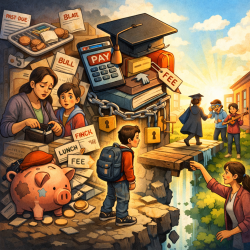
- Restricting physical entry into school
- Creating barriers to graduation
- Excluding students from graduation ceremonies
- Blocking participation in extracurriculars and school activities
- Withholding educational materials, report cards, and transcripts
- Limiting access to library materials
- Referrals to debt collection agencies
- Referrals to county prosecutors’ offices
- Additional fines and fees through court involvement
These outcomes transform schools from places designed to support learning into systems that can punish poverty—often in ways that compound over time.
Three stories that show what policy looks like in real life
To illustrate the lived consequences, the brief shares vignettes drawn from legal advocacy work (with pseudonyms used for privacy). These stories show how quickly fees can escalate into missed instruction, blocked opportunity, and destabilized family life.
Chloe: fees that kept a student out of school
Chloe, a high school student living in an emergency shelter, could not afford a $5 student ID replacement fee. Because of that, she missed many days of school. The situation worsened when the school charged an additional $1 per day for each day she was missing her ID—without a cap—allowing the balance to grow continuously. She was repeatedly turned away, and the school threatened court referral for truancy, which could have exposed her family to further penalties.
Emma: a post-graduation door closed over $15
After graduation, Emma—parenting on their own and experiencing homelessness after aging out of child welfare—could not pay a $15 fee for a replacement diploma. Without that document, they were unable to enter a specialized training program that could have led to a living wage and future advancement. The fee was not waived despite repeated efforts.
Nova: a uniform fee that forced impossible tradeoffs
Nova, a Black single mother of four, was told her child could not attend school without a full uniform that cost over $300. Paying meant falling behind on essential bills. Not paying meant her child could be sent home—effectively denied access to education. Nova “chose” education, but at the expense of utilities and car payments, and still could not pay off the uniform cost mid-year.
Why this matters for student well-being—and why schools should care
Schools are not only academic environments; they are ecosystems that shape mental health, relationships, and long-term outcomes. When students are excluded, shamed, or blocked from participation due to unpaid balances, the impact can show up as:
- Increased stress and anxiety for students and caregivers
- Reduced attendance and engagement
- Weakened trust between families and school staff
- Lower access to supportive services and enrichment opportunities
For districts already working to improve attendance, reduce behavioral incidents, and strengthen family partnerships, fines and fees can quietly undermine those goals.
Where TinyEYE fits: supporting schools by reducing barriers, not adding them
At TinyEYE, we work with schools to deliver online therapy services that help students access the support they need—wherever they are. While this research brief focuses on fines and fees, the underlying theme is broader: students thrive when access is consistent, equitable, and stigma-free.
When a student is kept out of school for an unpaid ID fee, or when a family is forced to choose between utilities and a uniform, the ripple effects can include missed instruction, reduced connection to trusted adults, and fewer opportunities to identify and address learning or communication needs early. Schools that want to strengthen student outcomes should view “access” as a full picture—attendance, participation, materials, and supportive services working together.
Action steps: what communities, school leaders, and policymakers can do next
The brief provides recommendations across stakeholder groups. Here are key actions highlighted:
For community members
- Learn your local school’s policies on fines and fees and determine whether exemptions apply (including protections under the federal McKinney-Vento Act or Pennsylvania’s Act 1).
- Advocate to school boards to end school-based educational fines and fees and return collected fees.
- Share the research to build awareness and collective action.
For school leaders
- Implement an immediate moratorium on collecting school-based fines and fees while policies are revised.
- Review all practices—including informal ones not captured in handbooks—to identify where fees are imposed.
- Prohibit the imposition or collection of these fees and train staff to ensure consistent implementation.
- Inform students and caregivers that fees are banned and that no child can be penalized for nonpayment.
- Create a complaint mechanism to report violations.
- Return collected fees, zero out balances, reverse punishments tied to nonpayment, and expunge records where applicable.
For policymakers
- Impose a moratorium until legislation formally bans school-based fines and fees.
- Pass legislation requiring balances to be zeroed out.
- Direct equity audits to assess disproportionate impact on students of color and students living in poverty.
- Encourage state and federal education agencies to issue guidance outlining harms and reiterating existing rights.
A hopeful conclusion: opportunity should not depend on a receipt
The most powerful message in the research brief is not just that fines and fees exist—it’s what they do. They can convert everyday school moments into gatekeeping mechanisms that sort students by income, housing stability, and access to resources.
If education is truly a fundamental right, then access to classrooms, materials, milestones, and post-graduation pathways must not be contingent on a family’s ability to pay. The next step toward equitable, supportive school environments is to identify these hidden costs, measure their impact honestly, and replace them with policies that keep students connected to learning.
For more information, please follow this link.