Artificial intelligence is moving into classrooms faster than most school systems can evaluate it. Teachers are experimenting. Students are using tools at home (and often in class). District leaders are being asked to approve products, write policies, and manage risk—sometimes with little more than vendor promises and anecdotes.
A major 2026 review from Stanford’s SCALE Initiative, The Evidence Base on AI in K-12: A 2026 Review, helps separate signal from noise. The headline finding is both encouraging and sobering: there are now 800+ academic papers relevant to AI in K-12 education, but only a tiny subset (20 studies) provides strong causal evidence about impact.
That matters because causal studies—like randomized controlled trials (RCTs) and strong quasi-experimental designs—are the best tools we have to answer the questions school leaders actually need answered:
- Does this tool improve learning, or just make work look better while the tool is turned on?
- Does it help teachers save time without lowering quality?
- Who benefits most—and who could be left behind?
Below is a practical, easy-to-read synthesis of what the strongest evidence says so far, and what it means for schools making decisions today.
First, a reality check: the evidence is still thin (especially in U.S. K-12)
The review emphasizes that rigorous causal research in U.S. K-12 student settings is essentially missing right now. Many studies are:
- Conducted internationally (different curricula, infrastructure, classroom norms)
- Run with adults (college students) rather than K-12 students
- Short-term or constrained (for example, one-time 20-minute experiments)
- Focused on immediate outcomes rather than long-term learning and transfer
So while early findings are useful, they should be treated as directional guidance, not final answers.
What the best studies suggest about students: performance rises “with AI,” but transfer is uncertain
Across the causal studies, a consistent pattern shows up: students often perform better while they have active access to AI tools. This includes improvements in:
- Math practice
- Programming projects
- Writing tasks (especially when AI provides feedback)
In other words, AI can act like a powerful “in-the-moment” support. But the more important question for schools is what happens when students must perform independently—on a quiz, exam, or real-world task without AI assistance.
Key insight: short-term boosts don’t always become durable learning
When students are assessed without AI support, results are mixed. Some studies show no improvement, and some show worse performance after AI-supported practice—especially when students used general-purpose chatbots in ways that replaced thinking rather than supporting it.
This distinction is critical for K-12 leaders. If AI improves the product (the essay, the solution, the code) but not the underlying skill, schools may see:
- Higher completion rates
- Better-looking assignments
- But weaker independent reasoning, recall, or transfer
“Easier” can come at a cost
Several studies suggest AI can reduce students’ cognitive burden—students may feel tasks are easier and more enjoyable. That can be a genuine benefit, particularly when frustration blocks progress.
But the review warns: reducing cognitive load isn’t automatically good. If AI removes the “productive struggle” that helps students build durable skills, students may:
- Rely on the tool instead of developing strategies
- Engage in less deep reasoning and argumentation
- Remember less of what they produced
In learning science terms, the tool may reduce not only “extraneous load” (unhelpful friction) but also “germane load” (the mental work that actually builds learning).
The design of the AI tool matters more than many people assume
One of the most actionable takeaways from the review is that pedagogical design and guardrails matter.
Tools built for learning—such as tutoring chatbots that provide hints, step-by-step reasoning, or scaffolded questioning—tend to show more promise than general-purpose chatbots that simply provide answers.
In particular, studies suggest:
- Step-by-step reasoning can improve performance compared to “solution-only” responses.
- Tutoring-specific chatbots may avoid some of the negative “crutch” effects seen with general-purpose tools.
- Socratic approaches (asking guiding questions) can increase engagement, but students may perceive them as less “helpful” because they don’t give direct answers.
For schools, this is a major procurement and implementation lesson: choosing “any AI” is not the same as choosing instructionally designed AI.
What the best studies suggest about educators: time savings and scalable coaching are real
The evidence for educators is more encouraging—and notably, several causal studies were conducted in U.S. K-12 settings.
Teachers can save time without lowering quality
In one study, teachers who used ChatGPT with guidance spent about 30% less time on lesson and resource preparation (roughly 25 minutes per week) with no detectable reduction in lesson quality based on blind expert ratings.
Other research suggests that even when AI doesn’t reduce total hours worked, it may shift effort toward higher-value teaching work—for example, using time saved on routine feedback to engage more directly with students.
AI can help scale instructional expertise—especially for less experienced educators
Some of the most promising causal findings involve AI tools that provide real-time suggestions or regular diagnostic feedback to tutors and teachers. In messaging-based tutoring environments, AI “co-pilots” improved instructional strategies (like using guiding questions) and increased student mastery.
Importantly, the review highlights that these supports can be especially beneficial for lower-rated and less experienced tutors. That matters because schools often face uneven access to experienced educators—and traditional coaching is expensive and hard to scale.
Equity and student wellness: the biggest unanswered questions
While the early causal evidence provides clues about performance and efficiency, the review is clear that two areas remain largely unexamined in strong causal literature:
- Equity impacts (who benefits, who is harmed, and how access differs across districts)
- Student wellness and social development (including safety and emotional impacts)
Equity could improve—or get worse
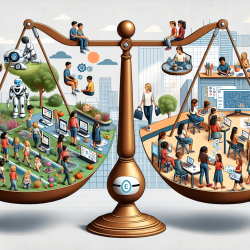
In theory, AI could reduce achievement gaps by providing high-quality, individualized support at scale and by helping less experienced educators improve faster.
But that outcome depends on real-world conditions, including:
- Whether under-resourced districts can afford education-specific tools (not just free general-purpose chatbots)
- Infrastructure and device access at school and at home
- Digital literacy and language accessibility (many tools are optimized for English)
Wellness and safety are rising concerns
The rapid rise of AI outside of school—including AI used as “social companions”—raises urgent questions about student safety, emotional wellbeing, and prosocial skill development. The review notes that causal research here is scarce, even though the stakes are high.
What this means for school leaders (and how TinyEYE thinks about it)
At TinyEYE, we support schools with online therapy services—work that depends on trust, student wellbeing, and evidence-informed practice. While this Stanford review is focused broadly on AI in K-12, it offers a useful decision lens that applies to any high-impact student service delivered through technology:
- Don’t confuse “better with the tool” with “better learning.” Ask how skills hold up when supports are removed.
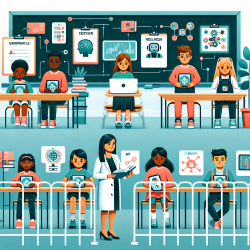
- Prioritize tools with guardrails. Look for scaffolding, step-by-step reasoning, and designs that build independence.
- Use AI to augment educators—not replace judgment. The best evidence supports efficiency and coaching, not full automation.
- Plan for equity and safety from day one. Access, privacy, and student wellness can’t be afterthoughts.
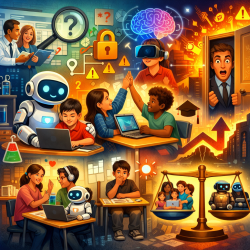
Most importantly, the review suggests a balanced stance: the evidence is limited, but it’s already pointing to patterns schools can act on—especially the importance of pedagogical design and the risk of over-reliance when AI makes tasks “too easy.”
For more information, please follow this link.