AI is everywhere in education right now—lesson planning, tutoring, writing support, feedback, and “personalized learning” promises. But the question school leaders keep asking is refreshingly practical: What do we actually know works?
A 2026 review from Stanford’s SCALE Initiative, The Evidence Base on AI in K-12: A 2026 Review (Fesler, Martinez, Agnew, Loeb), offers a helpful reality check. As of October 2025, their AI Hub for Education Research Repository contained over 800 papers related to AI in education. Yet only a small subset—20 studies—met the bar for strong causal evidence (the kind that can credibly estimate impact).
For districts, special education leaders, and student support teams (including those partnering with providers like TinyEYE for online therapy services), this matters. Decisions about AI tools are increasingly intertwined with staffing, student support, workload, and equity. If the evidence base is thin, implementation choices and guardrails become even more important.
What makes this review different (and why “causal” matters)
Not all research is equally useful for decision-making. The review emphasizes that causal studies—typically randomized controlled trials (RCTs) and strong quasi-experimental designs (QEDs)—provide the clearest signal of whether a tool changes outcomes.
Here’s the key constraint: the causal evidence is still limited, especially in U.S. K-12 settings for students. Much of the existing research:
- Focuses on learners over age 18 (postsecondary contexts)
- Occurs in international settings (which may not generalize cleanly to U.S. districts)
- Tests tools in constrained, short sessions (for example, one-time 20-minute experiments)
- Measures short-term outcomes more than durable learning, equity, or wellness
That doesn’t mean the evidence is useless—it means leaders should treat it as early signals, not final answers.
What the strongest studies suggest about students and AI
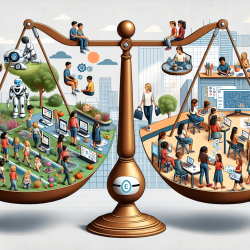
1) AI often boosts performance while students have access
Across the causal studies reviewed, AI tools frequently improve student performance during the activity when the tool is available—examples include math practice, programming tasks, and writing support.
This aligns with what many educators observe: AI can help students get unstuck, generate drafts, or receive feedback faster than traditional workflows allow.
2) The “transfer” problem: gains may fade when AI is removed
The review highlights a critical distinction between:
- Tool-supported performance (how well students do with AI help)
- Durable learning (what students can do independently later)
When students are assessed without AI access, results are mixed. Some studies show little to no improvement on closed-book or independent exams—even when practice performance improved with AI. In some cases, unrestricted access to general-purpose chatbots during learning was associated with worse unassisted outcomes later.
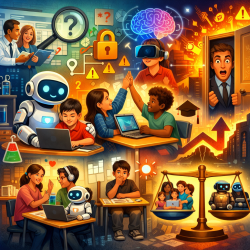
For school leaders, this is the “headline risk” to plan around: AI can make work easier in the moment, but easier doesn’t automatically mean better learning.
3) “Easier” can reduce productive struggle (and deeper thinking)
The review uses learning science concepts (like cognitive load theory and “desirable difficulties”) to explain why AI can be a double-edged sword. AI can reduce extraneous load (busywork like searching, organizing, or formatting), which can be helpful. But it can also reduce germane load—the productive mental effort that builds long-term understanding.
Some studies found that general-purpose chatbots reduced mental effort and improved student enjoyment, but also weakened reasoning quality, argumentation, or recall. In other words, students may feel better and move faster, yet learn less deeply.
4) Design matters: guardrails beat general-purpose tools
One of the most actionable findings is that pedagogical design features influence outcomes. Tools that provide step-by-step reasoning, hints, or scaffolding appear more promising than tools that simply give answers.
In several studies, tutoring-oriented chatbots (or guardrailed systems) performed better than general-purpose chatbots, especially when the tool nudged students to reason rather than copy.
For districts, this points to a practical procurement lens: evaluate whether a tool is built for learning (scaffolds, gradual release, feedback loops) versus built for convenience (instant solutions).
What the strongest studies suggest about educators and AI
1) Teachers can save time without lowering quality
On the educator side, the causal evidence is more directly relevant to K-12 settings, including studies in the U.S. One key pattern: AI can reduce time spent on lesson preparation and routine tasks without detectable decreases in quality (based on blind ratings in at least one study).
Time savings are not just a “nice to have.” In many districts, time is the scarcest resource—especially when teams are managing staffing shortages, compliance demands, and increasing student needs.
2) AI can help scale instructional expertise through feedback and diagnostics
Some studies show that AI tools can support educators and tutors with real-time suggestions, automated feedback, and diagnostic reporting—improving instructional quality and student outcomes.
Notably, AI supports may be especially beneficial for less experienced or lower-rated tutors, suggesting a potential lever for improving consistency of instructional support when expert coaching is limited.
3) Efficiency doesn’t have to mean “less human”—it can mean better focus
An important nuance in the review: even when AI doesn’t reduce total work hours, it may shift effort toward higher-value activities. For example, if routine feedback becomes faster, educators may reinvest time into more individualized conversations and coaching.
This is a useful framing for student support services too. When administrative load decreases, teams can redirect attention to relationship-based work—where humans are uniquely effective.
Equity and student wellness: the biggest unanswered questions
The review is direct: the causal literature has not yet meaningfully examined AI’s impacts on:
- Educational equity (who benefits most, who is left behind, and under what conditions)
- Student emotional and social development (including safety and wellness implications)
AI could reduce achievement gaps if high-quality, education-specific tools provide individualized support at scale—and if AI helps less experienced educators improve. But this depends on access: under-resourced districts may not be able to fund the best tools, potentially widening gaps.
Student wellness is even murkier. AI is increasingly used outside school, sometimes as a “social companion,” raising new questions about safety, prosocial development, and healthy boundaries—areas where evidence is still emerging.
What this means for school leaders (and how to act responsibly now)
Even with limited causal evidence, the review offers practical direction. If you’re making AI decisions today, consider these evidence-aligned moves:
- Separate “performance with AI” from “learning without AI.” Ask vendors how they measure transfer and independent mastery.
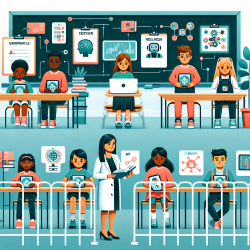
- Prefer tools with pedagogical guardrails. Look for hinting, step-by-step reasoning, and scaffolding over answer-generation.
- Design implementation around learning science. Build routines that preserve productive struggle (for example, require students to explain reasoning before checking AI output).
- Plan for equity up front. Consider device access, home access, language support, and staff training so benefits don’t concentrate among already-advantaged students.
- Don’t ignore wellness and safety. Establish clear policies for appropriate use, privacy, and boundaries—especially for tools students may use outside school.
- Use AI to protect educator time. The best-supported educator benefit in the evidence base is efficiency without quality loss—leverage that to reduce burnout and improve consistency of support.
For organizations like TinyEYE supporting schools with online therapy services, this evidence base reinforces a broader theme: technology is most powerful when it augments professionals rather than replacing the human elements that drive trust, motivation, and sustained growth. AI can help streamline preparation, documentation, and feedback workflows—but durable student outcomes still depend on thoughtful pedagogy, strong relationships, and well-designed supports.
For more information, please follow this link.