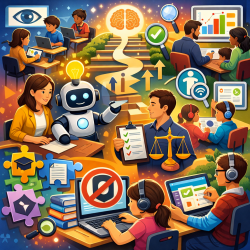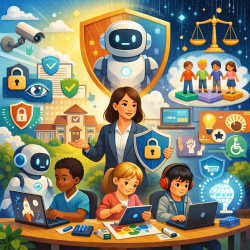

As school districts navigate staffing shortages, growing student needs, and rising expectations for instructional outcomes, artificial intelligence (AI) is quickly becoming part of the day-to-day reality of K-12 education. Whether it’s speech-to-text supports, translation tools, predictive text, or generative AI platforms that can draft and revise writing, AI is no longer “coming soon”—it is already embedded in many tools educators and students use.
From a special education leadership perspective, I’m seeing two truths at the same time: AI can expand access and improve efficiency, and AI can also introduce real risks if districts do not provide clear guidance, training, and safeguards. The Mississippi Department of Education’s “Artificial Intelligence Guidance for K-12 Classrooms” offers a practical framework that districts can use to promote benefits while mitigating risks. Below are key takeaways, translated into actionable considerations for district leaders, building administrators, and instructional teams.
What AI is (and why definitions matter)
AI refers to computer systems designed to mimic human tasks that require learning, problem solving, and pattern recognition. Many AI tools are powered by machine learning, which learns from large data sets (text, images, audio, video) to identify patterns and make predictions. Generative AI tools—often driven by large language models—can produce new content such as text and images based on a user’s prompt.
Why does this matter for schools? Because generative AI tools are not necessarily designed to be “truth engines.” They predict what response best matches the prompt. That distinction is essential when we talk about instruction, grading, IEP-related decision-making, and family communication.
AI in today’s classroom: It’s already here
Many common classroom tools already include AI features. Examples highlighted in the guidance include:
- Dictation (speech-to-text) and text-to-speech
- Grammar and spelling suggestions
- Live captions and translation tools
- Background noise reduction for audio/video
- Adaptive texts and assessments
- Predictive text
- Design suggestions in presentation software
- Real-time fluency trackers
For districts partnering with online therapy providers like TinyEYE, this is an important connection point: accessibility features and communication supports can be powerful complements to therapy services when they are used appropriately and aligned with student needs.
Opportunities vs. cautions: A balanced view districts can use
The guidance is clear that AI tools are not inherently “good” or “bad.” The purpose and intent behind use determines appropriateness. In practice, I encourage leadership teams to use a simple “opportunities and cautions” lens when evaluating tools and classroom use.
Opportunities
- Personalized learning experiences and support for mastery
- Tutoring-like assistance that helps students learn at a comfortable pace
- Basic accommodations (e.g., text-to-speech, translation), freeing educators to provide more intensive support
- Increased engagement, creativity, and discussion
- Improved productivity for teachers and students
- Brainstorming support for lesson planning
Cautions
- Inaccurate information and “confidently wrong” outputs
- Bias in training data and tool design
- Misalignment to standards, rigor, or grade-level expectations
- Cheating and plagiarism risks
- Overreliance that can reduce critical thinking and originality
- Potential for harmful or inappropriate content
- Copyright, licensing, and ownership concerns
- Data privacy and security risks depending on provider policies
One of the most important statements in the guidance is that AI is only as accurate as the data it processes. That has direct implications for instruction and for any use that touches student records or disability-related information.
Digital citizenship: The foundation for responsible AI use
Digital citizenship is positioned as the first and most essential component for appropriate AI use. It includes teaching students to be safe, kind, and responsible online, and to critically analyze resources and use them appropriately. Importantly, this is not a “one-and-done” lesson—it should be modeled and revisited whenever technology is used.
Practical digital citizenship expectations that districts can reinforce include:
- Following district acceptable use policies for AI tools
- Understanding academic integrity expectations and how they apply to AI
- Checking validity of AI-generated information and sources
- Citing sources, including AI tools when they contribute to work products
- Understanding that AI output quality depends on training data
- Using security practices such as spam filters and strong passwords
From a leadership standpoint, this is also where we can reduce conflict in parent meetings. When expectations are explicit and consistently taught, families are less likely to feel surprised by discipline decisions or grading outcomes connected to AI misuse.
Deterring cheating and plagiarism: Design matters more than detection
The guidance offers a strong reminder: before we can deter cheating, we must define what cheating looks like for each assignment and context. AI can provide “help” that ranges from acceptable brainstorming to inappropriate full-response generation. Districts should encourage teachers to clarify boundaries and communicate them to students and families.
Strategies emphasized include:
- Reiterating rules and expectations before assignments begin (and having students acknowledge them)
- Knowing students’ writing styles through frequent writing samples
- Requiring documentation of the writing process (drafts, reflections, or screen recording when appropriate)
- Using alternative assessments (hands-on projects, open-ended tasks, context-specific prompts)
- Reviewing version history in tools like Google Docs or Microsoft Word
- Using lock-down browsers when appropriate and available
- Entering prompts into AI tools to see what kinds of responses students could generate, then discussing accuracy and quality
The guidance also notes limitations of AI detection tools: they can be inaccurate, and they may falsely flag English learners or developing writers. Districts should be cautious about over-relying on detectors for high-stakes decisions and instead prioritize assignment design, process evidence, and instructional conversations.
Standards-aligned content and tools: Keep rigor and appropriateness front and center
AI can support lesson planning and resource curation, but the guidance emphasizes careful review for alignment, rigor, and grade-level appropriateness. AI may suggest activities that sound strong but do not truly meet the intent of a standard.
District leaders can support teachers by encouraging AI use for tasks such as:
- Deconstructing standards into subskills
- Identifying common misconceptions
- Generating lesson ideas that make content relevant to students
- Creating checklists for standards alignment during planning and observations
In special education, alignment matters doubly: we must ensure accommodations and scaffolds support access to grade-level standards without unintentionally reducing rigor or substituting the tool’s “work” for the student’s learning.
Active learning and engagement: Use AI to deepen thinking, not replace it
AI tools can increase engagement through debate, role-play, creative design, and multimedia supports. Students can interact with AI as a “character,” generate story elements, or create visuals to accompany writing. Administrators can support this by providing training, collaboration time, and a space for sharing best practices.
As a district practice, I recommend emphasizing AI uses that require students to explain reasoning, connect to classroom learning, and reflect on decisions—areas where authentic learning is visible.
Formative assessment and feedback: Faster insights, better next steps
Formative assessment and feedback are areas where AI can provide real-time support—practice questions aligned to skills, step-by-step problem help, or feedback on writing. Teachers can use AI-supported tools to identify patterns in student performance and target interventions.
However, districts should be clear: AI feedback is a support, not a substitute for professional judgment. Educators remain responsible for instructional decisions, grading practices, and ensuring feedback is appropriate and equitable.
Accessibility: A high-impact area for student success
Perhaps the most immediately beneficial application of AI in schools is accessibility. Tools such as speech-to-text, text-to-speech, translation, captions, and leveled explanations can reduce barriers for many learners. The guidance also stresses an important instructional principle: supports should be scaffolded appropriately, and reliance should be reduced over time when feasible to build student independence.
For districts facing therapist staffing shortages, accessibility tools can help students participate more fully between service sessions, but they should be implemented thoughtfully and aligned to IEP teams’ decisions. Technology can extend capacity, but it cannot replace the human element of teaching or related services.
Policy and training: The biggest risk is doing nothing
The guidance is direct: banning AI is often impractical, especially because AI features exist in many common platforms and students can access tools outside school. Doing nothing increases risk. Districts should instead focus on clear policy, tool evaluation, and ongoing training.
Key policy considerations include:
- Evaluating tools for instructional value, functionality, and technical safeguards
- Ensuring compliance with FERPA and COPPA through careful review of privacy policies
- Setting clear consequences for misuse while promoting appropriate uses
- Expanding digital citizenship instruction to explicitly include AI
- Monitoring use through observation and appropriate software tools
- Creating feedback loops with educators, students, and families to adjust policies and training
Training topics should include informed use, accuracy checks (including lateral reading and fact-checking), evaluating response quality, recognizing bias, understanding academic integrity, and designing learning activities that discourage misuse while still allowing productive, guided AI use.
Where TinyEYE fits in the conversation
TinyEYE’s work in online therapy services intersects with AI guidance in a practical way: districts need scalable, compliant solutions that protect student privacy, support accessibility, and maintain the human-centered services students require. As AI becomes more common, special education and related service leaders should ensure that any technology used alongside therapy services is aligned to district policy, confidentiality expectations, and IEP team decisions.
In my experience, the most successful districts treat AI as a governance issue and an instructional issue—not simply a technology issue. When we lead with clarity, training, and shared expectations, we reduce risk and increase the likelihood that AI tools truly support learning.
For more information, please follow this link.