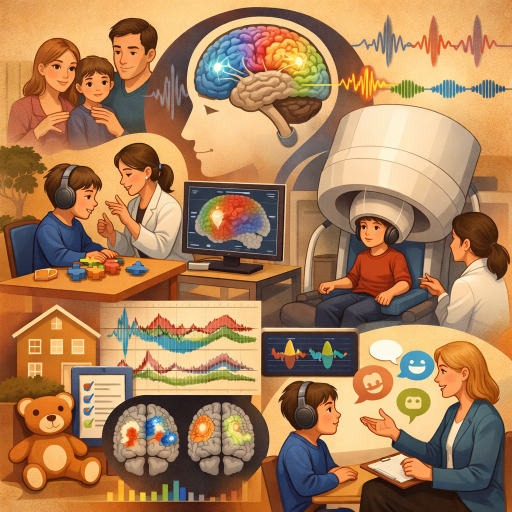
Why treating "language delay" as the target misses what's actually happening
When a child on the autism spectrum comes in with a language delay, the reflexive move is to write goals around vocabulary, syntax, or narrative structure — as if the language system itself is the broken part. A 2023 review of language in autism pushes back on that assumption. It asks directly whether language impairment in autism is a separate, co-occurring condition, a direct consequence of autism itself, or one point on a dimensional spectrum of neurodevelopmental traits, and concludes there is currently no agreed model of how language difficulties interact with autism's other features (Language in autism: domains, profiles and co-occurring conditions). That unresolved question matters for caseload planning: if language difficulty is downstream of something else — auditory processing, social communication, brain timing — then treating it as an isolated target might underperform treating the upstream system.
The four other studies below don't converge on a single upstream account, and it's worth saying that plainly. Study 2 itself states there is no current model connecting language difficulties to autism's other characteristics. Study 5 is about an environmental correlate and says nothing about auditory or timing mechanisms. Study 3 tests social communication, not audition. Only Study 1 explicitly advances an upstream auditory-processing hypothesis, and its authors present it as speculation, not a settled finding. What these studies do share is relevance to the same open question — each contributes one piece worth knowing, from a different population and method, and none of them, individually or combined, tested whether targeting these systems changes language outcomes.
The auditory clue: enhanced pitch perception isn't a deficit, but it may compete with speech-sound learning
A 2024 narrative review of auditory perception studies found consistent evidence that autistic children process nonlinguistic sound differently from neurotypical children — most notably, a higher prevalence of absolute pitch and enhanced pitch-discrimination ability (Enhanced sensitivity to pitch perception and its possible relation to language acquisition in autism). Importantly, this heightened pitch sensitivity tends to be found in autistic individuals with a history of language delay, which the authors read as a possible reciprocal relationship rather than coincidence.
Their proposed mechanism is a bias toward local-level auditory detail — the kind of fine-grained processing that makes absolute pitch possible. The authors speculate this heightened sensitivity to pitch differences may come at the cost of the normal development of perceiving the sounds that contribute most to early language development. Their framing is worth repeating precisely: this is a difference, not a deficit, and it can be an advantage in the right environment. The clinical implication is that some children may not be failing to hear speech sounds; they may be attending to acoustic information that isn't the information that drives typical language learning. That's a reasonable hypothesis-generating measure for intake assessment — a clinical inference this article is drawing from the review's speculation, not a diagnostic or predictive tool the review itself validated.
A candidate mechanism: brain rhythm ('oscillopathy') research on autism language deficits
Study 4 does not address pitch perception, absolute pitch, or auditory discrimination at all. It addresses language deficits in autism broadly, connecting them to brain oscillations — the rhythmic electrical activity the brain uses to parse and time incoming information (The Oscillopathic Nature of Language Deficits in Autism: From Genes to Language Evolution). The authors argue that language deficits in autism can be usefully understood as "oscillopathic" traits — disruptions in the brain's rhythmic timing mechanisms — rather than damage to a dedicated language module. They also note that candidate autism-risk genes are overrepresented among genes implicated in the evolution of language, including genes tied to brain rhythmicity specifically.
This article, not the paper's authors, is proposing a bridge between that idea and the pitch-perception finding above: if the timing scaffolding that parses speech into meaningful units is atypical, it's plausible that both pitch perception and higher-order language processing could be affected by the same root cause rather than being two unrelated problems that happen to co-occur. That bridge is speculative and belongs to this synthesis, not to the 2016 paper, which never mentions pitch perception. Treat the oscillopathy framing as one possible explanatory lens, not as evidence that pitch and language deficits share a demonstrated cause.
Social communication as an early predictor — except when it isn't
Early social communication skills are a common early-intervention target, and a 2023 longitudinal study gives a data-driven reason why — with an important wrinkle. The study followed 516 infants at high or low likelihood for autism based on family history, using a standardized social communication assessment at 12 and 24 months (Are early social communication skills a harbinger for language development in infants later diagnosed autistic?). Of the 516, 81 infants went on to meet criteria for autism. The sample was 84% White and drawn from families with an older sibling already diagnosed with autism — a high-familial-likelihood cohort, which is a different population than community-diagnosed autistic toddlers arriving on a caseload without that family history flag, so the pattern below may not generalize directly to every autistic client.
Across the full sample, infants with stronger social communication skills at 12 months had better language at 24 months — the expected pattern. Within the group later diagnosed autistic, 12-month social communication scores were already meaningfully lower than in both comparison groups — the scores did flag differences, and clinicians shouldn't read them as falsely reassuring. What was missing at 12 months was the association with later language: that coupling wasn't present until 24 months, when social communication became positively associated with subsequent language for the first time in that subgroup. In practice, a low 12-month social communication score in a high-familial-likelihood infant shouldn't be read either way as a forecast of later language outcome — the predictive relationship simply hadn't emerged yet at that age in this population.
Why one language profile doesn't fit all
The 2023 review on language domains in autism also lays out why a single intervention template is unlikely to serve an entire caseload. It identifies three broad profiles: verbal autistic individuals with no structural language impairment, verbal autistic individuals with structural language impairment, and minimally verbal autistic individuals. The review is explicit that this tripartite split still "hides enormous linguistic heterogeneity" — meaning even within one of these three buckets, presentations vary substantially.
Study 2's authors are explicit that they don't have a model explaining this heterogeneity; they call for future research designed to isolate specific linguistic and extralinguistic factors rather than offering a mechanism themselves. It's tempting to read the pitch-perception and oscillopathy material above as filling that gap, but that's an inference this article is drawing, not a conclusion Study 2 reaches or that the two literatures have been shown to connect empirically. What the heterogeneity finding supports on its own is narrower but still useful: a uniform intervention protocol is unlikely to serve an entire autism caseload well.
The environmental piece: shared reading frequency and language growth
Auditory processing and social communication are child-level variables. Shared reading is an environmental one, and a 2022 study gives clinicians a concrete, modifiable target to consider. Researchers followed 57 autistic toddlers (mean age 30.4 months at baseline, 43.8 months a year later) and a matched group of 31 non-autistic toddlers (Naturalistic parent–child reading frequency and language development in toddlers with and without autism). This is a single cohort study with a modest sample and parent-reported reading frequency rather than observed behavior, so the findings below are a solid first signal, not a settled dose-response relationship.
Two findings matter for practice. First, parents of autistic toddlers reported reading together significantly less often than parents of age-matched non-autistic children. The study's authors suggest this may reflect autism families facing more barriers to implementing shared reading; the study did not test, and does not rule out, whether preference also plays a role, so attributing the entire gap to access rather than preference is this article's summary of the authors' framing, not a tested finding. Second, within the autistic group, more frequent parent-child reading was associated with larger receptive and expressive language growth over the following year, even after controlling for maternal education, number of books in the home, and autism symptom severity.
Put together, this study suggests shared reading frequency is worth tracking as a modifiable environmental factor associated with language growth in autistic toddlers. It was a naturalistic, correlational, one-year follow-up — no reading intervention was delivered or tested — so this supports raising reading frequency with families as a plausible, low-cost target worth coaching toward, not a proven lever guaranteed to move outcomes if increased.
Connecting the dots
No single study here proves that autism language difficulty is fundamentally an auditory or social-communication problem in disguise. Each is a distinct piece of evidence, from a distinct population and method, and none should be quoted as if it settles the question. The pattern across them is suggestive: atypical pitch perception at the sound level (speculative, per Study 1), a theoretical brain-timing framework that this article — not Study 4's authors — connects to that pitch finding, a social-communication-to-language link that behaves differently on a delayed timeline within one high-familial-likelihood cohort, language profiles heterogeneous enough that Study 2's own authors say no explanatory model yet exists, and an environmental input, shared reading, that was associated with larger language growth over one year in one cohort of 57 toddlers.
This article's synthesis — not a conclusion any of the five papers draws — is that pitch/prosody perception and social communication are worth treating as plausible foundational targets rather than downstream symptoms to manage around a language-only plan. That's a hypothesis this evidence base makes reasonable to hold, not one it has tested. None of the five studies here tested assessment sequencing or treatment outcomes — none compared what happens clinically when auditory or social-communication targets are prioritized ahead of language-only goals. Everything in the practice section below is a defensible clinical rationale built from associational and theoretical evidence, not evidence of treatment efficacy.
What this means for practice
- Consider adding a pitch/prosody discrimination component to intake assessment for autistic clients with language delay. The 2024 review found enhanced pitch discrimination tends to co-occur with autistic individuals who have a history of language delay — treat this as a reasonable hypothesis-generating measure, not a validated diagnostic or prognostic tool; no study has tested whether screening for it changes assessment or treatment decisions.
- Don't assume a 12-month social communication score rules out later language risk in an infant with high familial likelihood for autism — the 2023 longitudinal study (an 84% White infant-sibling cohort) found the social-communication-to-language association only appeared at 24 months for the autistic subgroup. Also don't over-generalize this to your whole caseload: it's one study, in one specific high-risk population, and it did not test whether adjusting intervention timing changes outcomes.
- Expect — and plan for — at least three distinct language presentations on an autism caseload (no structural impairment, structural impairment, minimally verbal), per the 2023 profile review, and avoid applying one manualized protocol across all three.
- Use the oscillopathy hypothesis cautiously as a framework, not a diagnostic tool: Study 4 doesn't address pitch perception or auditory processing at all — the connection to the pitch-perception findings above is this article's proposed bridge, not the paper's own claim. It's theoretical, but it may offer a coherent rationale for why auditory-timing-based approaches (e.g., prosody-focused input, rhythm-based cueing) are worth considering as an adjunct, not a proven treatment.
- Screen shared reading frequency in every autism intake and treat low frequency as a modifiable target worth raising with families. The 2022 study (a single cohort of 57 autistic toddlers) found frequency was associated with language growth even controlling for maternal education and symptom severity, and found that parents in this sample reported reading together less often than matched peers — a difference the study's authors attribute partly to barriers, not proof of a fixed family trait or a population-wide default.