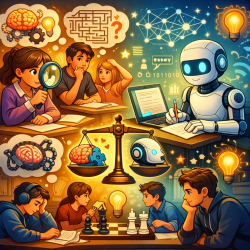
Generative artificial intelligence (GenAI) has moved from novelty to near-ubiquity in education. The OECD Digital Education Outlook 2026 synthesises a growing body of empirical research and expert insights to clarify a crucial point: GenAI can raise short-term performance, but it does not automatically improve learning. Whether it helps or harms depends on design, pedagogy, and governance.
For school leaders and student support teams—especially those working with constrained staffing and increasing service demands—this evidence matters. At TinyEYE, we provide online therapy services to schools, and we routinely see how digital tools can expand access while also introducing new risks (privacy, quality control, and overreliance). GenAI is no different: it can be a powerful assistant, but only when integrated with clear educational purpose and strong human oversight.
1) What GenAI is (and why “general-purpose” vs “educational” matters)
The OECD distinguishes between general-purpose GenAI tools (e.g., mainstream chatbots) and education-oriented GenAI tools (e.g., tutoring systems and teacher assistants designed with pedagogical goals). This distinction is not cosmetic. General-purpose tools are widely available—often free—and students can use them outside school without educator guidance. That reality forces schools to respond even if they do not “adopt” GenAI formally.
However, general-purpose GenAI also brings known limitations:
Hallucinations: plausible but incorrect outputs that require human scrutiny.
Inconsistent results over time: outputs can change due to probabilistic generation and system updates.
Cultural and linguistic bias: training data can skew toward dominant perspectives.
No true understanding: fluent language can mask shallow reasoning.
For schools, this means that “access” is not the same as “instructional value.” The OECD’s core message is that GenAI must be used with pedagogical intent—or redesigned as education-specific systems—if we want reliable learning benefits.
2) The performance–learning gap: why higher scores can hide weaker learning
One of the most important findings highlighted in the OECD report is the risk of confusing task performance with actual learning. Several studies show that students can produce better-looking work with GenAI, yet retain less knowledge or perform worse when the tool is removed.
A striking example comes from a field experiment in Türkiye: access to GPT-4 improved short-term practice performance substantially, but students performed worse on a closed-book exam once access was removed. This pattern aligns with what researchers describe as “cognitive offloading” or “metacognitive laziness”—students skipping the mental work that turns answers into understanding.
For school systems, this has direct implications:
If GenAI is used as a shortcut, it can undermine durable skill development.
Learning gains are more likely when GenAI is designed to scaffold thinking (e.g., tutoring modes that avoid giving direct answers).
Assessment and instruction may need redesign so that students demonstrate understanding, not just output quality.
3) Where the evidence is most promising: tutoring, feedback, and teacher support
3.1 Dialogue-based tutoring that supports thinking (not answer-giving)
The OECD notes that GenAI can enable more flexible, personalised tutoring than earlier rule-based systems—especially when it uses structured pedagogical approaches such as Socratic questioning. Early evidence is promising for configured tutoring systems that guide learners through reasoning rather than providing direct solutions.
For schools, this suggests a practical adoption principle: if you are exploring AI tutoring, prioritise tools that are explicitly designed to support learning processes (questioning, reflection, scaffolding), not just correctness.
3.2 Formative feedback at scale—best as a hybrid model
High-quality feedback is time-intensive, and GenAI can generate feedback quickly and in readable form. Research reviewed by the OECD suggests that GenAI feedback can sometimes match human feedback in measurable learning outcomes. Yet students often perceive human feedback as more credible and motivating.
The emerging consensus is a hybrid approach:
GenAI drafts feedback or identifies patterns.
Educators (and support professionals) review, contextualise, and take responsibility for final guidance.
This is especially relevant in student support services, where trust and relationship quality influence whether guidance is acted upon—an important parallel for online therapy contexts where rapport, ethics, and professional judgment are central.
3.3 Teacher productivity—without eroding autonomy
The OECD reports evidence of productivity gains for teachers (e.g., reduced lesson planning time). But it also warns that overreliance can erode professional skills and autonomy. The report calls for educational GenAI systems designed with teachers, enabling them to monitor student interactions and actively shape AI use.
From an implementation standpoint, schools should ask:
Does the tool preserve educator decision-making, or does it push automation by default?
Can staff see how students are using GenAI (interaction monitoring), not just the final product?
Are there settings to align outputs with curriculum, local policy, and age-appropriate practice?
4) Equity and access: GenAI can widen gaps unless designed to bridge them
The OECD highlights that GenAI uptake has been strongest in high-income countries and that adoption gaps risk widening existing digital divides. At the same time, GenAI may also help in low-infrastructure settings through approaches like small language models that can run offline, and through “AI Unplugged” designs that leverage intermittent connectivity.
For schools, equity planning should include:
Access: devices, connectivity, and assistive technology compatibility.
Capability: teacher training and student AI literacy (including critical evaluation of outputs).
Safeguards: privacy, bias mitigation, and age-appropriate use.
5) Governance and risk management: what schools should put in place now
The OECD is clear that realising GenAI’s benefits requires managing risks through sound policy frameworks and effective governance. For school systems, that typically means moving beyond informal experimentation to defined guardrails.
Key governance areas to prioritise include:
Data privacy and security: what data is entered into tools, where it is stored, and who can access it.
Academic integrity and assessment design: ensuring learning is measured, not just AI-assisted output.
Teacher autonomy: ensuring AI complements professional judgment rather than replacing it.
Transparency: clear communication to families and staff about what tools are used and why.
Evaluation: piloting with measurable outcomes (learning, engagement, workload, equity impacts).
For student support services and online therapy partners, alignment with these governance practices is essential—particularly around privacy, consent, and role clarity (what is automated vs what is delivered by qualified professionals).
6) Practical takeaways for school leaders and student support teams
Based on the OECD’s synthesis, a responsible GenAI strategy in schools can be summarised in six operational principles:
Design for learning, not shortcuts: prioritise tools and prompts that scaffold thinking.
Keep humans accountable: teachers and professionals remain responsible for decisions and feedback.
Prefer education-oriented systems when stakes are high (assessment, sensitive guidance, student supports).
Build AI literacy for staff and students, including critical evaluation and safe use.
Monitor equity impacts: ensure adoption does not privilege already-advantaged students.
Pilot, measure, iterate: treat GenAI adoption as a continuous improvement cycle, not a one-time purchase.
For more information, please follow this link.