In every school, there are students who are bright, curious, and full of ideas—but who still struggle to show what they know in traditional classroom tasks. That “mismatch” is often what educators notice first when a student may have a Specific Learning Disability (SLD).
SLD is sometimes called an “invisible handicap” because you can’t see it the way you might see a cast or a wheelchair. Yet it can affect a student’s day from the moment instructions are given to the moment work is handed in. The good news is that when schools understand how a student processes information, they can teach and assess in ways that are both supportive and academically meaningful.
This post summarizes key ideas from the New Brunswick Department of Education resource, Resource for the Identification and Teaching of Students with Specific Learning Disability (1999), and translates them into easy, practical takeaways for school teams.
What is a Specific Learning Disability (in plain language)?
Learning disabilities are a group of disorders linked to identifiable or inferred central nervous system dysfunction. They can show up as difficulties in areas like attention, memory, reasoning, coordination, communication, spelling, calculation, social competence, and emotional maturation.
One of the most important points: students with learning disabilities are typically of average or above-average intelligence. Many show a discrepancy between intellectual potential and academic achievement.
SLD is not primarily caused by:
- visual, hearing, motor, or cognitive impairments
- emotional disturbance
- environmental disadvantage
SLD can exist on its own or alongside other conditions (for example, Attention Deficit Disorder). Sometimes behavioural or emotional challenges develop secondarily after years of frustration—another reason early, accurate support matters.
“Fair” doesn’t mean “the same”
A standout message from the resource is this idea of fairness: students with SLD may not always be expected to express their knowledge in the same way as peers, even when they are learning the same curriculum concepts.
That means strong teaching and evaluation practices focus on:
- measuring knowledge, not endurance
- reducing barriers in the “output” (writing, timed work, copying)
- varying how information is presented and how students can respond
Why students struggle: a quick look at information processing
Many classroom tasks look simple on the surface—until you break down the steps. For example, “Write down the spelling words as I say them” requires a student to:
- filter out distractions (visual, auditory, tactile)
- pay attention and sustain focus
- perceive sounds accurately and in sequence
- access memory (what the word is, what it looks like)
- coordinate motor output (forming letters, spacing, line use)
When a student has a processing weakness in any part of that chain, the final product can look like “careless work,” “not trying,” or “not listening.” In reality, the student may be working much harder than it appears.
Common SLD deficit areas schools may see
The resource groups SLD-related difficulties into categories that are very useful for classroom planning:
- Attention deficit
- Auditory-processing deficit
- Visual-processing deficit
- Visual-spatial deficit (with or without motor difficulties)
- Written-expression deficit
- Language-processing deficit
- Mathematics deficit
- Organizational deficit
- Memory deficit
These categories help school teams move from “something’s wrong” to “here’s what the student needs to access learning.”
Assessment: think ongoing, multi-source, and practical
Assessment is described as an ongoing process of collecting data to evaluate performance and guide programming. Classroom teachers play a central role because they see the student’s learning in real time.
Useful assessment sources include:
- classroom observation
- work samples and portfolios
- journal entries or logs
- projects and interviews
- daily/weekly tests and criterion-referenced measures
- standardized tests (group or individual)
1) Observation: what to watch for
Observation is the first step. Teachers are encouraged to look for patterns such as:
- difficulty copying from the board or organizing work on the page
- slow work completion compared to peers
- difficulty following directions or understanding what was read
- high distractibility or difficulty sustaining attention
- memory patterns (e.g., learns today, forgets tomorrow)
- social cues being missed or misread (appearing overly dominant or overly passive)
2) Work samples: the “output” tells a story
Work samples can reveal specific processing needs. For example:
- Written language: brief responses, weak sentence structure, omitted words, punctuation/capitalization struggles
- Spelling: errors that don’t resemble the target word, especially with irregular patterns; limited carry-over from spelling lists to daily writing
- Math: trouble with facts, sequencing steps, lining up numbers, place value, operational signs, multi-step problems
- Visual-motor integration: inconsistent letter size/formation, slow copying, disorganized page layout
3) Informal reading tools that help teachers plan
The resource highlights tools like an Informal Reading Inventory (IRI) to find:
- Independent level (comfortable)
- Instructional level (learning with support)
- Frustration level (too difficult)
It also discusses graded word lists, running records, and miscue analysis to understand which cueing systems a student relies on and what breaks down during reading.
4) Formal assessment: when and why
Standardized tests of achievement and processing can add clarity, especially when diagnosis and formal planning are needed. The resource notes that standardized measures of intellectual functioning (such as the WISC) are typically part of confirming SLD, particularly to examine the discrepancy between potential and achievement.
Importantly, the document emphasizes that by the time formal testing occurs, schools should already be using meaningful educational programming and supports—not “waiting” for a label before helping.
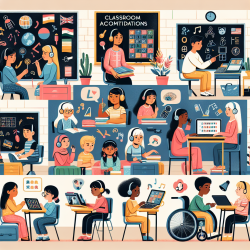
Classroom strategies and accommodations that make a real difference
Below are examples drawn from the resource’s strategy sections. The key theme is to reduce barriers while still teaching and evaluating curriculum knowledge.
Attention-related needs
- structured seating away from high-traffic areas
- one direction at a time, with checks for understanding
- movement breaks and activity-based lessons
- visual steps/examples for assignments
- shorter tests (same difficulty), extra time, quiet testing space
Auditory-processing needs
- provide written outlines for oral lessons
- slow, clear speech; emphasize key words and endings
- avoid “listen and write notes” at the same time
- taped texts/books and visual aids
- break tests into smaller parts; provide written directions
Visual-processing and visual-spatial needs
- reduce visual clutter on worksheets and test pages
- graph paper for math alignment
- highlight key ideas in reading
- sliding mask/ruler to track reading
- copied notes and extra time for visual tasks
Written-expression needs
- use story maps, outlines, and visual organizers
- allow oral responses, projects, or recorded answers when appropriate
- offer word processing and assistive tools
- provide a scribe when needed for assessment
- use test formats that reduce heavy writing demands
Math needs
- start with concrete manipulatives before symbolic work
- highlight operational signs and key words in word problems
- use color coding for operations and step cues (like “stop” markers)
- allow calculators/charts while still requiring the process to be shown
- avoid mixing too many concepts in one long test
Organization and memory needs
- consistent routines, clear lesson purposes, key words on the board
- agenda monitoring and color-coded materials
- chunk long assignments into smaller steps with check-ins
- mnemonics, visual organizers, and repeated practice
- provide examples/models on tests and assignments
Special Education Plans: the power of a shared roadmap
The New Brunswick Education Act defines a Special Education Plan as a program based on continuous assessment and evaluation, including specific objectives and recommended services.
For students with SLD, strong plans typically include:
- clear strengths and needs (including processing strengths/weaknesses)
- specific goals and short-term objectives
- classroom adaptations for presentation and evaluation
- roles and responsibilities across the team
- a method for monitoring progress and reporting
Collaboration is central—students, parents, teachers, resource staff, administrators, and specialists (which may include school psychologists and speech-language pathologists) all contribute to a plan that is realistic and supportive.
Parents’ role: essential partners, not “extra helpers”
Parents are often the first to notice signs: homework taking hours, avoidance, sadness, or anxiety about school. They also bring valuable information about early development and family history (learning disabilities can be genetic).
When parents are included as true partners, plans are more consistent and students are more likely to experience success across home and school environments.
Assistive technology and transition planning
The resource highlights assistive technology as a way to remove barriers and let students demonstrate their abilities. Examples include:
- word processing with spell check
- organizational software (e.g., visual outlining tools)
- portable keyboards or laptops for transferring work
- voice dictation tools (where appropriate)
- calculators and adapted input devices
Transition planning also matters. Supports should be in place before a student enters a new school setting to reduce frustration and anxiety, and documentation (plans, accommodations, assessment summaries) should follow the student in an organized way.
Where TinyEYE fits in
Supporting students with SLD works best when schools can act early, collaborate often, and match interventions to the student’s processing profile. TinyEYE partners with schools to deliver online therapy services that can support student needs as part of a broader, team-based plan—especially when access to specialists is limited or when consistency across schools is a challenge.
For more information, please follow this link.