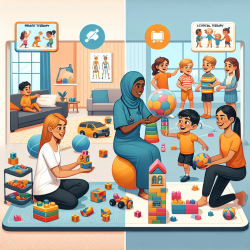
Play is not “just play.” For children, play is one of the most powerful ways to learn. Through play, kids practice new movements, try out language, handle big feelings, solve problems, and build friendships. When play skills are delayed or uneven, school can feel harder than it needs to be—because so much learning (especially in early years) is built on play-based routines.
Occupational therapy (OT) supports children in developing the skills they need to participate in everyday activities. In schools, that includes classroom routines, self-care, learning tasks, and yes—play. Play skills development in occupational therapy focuses on helping children engage in play that is meaningful, age-appropriate, and socially connected, while also supporting the underlying building blocks that make play possible.
At TinyEYE, we partner with schools to provide online therapy services, including OT support, so students can build these skills in ways that fit school schedules and real classroom needs.
What are “play skills”?
Play skills are the abilities children use to start, join, and sustain play—independently and with others. These skills change as children grow. A preschooler might practice pretend play and turn-taking. An older student might need help with cooperative games, flexible thinking, or handling winning and losing.
In OT, we often look at play skills in a few broad areas:
Motor play skills (moving, climbing, throwing, building, drawing)
Sensory processing (how a child responds to sound, touch, movement, and visual input during play)
Social play skills (sharing, turn-taking, reading cues, teamwork)
Cognitive play skills (problem-solving, planning, pretend play, rules)
Self-regulation (staying calm, shifting attention, coping with frustration)
Why play skills matter in school
Play is closely tied to school participation. When play is difficult, you may see challenges that look like “behavior” or “motivation,” but are actually skill gaps. For example:
A child avoids centers because manipulating small toys is hard.
A student “melts down” during games because losing feels overwhelming.
A child plays alone because joining peers requires complex social timing and language.
A student becomes silly or disruptive during group play because the sensory environment is too intense.
Strong play skills support classroom readiness, peer relationships, and confidence. They also create natural opportunities for language growth, executive functioning, and emotional development.
How occupational therapy supports play skills development
OT doesn’t simply “teach a game.” Occupational therapists look at what is getting in the way and then build skills through playful, motivating activities. Therapy is individualized and based on observation, collaboration with the school team, and student goals.
1) Building the motor foundation for play
Many play activities require strength, coordination, balance, and fine motor control. If those skills are hard, play can feel exhausting or frustrating.
Fine motor skills: grasp, pinch strength, hand separation, bilateral coordination (using both hands together)
Visual-motor skills: eye-hand coordination for puzzles, blocks, crafts, and ball play
Gross motor skills: core strength, balance, motor planning for playground games and movement play
OT strategies might include building with blocks, copying simple designs, using tongs or tweezers in games, or movement-based obstacle courses adapted to the child’s level.
2) Supporting sensory processing during play
Play spaces can be loud, busy, and unpredictable. Some children seek lots of movement and touch; others avoid it. Sensory differences can affect how a child participates with peers.
OT may help by:
Identifying sensory triggers (noise, crowding, messy materials, unexpected touch)
Teaching coping tools (breaks, breathing, asking for space, using headphones when appropriate)
Offering sensory-informed play choices (heavy work, movement breaks, calming routines)
The goal is not to force a child to tolerate everything, but to help them participate successfully and comfortably—while gradually expanding what feels manageable.
3) Growing social play skills
Social play is complex. It requires timing, communication, flexibility, and perspective-taking. OT can support social play by teaching clear, practical steps and practicing them in structured ways.
Entry skills: how to watch first, how to ask to join, what to do if the answer is “not right now”
Turn-taking: using visuals, scripts, or simple rules to make turns predictable
Cooperative play: building something together, sharing roles, negotiating
Sportsmanship: handling winning/losing, flexible thinking, coping with mistakes
For some students, it also helps to explicitly teach the “hidden rules” of play, such as staying near the group, matching the energy of the game, and noticing when peers change the plan.
4) Strengthening self-regulation through play
Play naturally brings up emotions: excitement, disappointment, impatience, and pride. OT uses play to practice regulation skills in real time.
Recognizing body signals (fast heart, tight hands, loud voice)
Using calming strategies (breathing, counting, squeezing a stress ball, movement breaks)
Practicing “pause and plan” when frustrated
Learning repair skills (apologizing, restarting, asking for help)
When regulation improves, play becomes more successful—and peer interactions often improve alongside it.
What play-based OT can look like (practical examples)
Play-based OT is purposeful, but it should still feel like play. Here are examples of activities that can target multiple skills at once:
Board and card games: turn-taking, attention, rule-following, coping with losing, fine motor (shuffling, dealing)
Pretend play: planning, sequencing, flexible thinking, language support, social roles
Construction play (LEGO, blocks): fine motor strength, visual-spatial skills, collaboration
Movement games (Simon Says, scavenger hunts): motor planning, impulse control, listening
Arts and crafts: grasp, bilateral coordination, persistence, following steps
Playground skills: climbing, swinging, ball play, joining group games safely
How schools and families can support play skills (simple, high-impact ideas)
Play skills grow fastest when adults create consistent opportunities to practice—without making play feel like a test.
Keep games short at first: start with 5–10 minutes and build stamina over time.
Use clear, predictable routines: “First we choose the game, then we review the rules, then we play, then we clean up.”
Teach one skill at a time: for example, focus on “waiting for my turn” before adding “coping with losing.”
Offer structured choices: “Do you want to play Uno or Connect Four?” helps reduce overwhelm.
Practice play scripts: simple phrases like “Can I play?” “What are the rules?” “My turn?” “Let’s try again.”
Celebrate effort and repair: praise trying again, asking for help, and returning to play after a mistake.
How online occupational therapy can support play skills at school
Online OT can be a strong fit for play skills development when sessions are designed with the school environment in mind. Therapists can coach students through interactive games, teach regulation tools, use visuals on screen, and collaborate with school staff to help skills carry over into recess, centers, and group work.
Online therapy can also support:
Consistent access to services when staffing is limited
Flexible scheduling within the school day
Collaboration with educators and support staff using shared strategies and goals
Key takeaways
Play is a core occupation of childhood and a major pathway for learning.
Play challenges often reflect underlying needs in motor skills, sensory processing, social communication, or self-regulation.
Occupational therapy supports play by building the foundation skills and teaching practical strategies for participation.
With the right supports, children can gain confidence, connect with peers, and enjoy play in ways that strengthen school success.
For more information, please follow this link.