The articulation-only default — and why these five studies keep contradicting it
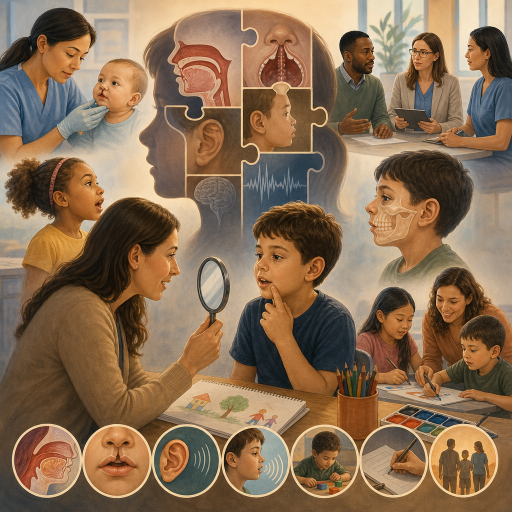
Most SSD referrals still start and often end with a sound inventory: which phonemes are in error, in what positions, and how severe. Five studies spanning cleft, syndromic, and non-syndromic developmental populations complicate that default, but not all in the same way or to the same degree. Four of them each identify something beyond the sound system itself — orofacial dysfunction and malocclusion, early motor and language history, phenotypic/orofacial severity, or co-occurring developmental phonological errors — that is statistically linked to how a child's speech sound disorder presents, persists, or travels with other difficulties. The fifth study tests a treatment-delivery model, not a co-occurring domain, and its design can't tell us what drives outcomes at all. The four substantive studies don't converge on one shared mechanism, and two of them independently land on the same factor — orofacial dysfunction — from very different populations. What they do agree on, each in its own narrower way, is that a phoneme-by-phoneme inventory doesn't capture what's going on with this child.
Structural cases: orofacial dysfunction and malocclusion aren't incidental
A 2022 study, Children and adolescents with speech sound disorders are more likely to have orofacial dysfunction and malocclusion, compared 61 children and adolescents with SSD (ages 6.0–16.7) to 44 peers with typical speech development (TSD). The SSD group had significantly poorer orofacial function — measured through an orofacial screening test plus bite force, jaw stability, chewing efficiency, and intraoral sensory-motor function — and a greater prevalence of malocclusion. Within the SSD group itself, poorer orofacial function was associated with a greater risk of malocclusion. The abstract's Background section describes children with SSD generally as a heterogeneous group that differs in underlying cause and severity — a statement about the population, not a description specific to this sample — and the abstract does not report this sample's recruitment source or any etiology exclusions. The authors' own conclusion is appropriately modest: this illustrates the importance of assessing coexisting orofacial characteristics in children with SSD and highlights the need for a multiprofessional approach. In a single 61-child clinic sample of unspecified etiology composition, that's a solid argument for adding orofacial screening to your own SSD intake — it isn't proof the finding generalizes to every SSD referral you'll see, but it's one more reason not to assume a "pure" articulation case without checking.
Syndromic cases: in Treacher Collins, speech severity tracks orofacial dysfunction — and so does age
A 2014 study, Associations between speech features and phenotypic severity in Treacher Collins syndrome (the TCS study), examined articulation, nasal resonance, voice, and intelligibility in 19 individuals with TCS across three age bands: children (n=4), adolescents (n=4), and adults (n=11). Children and adolescents had significantly higher speech composite scores (median 4, range 1–6) than adults (median 1, range 0–5), and speech composite scores correlated with both TCS phenotypic severity scores and Nordic Orofacial Test-Screening (NOT-S) total scores. Speech composite scores above 4 were associated with cleft palate specifically. With only 19 participants, this doesn't establish population prevalence, and the abstract does not report whether the severity correlation survives adjustment for age, so the two may be intertwined. What it does show, in the authors' own words, is that speech was significantly correlated with phenotypic severity of TCS and orofacial dysfunction, and their conclusion keeps both factors in play: follow-up and treatment of speech should still be focused on young patients, but some adults with TCS seem to require continuing speech and language pathology services. Three of the eleven adults in this sample still had multiple speech aberrations. The practical takeaway isn't that age should be ignored in favor of severity scores — age remained the dominant pattern here — it's that a subset of adults with TCS shouldn't be assumed to have aged out of needing SLP involvement just because most patients do.
Developmental cases: motor and language markers predict who doesn't outgrow SSD
A 2016 population cohort study, Prevalence and Predictors of Persistent Speech Sound Disorder at Eight Years Old, used data from the Avon Longitudinal Study of Parents and Children (the ALSPAC cohort) to identify predictors of persistent SSD at age 8, after excluding children with only common residual distortion errors. Estimated prevalence of persistent SSD was 3.6%. Early predictors included weak sucking at 4 weeks, not often combining words at 24 months, limited use of word morphology at 38 months, and being unintelligible to strangers at 38 months. School-age predictors included maternal report of difficulty pronouncing sounds and hearing impairment at age 7, tympanostomy tube insertion at any age up to 8 years, and a history of suspected coordination problems. The authors conclude that motor, cognitive, and linguistic processes — not sound errors in isolation — place a child at risk for persistence. These are population-level predictors from multivariable logistic regression in a birth cohort, not a validated individual-level clinical prediction tool, so they shouldn't be treated as a diagnostic checklist on their own. But they are a more rigorously tested basis for intake questions than most case-history templates in routine use: an early feeding history and a coordination/motor milestone history are worth asking about specifically, not collecting as background color.
Cleft-specific language risk: combined error profiles, not cleft characteristics alone, are associated with language trouble
A 2025 study, Rethinking speech sound disorder (SSD) in non-syndromic cleft lip and palate (the 2025 non-syndromic CP±L study), assessed speech (DEAP) and language (CELF-5 UK) in 95 children aged 5–8 with non-syndromic cleft lip and/or palate, excluding syndromic diagnoses, global learning disability, sensorineural hearing loss, and non-English first language. This is a cross-sectional, observational study, so it identifies associations at a single time point rather than predicting future outcomes. Four distinct speech profiles emerged: typical speech, cleft speech characteristics (CSC) only, developmental speech characteristics (DSC), and combined CSC+DSC. Language scores were lower for children with DSC (with or without CSC), and there was a significant association between the combined CSC+DSC profile and expressive language outcomes, with an odds ratio of 10.82 (95% CI 2.42–48.32, p=0.002). Cleft speech characteristics alone were not associated with the same language risk — it was the presence of developmental phonological errors layered on top of cleft-typical errors that was associated with lower expressive language scores. The authors' direct recommendation: clinicians should be alert to the need for additional language assessment specifically for children presenting with delayed phonological processes, given implications for educational attainment.
The one study that can't answer the team-composition question
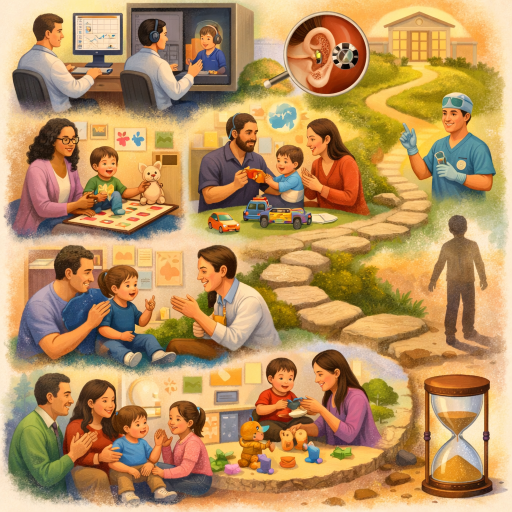
A 2024 study, Speech Task Force and Quality of Life after Surgery in Children with Cleft Lip and Palate (the GSLP/SSLP tiered-care study), tested a tiered care model in 15 children with cleft palate with or without cleft lip: a general speech-language pathologist (GSLP) delivering five 30-minute sessions combined with a specialist SLP (SSLP) delivering an intensive 3-day speech camp plus follow-up camps. Post-treatment, articulation errors dropped significantly at word, sentence, and screening levels, and quality of life improved, measured with the WHOQOL-BREF-Thai. With only 15 children enrolled, and no arm testing the GSLP alone, the SSLP alone, or a single continuous-care model against the tiered structure, the study can't isolate whether the combined-discipline structure, the added intensity, or the camp format drove the improvement. Nothing here disagrees with the other four studies — it simply doesn't test a co-occurring domain (orofacial, motor, or language) at all, so it has nothing to add to the question of what else to screen for. Read it as evidence that combined-intensity care can produce measurable gains in this population, not as proof that team composition itself, independent of dosage, is the active ingredient.
Reading the pattern across etiologies
Put side by side: a heterogeneous SSD clinic sample links orofacial dysfunction and malocclusion to group membership; a rare craniofacial syndrome links speech severity to phenotypic and orofacial severity scores, confounded with age; a general-population birth cohort links early motor and language markers to which children still have SSD at age 8; and a cleft-specific cohort links a combined phonological error profile to expressive language difficulty. That's four different outcome variables — group membership, severity, persistence, and language status — not one shared finding dressed up four ways, and two of the four (the orofacial dysfunction and malocclusion study and the TCS study) converge on the same underlying construct, orofacial dysfunction — though only the TCS study names its screening instrument (the NOT-S); the orofacial dysfunction and malocclusion study's abstract does not name its screening test, so the tool-level overlap can't be confirmed. The fifth study, the GSLP/SSLP tiered-care study, sits outside this pattern altogether: it's a 15-child single-arm treatment study that doesn't test any co-occurring domain and reaches no conclusion about multi-domain assessment, so it isn't part of the "convergence" and shouldn't be counted as another vote for it. What's left after removing that fifth study is still worth naming carefully: in each of these populations, a different co-occurring domain — structural, motor, or linguistic — proved relevant, and in each case it was something a phoneme inventory alone wouldn't have surfaced.
What this means for your assessment protocol
None of these five studies prescribe a screening checklist — that's a clinical decision your team makes using standard guidance. For context, ASHA's Speech Sound Disorders practice portal already directs clinicians toward an orofacial examination and oral motor screening alongside phonological screening, and states that language testing is included in a comprehensive speech sound assessment because of the high incidence of co-occurring language problems. Building on the specific measures and predictor variables each study identified, consider these referral triggers as part of intake, not as an afterthought:
- Poor results on an orofacial screening test — weak bite force, jaw instability, or reduced chewing efficiency — on oral-motor exam → dental/orthodontic referral, consistent with the orofacial dysfunction–malocclusion association found in the orofacial dysfunction and malocclusion study.
- Case history positive for weak sucking at 4 weeks, not often combining words by 24 months, limited use of word morphology at 38 months, or being unintelligible to strangers at 38 months → treat these as documented persistence-risk markers from the ALSPAC cohort, not routine background history.
- School-age case history showing a parent-reported history of suspected coordination problems, difficulty pronouncing certain sounds, hearing impairment at age 7, or tympanostomy tube insertion at any age up to 8 years → same ALSPAC predictor set; consider a coordination/motor screen alongside continued monitoring.
- Non-syndromic cleft lip and/or palate with speech errors that mix cleft speech characteristics (CSC) with developmental, non-structural error patterns (a combined CSC+DSC profile) → full expressive language evaluation, per the 2025 non-syndromic CP±L study's finding (OR 10.82, 95% CI 2.42–48.32).
- Treacher Collins syndrome diagnosis with ongoing speech concerns, at any age → don't assume the case is closed at a standard discharge age. The TCS study (19 participants, 11 of them adults) found a subgroup of adults with multiple persisting speech deviations, so continued monitoring tied to phenotypic and orofacial severity markers, not chronological age alone, is warranted for at least some patients with TCS specifically; extending this caution to other craniofacial syndromes is a reasonable clinical inference, not something this study tested.
- Persistent unintelligibility to unfamiliar listeners past 38 months, or limited morphology use, in a child otherwise progressing → flag for closer monitoring as a persistence risk rather than assuming the pattern is an age-typical residual distortion that will resolve on its own.
What this means for caseload and referral practice in schools and telepractice settings
School-based and teletherapy caseloads rarely come with a craniofacial team or an on-site occupational therapist down the hall, which is exactly why the referral triggers above need to be built into intake paperwork rather than left to clinical instinct under a large caseload. If your case history form doesn't currently ask about early feeding and sucking, word-combination and morphology milestones, or a history of coordination problems, the ALSPAC predictors above are a concrete reason to add those questions before the first session rather than after a year of plateaued articulation therapy. If your intake doesn't include an orofacial/oral-motor screen for every SSD referral — not just the ones with a visible craniofacial diagnosis — that's consistent with ASHA's Speech Sound Disorders practice portal, which already directs clinicians toward an orofacial exam and oral-motor screening as part of routine assessment; the orofacial dysfunction and malocclusion study adds a concrete reason why, in the one clinic sample it studied, that screening surfaced a real association worth checking for.
In telepractice specifically, the oral-motor and orofacial components are arguably the pieces most at risk of being skipped, since they're plausibly harder to screen well over video than an auditory speech sample is — that's a reasonable hypothesis to test against your own remote-evaluation data, not an established finding from these five studies. That's an argument for building a standard camera-positioning and oral-motor observation routine into every initial SSD evaluation done remotely, and for having a clear, fast pathway to loop in a school-based OT, a family's dentist or orthodontist, or a language evaluation — rather than treating those as separate referrals to be made only if articulation therapy stalls. For students with a craniofacial syndrome or non-syndromic cleft history on file, don't let a standard discharge age or a fixed number of therapy blocks close the case automatically; flag those files for a phenotypic/language recheck at transition points (kindergarten entry, upper elementary, middle school) — concretely, a DEAP-style speech-profile split (checking for combined cleft-plus-developmental error patterns) paired with a CELF-type expressive language check for cleft cases, and an orofacial screen along NOT-S-type lines for craniofacial-syndrome cases — rather than relying on chronological age or a generic progress-monitoring cadence. None of this requires a new assessment battery — it requires treating the co-occurring domains these five studies point to as routine parts of an SSD referral, the same way an audiological screen already is.