Why “intensive intervention” matters so much in the early years
In early childhood settings (birth through age 8), growth can be rapid—and so can frustration when supports don’t match a child’s needs. For young children with high-intensity support needs (for example, complex communication needs, autism, developmental disabilities, multiple disabilities, or significant social-emotional and behavioral needs), “more of the same” often isn’t enough. They may need instruction that is more individualized, more intentional, and more consistently adjusted based on real evidence of what is (and isn’t) working.
A 2024 article in the Journal of Special Education Preparation takes on a key challenge in the field: we have strong early childhood standards and recommended practices, but we still need clearer guidance on how to intensify intervention for young learners in ways that are developmentally appropriate, culturally responsive, and practical for educators to use.
At TinyEYE, we partner with schools through online therapy services, and we see this same need from another angle: teams want to do the right thing, but they need shared language, strong routines, and data that actually helps them make decisions. This post breaks down the article’s key ideas into a simple, school-friendly guide.
The big idea: intensify support using data, not guesswork
The article highlights a gap between what standards encourage (like data-based decision-making) and what often happens in real classrooms (limited time, limited training, limited data confidence). Many educators report that data use isn’t commonplace, and that data literacy training is often missing in preparation programs.
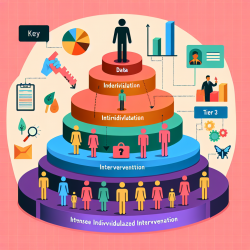
That matters because intensive intervention is not just “more minutes.” It’s a structured process—often described as data-based individualization (DBI)—where teams:
- Start with evidence-based practices
- Monitor the child’s response frequently
- Make systematic adjustments when progress isn’t strong enough
- Keep going until the child reaches meaningful outcomes
In K–12 settings, the National Center for Intensive Intervention (NCII) offers a well-known taxonomy for intensifying interventions. The authors argue we can adapt that approach for early childhood, but we must align it with what makes early learning unique: natural routines, play-based learning, family partnerships, and developmentally appropriate practice (DAP).
Start with the foundation: strengths-based and culturally sustaining practice
Before getting into tactics, the article emphasizes something essential: intensive intervention should be grounded in a strengths-based, culturally responsive, and culturally sustaining approach.
In plain terms, that means:
- We don’t define children by deficits; we use strengths as “levers” for growth.
- We treat family knowledge, language, identity, and lived experience as central—not extra.
- We examine our own assumptions and build practices that sustain (not suppress) a child’s cultural and linguistic expression.
This matters for school teams because intensification can accidentally become “more compliance” if it isn’t anchored in belonging, dignity, and meaningful goals. The authors even note that some traditional language (like “dosage”) can reflect deficit-oriented systems, and they adapt terms to better fit early childhood practice.
The 7 competencies: a practical checklist for supporting high-intensity needs
The heart of the article is a set of seven “intensification competencies” proposed for pre-service preparation—especially aligned to DEC (Division for Early Childhood) Standard 6, which focuses on responsive and reciprocal interactions, interventions, and instruction.
Even if you’re not designing a university program, these competencies are highly useful for school teams. Think of them as a shared roadmap for how to intensify support for one child in a way that is observable, coachable, and measurable.
1) Intervention strength: choose strategies that are likely to work
Teams evaluate and select interventions from evidence-based practices that are socially valid and likely to be effective for the child. In early childhood, that often means selecting and combining specific practices (like visual supports, prompting strategies, or natural reinforcement) rather than relying only on packaged programs.
A key takeaway: evidence matters, but so do child and family priorities. Strong intervention is both research-informed and person-centered.
2) Frequency of instructional sequence (dosage): build more learning moments into real routines
For young children, “dosage” is often best increased by embedding more opportunities to respond (OTRs) throughout natural routines—snack, centers, transitions, play, circle, recess—rather than only adding separate intervention blocks.
The authors also highlight two details that are easy to overlook:
- Wait time: children may need extra processing time to respond successfully.
- Feedback: responses should be met with clear, positive, and meaningful feedback.
3) Alignment with DAP: set goals that fit early development
Instead of forcing early childhood goals into a K–12 “grade-level standards” mindset, this competency emphasizes developmentally appropriate practice. Goals should focus on needed skills, build on the child’s funds of knowledge, and be created with the family.
This is especially relevant when teams are deciding what to target first: communication, participation, play, peer interaction, self-regulation, early literacy foundations, or adaptive skills.
4) Attention to transfer: plan for generalization from day one
In early childhood, skills must show up in real life—not just during a therapy session or a single activity. This competency focuses on creating meaningful learning opportunities in natural environments so the child can use skills across people, places, and routines.
For school teams, this is the difference between “the child can do it with the specialist” and “the child can do it with peers, during play, in the classroom.”
5) Comprehensiveness: use systematic instruction plus environmental supports
Comprehensiveness means using a mix of effective instructional strategies and supports—such as explicit instruction principles, errorless learning, modeling, prompting and fading, and environmental adjustments—embedded into everyday activities.
This is a helpful reminder: intensifying intervention isn’t only about the child trying harder. It’s also about adults designing the environment so access and engagement increase.
6) Behavioral support: teach social-emotional and communication skills together
The NCII taxonomy stresses that behavioral supports should be considered alongside academic supports for a stronger combined effect. In early childhood, this is especially critical because communication, behavior, and social-emotional development are tightly linked.
This competency focuses on assessing, developing, and implementing developmentally appropriate behavioral and social-emotional supports across routines—while centering cultural and linguistic identity as part of justice and equity.
7) Individualization: use a data-based process to adjust over time
This is the “engine” of DBI: collect sensitive, frequent data and use it to make decisions. The article emphasizes that for children with significant support needs, teams may need more frequent monitoring (daily or weekly) rather than waiting for quarterly checkpoints.
The authors describe practical expectations like using different sampling methods and analyzing time-series graphs—so decisions are based on patterns, not impressions.
What this means for schools (and how online therapy can help)
These competencies were designed for pre-service preparation, but they translate well into school-based practice because they are concrete. Here are a few ways school teams can apply the framework immediately:
- Use one shared plan across the team: align teacher, paraprofessional, therapist, and family supports around the same goals and routines.
- Embed instruction: increase opportunities to respond during natural routines instead of relying only on pull-out time.
- Track a small set of meaningful data: choose measures that are feasible and sensitive to change (especially for communication, participation, and social-emotional skills).
- Adjust intentionally: when progress stalls, change one dimension at a time (e.g., increase OTRs, add wait time, change prompts, adjust reinforcement, modify the environment).
For TinyEYE’s school partners, online therapy can support this kind of work by helping teams:
- Select evidence-based strategies that fit the child and the classroom context
- Co-design goals with educators and families
- Build routine-based intervention plans that are realistic for staff
- Create simple progress-monitoring systems that inform next steps
- Coach implementation so strategies show up consistently across the week
A final takeaway: intensification should feel doable, not overwhelming
The most encouraging message in the article is that intensive intervention isn’t a mysterious “extra program.” It’s a set of teachable, observable skills grounded in what early childhood already values: relationships, routines, family partnership, and developmentally appropriate learning.
When teams combine that early childhood foundation with structured data-based individualization, they’re better equipped to support young children with high-intensity needs in inclusive, equitable, and joyful ways.
For more information, please follow this link.