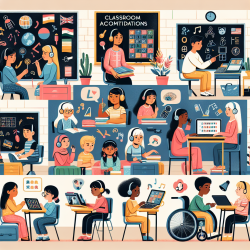

In schools, we often meet students who are bright, curious, and full of ideas, yet they struggle with reading, writing, math, attention, organization, or memory in ways that don’t “match” their overall ability. This is where the concept of a Specific Learning Disability (SLD) becomes so important.
As a Special Education Director, I’ve learned through conferences, publications, and webinars that the most effective teams do two things well: they identify a student’s learning pattern accurately, and they respond with practical teaching and fair evaluation. That word “fair” matters. As Richard Lavoie reminds us, fairness is not everyone getting the same thing; it’s everyone getting what they need.
This post pulls key insights from a New Brunswick Department of Education resource on identifying and teaching students with Specific Learning Disability and translates them into school-friendly takeaways. I’ll also share how online therapy partners like TinyEYE can support schools—especially when staffing shortages make it difficult to deliver consistent services.
What is a Specific Learning Disability (SLD)?
Learning disabilities are generally understood as a group of disorders related to how the brain processes information. Students with SLD are often of average or above-average intelligence, but may show a noticeable gap between their intellectual potential and academic achievement.
Importantly, SLD is not primarily caused by:
- Sensory impairment (vision/hearing)
- Physical challenges
- Developmental delay
- Emotional disturbance
- Environmental disadvantage
That said, SLD can co-exist with other conditions (such as Attention Deficit Disorder), and students may develop secondary issues like anxiety, low self-esteem, or avoidance behaviors if their needs aren’t recognized early.
Why “processing” matters more than we think
When we ask a student to do something simple—like write spelling words—there’s a lot going on under the surface. The student must manage attention (filtering distractions), accurately perceive visual and auditory input, access memory, organize the information, and produce a motor response (writing). If any part of that chain breaks down, the final “output” can look like the student wasn’t listening or didn’t try.
This is why learning disabilities are often called an “invisible handicap.” Without the right lens, adults may misinterpret a processing difficulty as laziness or lack of motivation.
Common areas of difficulty (and what they can look like)
The resource organizes SLD patterns into specific deficit areas. In real classrooms, students may show one primary area of need or a combination.
- Attention deficit: difficulty filtering distractions, sustaining focus, following through on instructions
- Auditory-processing deficit: trouble interpreting spoken information, following oral directions, remembering what was heard
- Visual-processing deficit: difficulty interpreting visual information, copying accurately, tracking print, silent reading comprehension
- Visual-spatial deficit: spacing, organization on paper, mapping/graphing, place value alignment, depth/measurement concepts
- Written-expression deficit: getting ideas onto paper in a structured way, spelling, mechanics, dysgraphia/agraphia
- Language-processing deficit: vocabulary, grammar, sequencing, main idea, comprehension, word retrieval
- Mathematics deficit: number sense, facts, procedures, choosing the right operation, multi-step problems
- Organizational deficit: planning, monitoring, managing materials/time, task initiation
- Memory deficit: retaining and recalling information over time, remembering sequences, retrieving facts quickly
Assessment: a practical, school-based pathway
Assessment is not a one-time event. It’s an ongoing process of collecting data to understand how a student learns and what supports are needed.
1) Start with classroom observation
Teachers are in the best position to notice patterns over time. Watch for consistent indicators such as:
- Difficulty copying from the board
- Slow, effortful writing or unusual spacing/letter formation
- Difficulty following directions (especially multi-step directions)
- Inattention that looks like “tuning out,” particularly in noisy settings
- Strong oral ideas but minimal written output
- Frequent forgetting of previously taught concepts
2) Review work samples
Work samples help us see how processing difficulties show up in output. Look at writing mechanics, spelling patterns (omissions/substitutions/reversals), math alignment, and whether errors are consistent.
3) Use informal tools strategically
Informal reading inventories (IRIs), graded word lists, running records, and miscue analysis can provide valuable diagnostic clues. For example, if a student relies heavily on visual guessing and lacks efficient decoding strategies, the error pattern will often show it.
4) Consider formal/standardized assessment when warranted
Standardized achievement tests can clarify skill gaps in reading decoding, comprehension, math, and written language. Standardized processing measures and (when appropriate) intellectual assessment can help confirm the discrepancy between potential and achievement that is often part of SLD identification.
From a compliance standpoint, schools should ensure assessments are completed by qualified professionals and interpreted within a team process—not in isolation.
Teaching strategies and “fair” evaluation: what helps right away
One of the most helpful messages in the resource is this: we can often circumvent a processing weakness by teaching through a student’s strengths, while still providing explicit intervention where needed (especially in early years).
High-impact classroom supports (across many SLD profiles)
- Give one direction at a time and check for understanding
- Provide written directions to support verbal directions
- Reduce visual clutter on worksheets and tests
- Adjust test length (measure knowledge, not endurance)
- Allow extra time and planned breaks
- Offer alternative ways to show learning (oral responses, projects, visuals)
- Use outlines, graphic organizers, and models of finished work
- Provide copied notes or allow audio access to content
- Use frequent shorter checks for understanding rather than one long test
Examples by need area
- Attention: structured seating, movement breaks, clear routines, calm redirection signals
- Auditory processing: slower speech, key words emphasized, avoid “listen and write” at the same time, provide notes
- Visual processing: masking tools for reading, highlighted main ideas, fewer items per page, oral testing when appropriate
- Written expression: word processor, scribe, point-form answers, reduced copying demands, explicit writing organizers
- Math: manipulatives before symbols, color coding operations, reference sheets, graph paper, calculator with process shown
- Organization: agenda monitoring, chunking assignments, checklists, color-coded binders, home-school communication loops
Special Education Plans: make them actionable
A Special Education Plan should be more than a document—it should be a working agreement. The resource emphasizes collaborative planning that includes:
- Strengths and talents (not just deficits)
- Specific objectives tied to agreed-upon goals
- Adaptations to instruction, materials, and evaluation
- Who is responsible for what (roles across team members)
- How progress will be monitored and reported
In practice, the best plans are clear enough that a new teacher can pick them up and implement supports immediately—especially during transitions between schools or grade levels.
Parents’ role: essential and ongoing
Parents are often the first to notice that homework takes hours, that a child avoids certain tasks, or that school anxiety is increasing. They also bring developmental history and family history that can inform the team’s understanding.
Schools can support families by:
- Inviting meaningful input (not just attendance) in planning meetings
- Sharing strategies that can be reinforced at home
- Communicating in accessible language (and adjusting if a parent may also have learning difficulties)
- Connecting families to community resources when needed
Assistive technology and online therapy: practical support when staffing is tight
Assistive technology can remove barriers so students can demonstrate what they know. Tools may include word prediction, speech-to-text, text-to-speech, graphic organizer software, calculators, and alternative access devices.
This is also where online therapy services can be a strong support for districts. When schools face SLP, OT, or mental health staffing shortages, service gaps can delay assessment, intervention, and progress monitoring. TinyEYE’s online therapy model can help districts:
- Maintain service continuity when in-person hiring is difficult
- Provide therapy that aligns with school schedules and IEP/SEP goals
- Support collaboration with educators and families through virtual meetings
- Increase access for rural or hard-to-staff schools
From a leadership and compliance perspective, consistency matters. When related services are reliably delivered, teams can make better decisions based on real progress data rather than missed sessions.
Transition planning: don’t leave it to chance
Transitions (elementary to middle, middle to high school) can trigger anxiety and setbacks if supports aren’t in place on day one. The resource emphasizes that it is not the parent’s job to educate the new school team. Records, accommodation lists, and plans should transfer smoothly, and receiving staff should be briefed proactively.
For more information, please follow this link.