Playground Avoidance Is Information, Not a Character Flaw
If you’ve ever watched your child hang back while other kids climb, swing, and slide, you’re not alone. Many families wonder, “Why does my child avoid playground equipment?” It can feel confusing—especially if your child enjoys running around at home or seems fearless in other settings.
In school-based therapy, we often view playground behavior as communication. Avoidance is frequently a sign that something about the equipment, the environment, or the social expectations feels too hard, too unpredictable, or too uncomfortable. The good news is that once you understand the “why,” you can support your child with practical steps that build skills and confidence over time.
Common Reasons Children Avoid Playground Equipment
1) Sensory Processing Differences
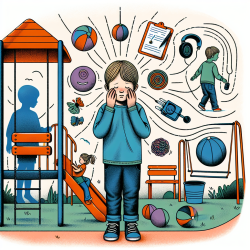
Playgrounds are sensory-rich environments: movement, noise, bright sunlight, crowds, and unpredictable touches from other kids. For some children, that’s exciting. For others, it’s overwhelming.
Movement sensitivity (vestibular): Swings, spinning, climbing, and going down slides can trigger dizziness, nausea, or fear. A child may avoid anything that makes their head move quickly or changes their body position.
Body awareness challenges (proprioception): Some children have difficulty sensing where their body is in space. Climbing a ladder or balancing on a beam can feel unsafe because their body doesn’t “map” the movement automatically.
Tactile sensitivity: Hot metal, rough ropes, sandy surfaces, or sticky textures can be genuinely uncomfortable. Even the feel of rubber mulch or the grit on hands can be a dealbreaker.
Sound and visual overload: A busy playground can be loud and visually chaotic, making it hard to focus on navigating equipment safely.
2) Gross Motor Skill Delays or Low Muscle Tone
Playground equipment demands strength, endurance, balance, and coordination. If these skills are still developing, your child may avoid equipment to prevent embarrassment or because it simply feels exhausting.
Low muscle tone can make climbing and hanging difficult and tiring.
Balance challenges may show up as fear of bridges, stepping stones, or wobbly surfaces.
Coordination difficulties can make ladders, monkey bars, and even stepping up onto platforms feel risky.
3) Motor Planning (Praxis) Difficulties
Motor planning is the ability to figure out how to move your body through a new task. Many playground activities require multi-step planning: step up, hold on, shift weight, reach, pull, and stabilize.
If motor planning is hard, your child might:
Watch other kids but not join in
Start climbing and then freeze
Stick to equipment they already know
Avoid “open-ended” structures where the path isn’t obvious
4) Fear of Falling or Past Negative Experiences
A single slip, bump, or scary moment can shape a child’s expectations. Some children are naturally cautious; others develop fear after a fall or after being pushed to try something before they felt ready.
Look for signs like stiff posture, white-knuckle gripping, or repeatedly asking for help on equipment they used to manage.
5) Social and Communication Factors
Playgrounds are social. Kids negotiate turns, interpret unspoken rules, and handle fast-moving play. If your child struggles with social communication, they may avoid equipment because the social side feels stressful.
They may worry about “doing it wrong” in front of peers
They may not know how to join a game already in progress
They may feel anxious about waiting, sharing space, or handling conflict
6) Attention, Impulsivity, or Safety Awareness
Some children avoid equipment because they’ve been told “no” frequently due to safety concerns. Others may be unsure of expectations—where they’re allowed to climb, how to take turns, or how to move safely around others.
In these cases, avoidance can be a way to prevent getting in trouble or feeling out of control.
What to Notice: Helpful Clues for Families and Schools
Before pushing for more participation, try to observe patterns. These details help educators and therapists understand what supports might be needed.
Which equipment is avoided? (swings, slides, climbing walls, ladders, monkey bars)
What does your child do instead? (walk the perimeter, talk to adults, play alone, stay near the door)
When does avoidance happen? (busy recess vs. quiet times, hot days, after a tough morning)
How do they react to movement in other settings? (car rides, escalators, bikes, trampolines)
Do they avoid messy textures? (sand, grass, finger paint, certain clothing)
Do they seem worried about peers watching?
How to Support Your Child Without Forcing the Issue
Start With “Just Right” Challenges
Confidence grows when the challenge is manageable. Instead of starting with the tallest structure, begin with equipment that offers success quickly.
Try a low step platform before a ladder
Use a small slide before a tall, enclosed one
Practice stepping over low obstacles before balance beams
Use Gradual Exposure and Predictable Routines
For children who feel anxious or overwhelmed, predictability reduces stress.
Visit the playground during quieter times
Walk the route first: “We’ll do the steps, then the slide, then take a break.”
Use short practice bursts with breaks in between
Teach the “Body Skills” in Everyday Play
You can build playground readiness at home in playful ways:
Strength: animal walks, wall push-ups, carrying groceries, climbing at an indoor play space
Balance: walking on a line of tape, stepping stones made from pillows, curb walking with supervision
Coordination: throwing/catching balloons, kicking a ball, hopscotch
Grip strength: playdough, clothespins, hanging from a bar for short counts
Support Social Entry
If the barrier is social, a child may need simple scripts and structured roles.
Practice one sentence starters: “Can I have a turn after you?” “Do you want to play chase?”
Set up playdates with one peer instead of a large group
Ask school staff about supported recess or small-group opportunities
Validate Feelings While Building Skills
A supportive message sounds like: “That looks tricky. We can try the first step together.” This approach respects your child’s nervous system and still invites growth.
What often backfires is labeling avoidance as laziness or insisting they “just do it.” For many children, the fear or discomfort is real—even if adults can’t see it.
When to Seek Extra Support
If playground avoidance is persistent or interferes with participation at school, it may be time to consult your child’s school team. Occupational therapists and physical therapists can look at sensory processing, motor skills, balance, coordination, and motor planning. Speech-language pathologists can support social communication skills that impact recess participation.
At TinyEYE, we provide online therapy services to schools, helping students access support in a flexible, school-based model. When therapy goals connect to real school routines—like recess—progress often becomes more meaningful and easier to generalize.
Key Takeaways
Playground avoidance is often linked to sensory processing, motor skills, motor planning, anxiety, or social communication—not defiance.
Look for patterns in what is avoided and when it happens.
Build confidence through small, “just right” challenges and predictable practice.
School-based therapy supports can target the underlying skills needed for safe, confident play.
For more information, please follow this link.