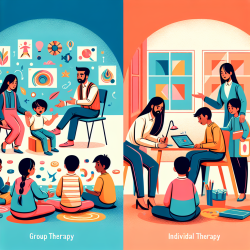
Why This Choice Matters in Schools
When a child needs therapy support at school—whether it’s speech-language therapy, occupational therapy, counseling supports, or social communication help—one of the first questions educators and families often ask is: should this be individual therapy or group therapy?
It’s a great question because the format can shape a child’s progress, confidence, and day-to-day experience. The good news is that both options can be highly effective. The best choice depends on the child’s goals, learning style, and the skills they’re working on.
At TinyEYE, we support schools with online therapy services, and we often help teams think through the practical and student-centered differences between group and individual sessions. Below is a clear, easy guide to help you compare the two and make informed decisions.
What Is Individual Therapy for Kids?
Individual therapy is a one-on-one session between the student and the therapist. The therapist tailors activities, pacing, and feedback to that child’s needs in real time.
In a school setting, individual therapy is often used when goals are highly specific, when a student needs intensive practice, or when privacy and emotional comfort are important.
Common strengths of individual therapy
- Highly personalized instruction: The therapist can adjust instantly based on the child’s responses.
- More repetitions and practice time: The student gets more turns, more feedback, and more targeted coaching.
- Supports sensitive needs: Some students feel safer practicing difficult skills in a private setting.
- Fewer distractions: Helpful for students who struggle with attention, sensory input, or anxiety.
When individual therapy may be the best fit
- The child is working on a skill that requires intensive, structured practice (for example, specific speech sound production).
- The child has complex needs or multiple overlapping goals that require careful sequencing.
- The child is easily overwhelmed in social settings or becomes quiet in groups.
- The child needs support with confidence before practicing skills with peers.
What Is Group Therapy for Kids?
Group therapy involves two or more students working with a therapist at the same time. Groups can be small (often 2–4 students) and are typically built around similar goals, skill levels, or classroom needs.
In schools, group therapy is common because it can mirror real-life communication and social situations. It can also help students generalize skills—meaning they can use what they learn beyond the therapy session.
Common strengths of group therapy
- Real social practice: Students can practice skills with peers, not just an adult.
- Motivation and engagement: Many children try harder when they see peers participating.
- Turn-taking and collaboration: Built-in opportunities for conversation, waiting, listening, and teamwork.
- Generalization: Skills often transfer more naturally to the classroom and playground.
When group therapy may be the best fit
- The goals involve social communication (like conversation skills, perspective-taking, or pragmatic language).
- The child benefits from peer modeling (learning by watching others).
- The child is ready to practice skills in a more realistic, interactive environment.
- The school team wants to support multiple students efficiently while still maintaining quality.
Group vs. Individual: A Quick Comparison
Here’s a simple way to think about it: individual therapy is often best for precision and intensity, while group therapy is often best for practice and carryover.
- Personalization: Individual therapy offers the most customized approach.
- Peer interaction: Group therapy offers natural social learning.
- Student comfort: Some students thrive one-on-one; others feel more relaxed when they’re not the sole focus.
- Skill type: Technical skills may progress faster individually; functional communication may grow faster in groups.
How Schools Can Decide: Key Questions to Ask
If you’re part of a school team (or a family working with one), these questions can help clarify the best fit:
- What are the student’s primary goals? Are they skill-specific (like articulation) or interaction-based (like conversation)?
- How does the student respond in groups? Do they participate, shut down, or get distracted?
- Does the student need confidence-building first? Sometimes individual sessions help a child feel successful before joining a group.
- What does progress look like? If the goal is classroom participation, group practice may support real-world use.
- Are there students with similar goals and compatible personalities? A well-matched group matters.
Can Kids Do Both? Yes—and It’s Often Ideal
Many students benefit from a blended approach: individual therapy for targeted instruction and group therapy for practice and generalization.
For example:
- A student might work on specific speech sounds one-on-one, then practice using those sounds in a small group conversation.
- A student building language skills might learn strategies individually, then apply them during group storytelling or classroom-style activities.
- A student learning emotional regulation tools might practice privately first, then use those tools during peer interaction.
This combination can be especially helpful in school settings because it supports both skill development and real-life application.
How Online Therapy Fits In (And Why It Works)
Online therapy (teletherapy) can support both individual and group formats effectively when it’s delivered with strong planning, student-friendly tools, and school collaboration.
In many schools, online therapy helps teams:
- Increase access to qualified therapists, especially in areas with staffing shortages.
- Maintain consistent scheduling across the school year.
- Offer flexible service models (individual, group, or blended) based on student needs.
- Support documentation and progress monitoring with organized systems and clear communication.
For students, online sessions can feel engaging and structured, and many children enjoy interactive digital activities. For schools, it can be a practical way to ensure students receive services without long delays.
Common Myths (Cleared Up)
Myth 1: Group therapy is “less effective” than individual therapy
Group therapy isn’t a watered-down option. For many goals—especially social communication—group therapy can be the most effective format because it matches how children use skills in real life.
Myth 2: Individual therapy is always best for faster progress
Individual therapy can speed up progress for certain technical skills, but progress also depends on carryover. A student may master a skill one-on-one and still struggle to use it with peers unless they practice in group or classroom-like settings.
Myth 3: One format should stay the same all year
Students change. A child might start with individual therapy and transition to a group as confidence grows—or move back to individual sessions when new challenges appear. Flexibility is a strength, not a problem.
Bottom Line: Match the Format to the Goal
Choosing between group and individual therapy for kids isn’t about which is “better.” It’s about which is best for the student right now.
- Choose individual therapy when a child needs intensive, personalized support or a low-pressure environment.
- Choose group therapy when a child needs peer practice, social learning, and real-world communication opportunities.
- Consider both when you want the benefits of targeted instruction plus meaningful practice.
When schools, families, and therapists collaborate on the right service model, therapy becomes more than a session—it becomes a practical support that helps students participate, communicate, and thrive throughout the school day.
For more information, please follow this link.