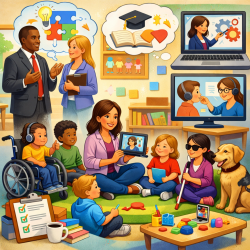
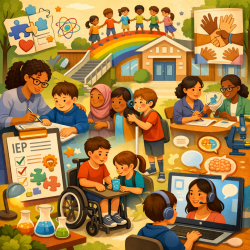
In Ontario, the word “inclusion” shows up everywhere: in policy documents, school improvement plans, and family conversations. But families and educators often share the same frustration: inclusion can be promised on paper, yet feel inconsistent in real classrooms.
A recent overview of inclusive education in Ontario (Alyass & Buist, 2025) argues that the system has historically been designed in ways that exclude Disabled students and other marginalized groups. The authors highlight a hard truth many school teams recognize: creating an Individual Education Plan (IEP) and placing a student in a building does not automatically mean that student experiences belonging, access, and meaningful learning.
As a Special Education Director, I read work like this through two lenses at once: the human lens (students, families, identity, dignity) and the systems lens (staffing, training, funding, legal compliance, and service delivery). This post breaks down key takeaways in a simple, practical way—and connects them to what schools can do next.
Inclusion: More Than “A Seat at the Table”
The article opens with a quote that is easy to remember and hard to ignore: “Inclusion is not just inviting someone to sit at your table. It is believing they belong there” (Carella, 2024). In schools, we sometimes confuse physical placement with true inclusion. A student can be in a general education classroom and still be excluded through:
- instruction that isn’t accessible (pace, language level, format, sensory demands)
- limited communication supports
- behavior systems that punish disability-related needs
- low expectations or “they can’t” assumptions
- IEPs that exist, but are not implemented consistently
Inclusion requires daily design choices—how we teach, how we assess, how we support communication, and how we build peer belonging.
Why Terminology Matters (and Why Teams Disagree)
The paper also explains something that comes up frequently in IEP meetings: language preferences. Some individuals prefer “people-first language” (e.g., “student with a disability”). Others prefer identity-first language (e.g., “Disabled student”), viewing disability as a valued identity rather than something to separate from the person (Titchkosky, 2001).
In practice, the most respectful approach is straightforward:
- Ask the student and family what language they prefer.
- Use that preference consistently in meetings and documentation when appropriate.
- Train staff so language aligns with dignity and current best practice.
A Brief History: How Segregation Became “Normal”
Ontario’s current structures did not appear overnight. The paper traces special education back to institutional models in the 1800s and early 1900s, when students with disabilities were frequently segregated—or excluded entirely (Schlifer, 2005). Over time, special classes expanded, and segregation was often justified as necessary because public schools “could not provide” for certain students.
By the 1960s, civil rights movements and family advocacy pushed systems toward integration and new legislation. However, the legacy of sorting students—by perceived ability, behavior, language, disability, race, and class—still shapes how services are organized today.
Race, Disability, and Overrepresentation: A Critical Equity Issue
The paper also highlights that marginalized groups continue to face barriers in Ontario schools, and that racialized students are overrepresented in certain special education categories—particularly behavioral, intellectual, and language-related disability labels (Galabuzi, 2014). At the same time, racialized students are less likely to be identified as gifted, or diagnosed with learning disabilities and autism than their white peers (Galabuzi, 2014).
For school leaders, this is not just a data point—it is a planning and compliance issue. Disproportionality should trigger questions such as:
- Are referral practices consistent across schools and classrooms?
- Are we distinguishing language acquisition needs from disability?
- Do we have culturally responsive assessment tools and interpreters?
- Are behavior expectations and discipline practices equitable?
- Are families true partners in decision-making?
The “Empty Vessel” Myth: Learning Is Not a Transfer of Information
Another key concept in the article is the critique of the “empty vessel” model—the outdated idea that students simply receive knowledge poured into them. Rodriguez (2012) emphasizes that learning is not a physical transaction; knowledge develops through interaction, context, goals, and environment.
This matters for inclusive education because students with disabilities often need instruction that is:
- interactive and scaffolded
- multimodal (visual, auditory, hands-on)
- designed for generalization (skills used across settings)
- responsive to communication needs
In other words, inclusion is not “same work, same way.” It is access to meaningful learning through intentional design.
IEPs in Ontario: Helpful Tool, Not a Guarantee of Inclusion
Ontario uses IEPs as a central planning tool for students who require special education supports. The article summarizes how students typically access specialized programming through school-based assessment processes that may include multidisciplinary evaluation and team decision-making (Dworet & Bennett, 2002; Minuk et al., 2024).
Minuk et al. (2024) also clarify an important distinction:
- Placement is where a student receives education (general education, partial integration, special class, etc.).
- Programming is what the student learns and how they access learning (accommodations, assistive technology, specialized instruction).
School teams can meet compliance requirements for an IEP and still struggle with inclusion if programming is not implemented with fidelity, if staff are not trained, or if services are unavailable due to staffing shortages.
Policy Promises vs. Day-to-Day Reality
The Ontario Human Rights framework emphasizes equal treatment in education without discrimination based on disability. The Policy on Accessible Education for Students with Disabilities (2018) also discusses “undue hardship,” noting that only cost, outside funding, and health and safety are valid considerations—while inconvenience or morale are not.
Yet the paper argues that policy statements often do not translate cleanly into classroom practice. Educators may feel caught between legal expectations and real constraints: large class sizes, reduced funding, limited planning time, and insufficient training in disability and inclusive education (McCrimmon, 2015).
This is where leadership matters. When systems are strained, schools need clear implementation supports—not just written guidance.
What Future Planning Should Include (Practical Steps Schools Can Take)
The article offers recommendations that align with what many districts are working toward: better planning, stronger teacher education, and policy development that includes Disabled voices and intersectional perspectives.
From a district implementation standpoint, here are practical planning moves that can make inclusion more real:
- Build staff capacity: Provide ongoing training on disability, Universal Design for Learning (UDL), accommodations vs. modifications, and accessible communication supports.
- Strengthen collaboration: Protect time for co-planning between general educators, special educators, and therapists.
- Use data for equity: Monitor disproportionality in referrals, placements, suspensions, and identification categories.
- Improve family partnership: Ensure families understand options, have interpreters when needed, and are included early—before decisions feel finalized.
- Plan for service delivery: Don’t wait for vacancies to become crises. Forecast needs, track timelines, and create contingency plans.
Where Online Therapy Fits: Turning Planning Into Services
Many Ontario (and North American) school systems face therapist staffing shortages—especially in speech-language pathology, occupational therapy, mental health supports, and specialized intervention services. Even with strong intentions, inclusion can break down when students cannot access the services written into their plans.
This is one reason online therapy has become an important part of the service-delivery toolkit. At TinyEYE, we partner with schools to provide online therapy services that can help districts:
- reduce service gaps when in-person hiring is difficult
- support IEP implementation with consistent scheduling
- increase access for rural, remote, or high-need schools
- strengthen documentation and progress monitoring
- support collaborative consultation with school teams and families
Online therapy is not “less than” when done well. It is a practical way to protect student access—especially when the alternative is delayed or missed services.
Closing Thought
Ontario’s history shows that special education has often been built around sorting and separating. The challenge now is to design schools where students are not treated as “unexpected,” where disability is understood without deficit-only thinking, and where inclusion is experienced—not just stated.
When we connect policy, planning, staffing, and instruction, we get closer to what families are asking for: a school experience where students are supported, valued, and truly belong.
For more information, please follow this link.