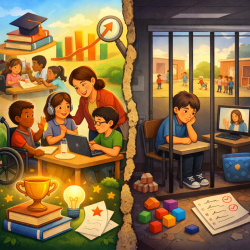
School systems have debated special education placement for decades: should students with disabilities learn primarily in general education classrooms with supports, or in self-contained special education classes? Placement decisions are never purely logistical. They shape students’ access to curriculum, peer relationships, identity development, and long-term academic pathways.
A recent systematic literature review by Barron, Collis, Richmond, and colleagues (covering research from 2005–2024) offers an evidence-based lens on a central question: what does empirical research suggest about the impact of self-contained special education programs on students’ academic achievement, sense of belonging, and engagement in school?
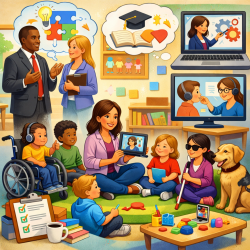
For school administrators, special education leaders, and student support teams—including providers like TinyEYE that deliver online therapy services to schools—this evidence matters because therapy and educational programming do not operate in isolation. Placement influences how services are delivered, how goals are generalized into daily instruction, and whether students experience school as a community where they are known, valued, and challenged.
What Counts as “Self-Contained” in the Research?
In the review, a placement was considered self-contained when a student spent 50% or more of their school day separated from general education peers (i.e., exclusively with other disabled students). Comparison groups varied across studies and were described using terms such as “general education,” “mainstream,” “regular,” “resource room,” or “inclusive.”
One of the review’s most important contributions is its caution about language: many studies use the term “inclusion” when they are actually describing integration (placement in a general education classroom without confirming systemic or instructional changes that remove barriers). This distinction matters because “being in the room” is not the same as “being meaningfully included.”
How the Systematic Review Was Conducted (In Plain Language)
The authors searched seven major academic databases (including ERIC, PsycINFO, JSTOR, and others) for peer-reviewed studies published between 2005 and 2024. After removing duplicates and applying strict inclusion criteria, they narrowed 1,120 abstracts down to 15 empirical studies that directly examined the impact of self-contained placement (not a specific intervention) on:
- Academic achievement (e.g., literacy, numeracy, graduation outcomes)
- Belonging (e.g., friendships, safety, relationships, bullying, social anxiety)
- Engagement (e.g., emotional engagement, participation, attention, task involvement)
This is a relatively small final set—an important signal in itself. Despite how common placement debates are, rigorous studies that isolate the impact of placement are limited.
Key Finding #1: No Evidence of Stronger Academic Outcomes in Self-Contained Programs
Across the six studies focused on academic achievement, the review found a consistent pattern: no studies showed more favorable academic outcomes for students in self-contained placements.
Literacy Outcomes
Five studies examined literacy. Across these studies, students who spent more time in non-separated settings (often defined as 80%+ of the day in general education) tended to show stronger literacy outcomes than peers in more separated placements.
Notably, several of the stronger academic studies used matching methods (such as propensity score matching) to reduce bias—attempting to compare students with similar profiles across different placements. Even with these controls, the academic advantage did not tilt toward self-contained settings.
Numeracy Outcomes
Four studies examined numeracy. Three found stronger results for students in non-separated settings; one found no difference. Again, the review did not identify a math advantage for self-contained placement.
Academic Trajectories and Long-Term Pathways
Two studies addressed longer-term outcomes such as graduation likelihood and secondary academic streaming. One particularly concerning finding (from Toronto District School Board data) suggested that students who had been in self-contained programs were more likely to be streamed into lower academic tracks later—even when prior standardized test performance was controlled.
In practical terms, this raises a high-stakes question for school systems: even when self-contained placement is intended as support, could it inadvertently narrow future options?
Key Finding #2: Belonging Is Mixed—But Risks Like Bullying and Social Anxiety Appear Salient
Eight studies addressed belonging, and the findings were more nuanced than academics. Some students reported positive peer support in self-contained environments, while other evidence pointed to isolation, stigma, and heightened vulnerability.
Relationships and Social Participation
- Some evidence favored non-separated settings: one matched-pairs study found students in general education settings had more peer relationships and social participation.
- Some evidence favored self-contained settings: in certain studies, students reported feeling more supported by peers in self-contained classes, particularly when compared with settings where they may have been physically present but socially excluded.
These differences underscore a central reality: belonging is not guaranteed by placement type alone. Classroom culture, peer norms, adult facilitation, and disability attitudes all shape whether students feel connected.
Bullying and Cyberbullying
Two studies raised concerns about bullying experiences. For example, one study reported higher rates of cyberbullying victimization among students with learning disabilities in self-contained settings compared to peers with learning disabilities in general education classes. Another study found disabled students were more likely to be bullied than non-disabled peers overall, and reported substantially higher anxiety about bullying among students in self-contained placements.
While some of these studies had methodological limitations (e.g., groups not fully matched), the pattern aligns with broader concerns in disability studies: segregation can increase visibility, stigma, and social vulnerability—especially when disability is treated as a marker of “otherness.”
Social Anxiety
One study found that students with learning disabilities in partially inclusive settings reported lower social anxiety than peers in self-contained classes, and that reduced social anxiety was linked to greater class satisfaction. This is a critical insight for schools: anxiety is not merely a mental health issue—it can be a barrier to participation, communication, and learning.
Key Finding #3: Engagement Shows Limited Evidence Favoring Self-Contained Settings—But Context Matters
Only three studies met criteria for engagement. Two suggested more favorable engagement-related experiences in self-contained contexts (for example, enjoyment or participation in specific settings like math support or physical education). Another found no difference in academic task engagement between self-contained and general education classrooms, but noted higher odds of distractions in self-contained programs.
The review’s discussion offers a crucial caution: when self-contained settings appear “better” for engagement, the comparison may be against integrated settings that lack adequate supports—not against truly inclusive environments designed to remove barriers.
Why “Inclusion” vs. “Integration” Changes How We Interpret the Evidence
The authors ground their analysis in a social model approach to disability and critical disability theory, emphasizing that barriers are often environmental and attitudinal—not inherent to the student. This framing leads to a practical interpretation for schools:
- If a student struggles in a general education classroom without structural supports, that is not evidence that inclusion “fails.”
- It may be evidence that the system has not yet implemented inclusive design (curriculum access, accommodations, co-planning, assistive technology, peer supports, and disability-affirming culture).
For decision-makers, this means placement debates should not be reduced to a binary choice between “general ed” and “self-contained.” The quality of support, expectations, and participation opportunities in each setting is often the real variable.
Implications for School Leaders and Student Support Teams (Including Therapy Providers)
For schools partnering with TinyEYE, the review reinforces that student outcomes are shaped by how well supports are embedded into daily learning environments. Online therapy can be especially powerful when it is integrated into a broader inclusive strategy rather than treated as a separate service “delivered somewhere else.”
Evidence-Informed Considerations for Placement and Programming
- Prioritize access to grade-level curriculum with appropriate scaffolds and accommodations.
- Monitor belonging as an outcome, not just academics—friendships, safety, and adult relationships are measurable and meaningful.
- Plan for generalization: therapy goals (speech-language, OT, mental health supports) are most durable when reinforced across contexts and routines.
- Interrogate “inclusion” claims: ask what structural changes are present (co-teaching, UDL practices, peer supports, accessible materials), not just where a student sits.
- Protect student agency: the review emphasizes that one-size-fits-all solutions rarely serve students well; flexible, responsive options and student voice matter.
Conclusion: Limited Support for Self-Contained Placement—And a Call for More Precise, Higher-Quality Research
Across 15 studies, the systematic review found limited support for self-contained special education placements. The most consistent finding was that self-contained programs did not demonstrate stronger academic outcomes. Belonging and engagement findings were mixed, with a small number of studies showing more favorable experiences in self-contained settings—often in comparison to environments that may have been integrated rather than truly inclusive. Importantly, two studies explicitly reported harm associated with self-contained placement.
For schools, the takeaway is not that a single placement is universally “right” or “wrong,” but that placement decisions should be made with careful attention to evidence, student experience, and the difference between physical access and meaningful inclusion.
For more information, please follow this link.