Why this Literacy Framework matters more than “reading time”
When schools talk about literacy, it’s easy for the conversation to narrow to reading scores, decoding, or “getting kids to read more.” But the Calgary Board of Education’s K–12 Literacy Framework (September 2025) pushes the conversation into a more complete—and more useful—direction: literacy is about a learner’s ability, confidence, and willingness to use language to acquire, construct, and communicate meaning in daily life.
That definition matters because it makes literacy everyone’s work, not just the work of the English Language Arts classroom. It also makes literacy inseparable from identity, belonging, and equity. As the Framework emphasizes, students need to authentically see themselves in the learning environment before skill development can fully take hold. In other words: literacy growth accelerates when students feel safe, represented, and connected.
The Framework’s “big idea”: three pillars that work together
The Literacy Framework is organized around three essential elements that reinforce each other. When schools strengthen all three, literacy becomes more equitable, more consistent across grades, and more sustainable over time.
Literacy Environments: the spaces, routines, materials, and relationship conditions that shape whether students feel they belong and can participate.
Literacy Teaching Practices: research-informed, explicit, systematic instruction that develops both foundational and higher-level skills across K–12.
Assessment and Reporting Practices: a continuous cycle of gathering evidence, interpreting it, and adjusting instruction—while involving students in the process.
For school teams, this is an important shift: it’s not enough to buy a new program or add an intervention block. The Framework is essentially saying, “If the environment, instruction, and assessment aren’t aligned, students experience gaps—even when everyone is trying their best.”
1) Literacy environments: the hidden driver of engagement and progress
The Framework positions literacy environments as inclusive spaces where students can access communities of learning—physically and virtually. This matters for K–12 because literacy identity doesn’t develop in isolation; it develops through repeated experiences of success, relevance, and connection.
Student identity and engagement: “Do I belong here?” comes first
Students arrive with diverse languages, cultures, interests, and “funds of identity.” The Framework encourages schools to intentionally build reader and writer identities by honoring voice and choice, strengthening home-school-community literacy relationships, and creating structured opportunities for perspective-taking and dialogue.
Use reading and writing interest inventories to learn what students care about.
Build routines for goal-setting, reflection, and self-assessment.
Use book talks and celebrations of learning to make literacy social and visible.
Learning spaces: design matters (including virtual spaces)
Learning spaces should support both lively discussion and quiet reflection, with easy access to organized materials and purposeful technology use. This is especially relevant in today’s classrooms where students may be learning in hybrid contexts or relying on assistive tools.
Instructional materials: “mirrors and windows” aren’t optional
The Framework calls for materials that are multimodal, culturally responsive, and bias-aware—while also supporting foundational instruction (including decodable texts for phonics practice). Students need to see themselves (“mirrors”) and learn about others (“windows”), including First Nations, Métis, and Inuit knowledge systems, languages, and histories.
Routines: predictable structure reduces cognitive load
Daily routines build safety and trust. They also protect instructional time. Clear expectations, posted learning intentions, consistent groupings, and meaningful daily reading and writing tasks across content areas create a steady rhythm where students can practice and consolidate skills.
2) Literacy teaching practices: what strong instruction includes (K–12)
The Framework is grounded in enduring literacy research and aligns with science of reading principles. It emphasizes explicit and systematic instruction, collaboration among educators, and a belief that every student can grow with the right supports.
Oral language: the foundation under everything
Oral language is at the center of classroom life—from following instructions to collaborating with peers. The Framework draws on definitions that include phonological awareness, syntax, morphology, pragmatics, and semantics. For many learners, oral language is where literacy success begins (or where challenges first become visible).
Build in structured talk: think-pair-share, reciprocal teaching, dialogic discussion.
Model complex vocabulary and sentence structures in read-alouds and discussion.
Use wait time and culturally responsive communication practices.
For TinyEYE and school partners, this is a key connection point: speech-language support can directly strengthen classroom literacy outcomes when it targets the language demands students face all day long.
Reading: it’s not natural—so it must be taught intentionally
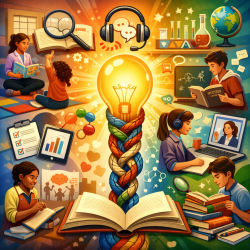
The Framework highlights that humans invented reading; brains are not “born to read.” That’s why models like Scarborough’s Reading Rope are so useful: they show how skilled reading depends on two interwoven strands—language comprehension and word recognition—made up of many smaller threads.
It also references the Active View of Reading, which expands the picture by including motivation, engagement, strategy use, and executive function as real contributors to reading success. This is a practical reminder for schools: two students with similar decoding skills may still read very differently depending on attention, self-regulation, and confidence.
The “big five” components schools can’t ignore
Phonological awareness: hearing and manipulating sounds in spoken language, including phonemic awareness (blending, segmenting, manipulating phonemes).
Phonics: connecting graphemes to phonemes through explicit, systematic instruction and application in real reading and writing (often supported by decodable text).
Fluency: accuracy, rate, and expression (prosody)—the bridge between decoding and comprehension.
Vocabulary: an equity issue; limited word knowledge restricts access to texts and learning. The Framework emphasizes Tier 2 and Tier 3 vocabulary instruction across subjects.
Comprehension: active meaning-making that includes background knowledge, vocabulary, foundational skills, and strategies like monitoring, summarizing, questioning, and inferring.
Writing: how students make thinking visible
Writing is presented as a multimodal, non-linear process that supports learning, reflection, and communication. The Framework includes the “Writing Rope” concept: skilled writing weaves together critical thinking, syntax, text structure, craft, and transcription skills (spelling, handwriting, keyboarding).
Schools are encouraged to protect daily structured writing time, use mentor texts and explicit instruction, connect reading and writing, and use digital tools (including AI thoughtfully) for feedback, revising, and editing.
3) Disciplinary literacy: every teacher teaches literacy (but differently)
One of the most actionable messages in the Framework is this: disciplinary literacy is not “doing ELA in science.” Each discipline has its own ways of using language, evidence, text structures, and symbolic representations. Students need to learn how historians read sources, how scientists interpret diagrams, and how mathematicians justify solutions using precise language and data displays.
Design inquiry around essential disciplinary questions.
Select multimodal disciplinary texts (graphs, podcasts, primary sources, tables, images).
Explicitly model how experts read and think in that subject area.
Pre-teach and reinforce discipline-specific vocabulary and background knowledge.
4) Assessment: the bridge between teaching and learning
The Framework frames assessment as a responsive cycle that improves learning—not just a way to score it. It emphasizes fairness, transparency, alignment to learning goals, and active student involvement.
Diagnostic assessment: used at the beginning of a learning cycle to understand what students know and need; not used for grades.
Formative assessment: ongoing checks for understanding that inform instruction and provide feedback; typically not graded.
Summative assessment: occurs at or near the end of a learning cycle to evaluate achievement of learning goals; informs grades and reporting.
For many schools, the biggest opportunity is consistency: when teams align what they assess, how they interpret evidence (observation, conversation, product), and how they respond instructionally, students experience fewer “surprises” and more steady growth.
Where TinyEYE fits: supporting literacy through online therapy in schools
TinyEYE provides online therapy services to schools, and the Framework’s emphasis on oral language, identity, and equitable access aligns naturally with telepractice models when implemented thoughtfully.
Oral language support that connects to classroom demands: vocabulary, syntax, morphology, narrative skills, and pragmatic language can be targeted in ways that directly support reading and writing tasks.
Collaboration with educators: therapy is most powerful when goals align with classroom instruction, routines, and assessment cycles.
Access and equity: online services can help schools reach students who might otherwise face delays due to staffing shortages or geographic barriers.
When literacy is treated as a shared responsibility—across teachers, specialists, leaders, and families—students benefit from coherent supports that build skill and confidence at the same time.
For more information, please follow this link.