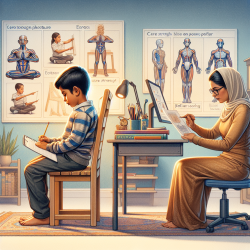
Poor Posture in Kids: Why It Matters More Than “Sitting Up Straight”
As a Special Education Director, I’ve sat in countless IEP meetings where a parent shares a familiar concern: “My child is always slumped over,” “They melt down during homework,” or “They avoid writing and complain their hand hurts.” Often, what looks like a simple “posture issue” is actually a functional school participation issue—one that can impact learning, stamina, behavior, and confidence.
Occupational therapy (OT) is uniquely positioned to connect posture to everyday school skills. Posture isn’t about perfect alignment or forcing a child to sit like an adult. It’s about whether a student can maintain a stable, comfortable position long enough to access instruction, complete tasks, and participate with peers.
What “Poor Posture” Can Look Like in School
Posture challenges show up in different ways depending on the child’s age, strength, sensory needs, and classroom demands. Common signs educators and families notice include:
- Slouching, leaning on one arm, or “wrapping” around the desk
- Head down close to the paper or turning the head to see work
- W-sitting on the floor or frequently changing positions during circle time
- Resting the chin in the hand, propping on elbows, or sliding down in the chair
- Fidgeting that increases during writing, reading, or longer lessons
- Complaints of fatigue, headaches, neck/shoulder discomfort, or hand pain
- Avoidance of fine motor tasks (coloring, cutting, writing) or slow work pace
These patterns are not “bad habits” in isolation. They are often a child’s attempt to stabilize their body, manage sensory input, or compensate for weakness, low endurance, vision demands, or poor seating fit.
Why Posture Impacts Learning and Behavior
When posture is inefficient, a student may use extra energy just to stay upright. That leaves fewer resources for attention, working memory, and task completion. In school, we often see posture-related challenges show up as:
- Reduced endurance: The student tires quickly during writing, reading, or computer work.
- Lower quality handwriting: If the trunk and shoulder are unstable, fine motor control often suffers.
- Decreased attention: Constantly adjusting position can look like distractibility.
- Increased frustration: Tasks feel harder than they “should,” leading to avoidance or behavior concerns.
- Breathing and voice impacts: Slumped posture can reduce breath support, which may affect voice volume and stamina.
It’s important to remember: posture is a whole-body skill. It involves core strength, shoulder stability, balance, coordination, sensory processing, and the ability to sustain effort over time.
Common Contributors OTs Consider
In OT, we look beyond “sit up straight” and ask: “What is driving this posture?” Some common contributors include:
- Core weakness or low muscle tone: The student may collapse into the chair or desk for support.
- Limited postural endurance: They can sit upright briefly but can’t sustain it through a lesson.
- Poor seating fit: Feet dangling, desk too high/low, or chair too deep can force compensations.
- Sensory processing needs: Some students seek pressure by leaning, while others avoid certain positions.
- Visual demands: If a student struggles to see the board or paper clearly, they may crane the neck or lean in.
- Motor planning and coordination: Organizing the body for a task can be difficult, especially during multi-step work.
- Fatigue, stress, or reduced sleep: These can reduce a child’s ability to maintain posture and regulate behavior.
OTs also consider whether posture changes across environments. A student who sits upright during preferred activities but slumps during writing may be telling us something important about task demands, fatigue, or skill gaps.
How Occupational Therapy Supports Posture (Without Making School Feel Like a Workout)
School-based OT focuses on function. The goal is not “perfect posture.” The goal is improved access: writing more comfortably, attending longer, participating more confidently, and reducing fatigue.
OT intervention often includes a combination of:
1) Environmental and Seating Adjustments
- Ensuring feet are supported (floor contact or a stable footrest)
- Adjusting desk height so shoulders are relaxed and elbows are supported
- Providing seating options when appropriate (e.g., supportive cushion, alternative chair)
- Positioning materials to reduce neck strain (paper angle, book stands, screen height)
These changes can be powerful because they reduce the physical “cost” of learning.
2) Skill-Building Through Meaningful Activities
OTs build postural control through purposeful tasks rather than repetitive drills. Examples include:
- Fine motor tasks at vertical surfaces (easel, whiteboard) to promote shoulder stability
- Play-based core strengthening (animal walks, obstacle courses, scooter board activities)
- Classroom-friendly movement routines that support regulation and endurance
- Handwriting supports that reduce strain (paper placement, grip, pacing strategies)
3) Sensory and Self-Regulation Supports
For some students, posture is tied to regulation. OT may recommend strategies such as:
- Scheduled movement breaks aligned to instruction (not random interruptions)
- Heavy work activities (pushing, pulling, carrying) to support body awareness
- Calming strategies that reduce “collapse” from fatigue or overwhelm
4) Coaching for Staff and Families
One of the most effective OT approaches is coaching—helping adults adjust the environment, prompt effectively, and build routines that stick. In my experience, the best outcomes happen when strategies are simple, consistent, and realistic for busy classrooms and households.
Quick Classroom and Home Tips You Can Try Today
These are general ideas and not a substitute for an individualized OT evaluation, but they can be helpful starting points:
- Check the “90-90-90” setup: hips, knees, and ankles close to 90 degrees with feet supported.
- Reduce desk clutter: less reaching and twisting supports steadier posture.
- Use short movement “resets”: 30–60 seconds between tasks can improve endurance.
- Try a slant board or angled surface: often helps with wrist position and visual access.
- Break writing into chunks: stamina grows when tasks are paced appropriately.
- Watch for vision clues: frequent squinting, leaning in, or head turning may warrant a vision check.
When to Consider an OT Referral
It may be time to consult OT (through your school team or privately) when posture concerns:
- Interfere with handwriting, cutting, computer work, or classroom participation
- Cause frequent fatigue, pain complaints, or avoidance of schoolwork
- Contribute to behavioral concerns during seated tasks
- Persist despite reasonable seating and routine adjustments
- Appear alongside other motor, sensory, or self-regulation challenges
From a district perspective, we also consider whether the concern impacts educational access and whether targeted supports can be implemented within a Multi-Tiered System of Supports (MTSS) before moving to more intensive services.
How Online OT Can Help Schools Address Posture Concerns
Many districts—including ours—face therapist staffing shortages. That reality can delay services and increase pressure on school teams. Online therapy can be a practical way to maintain continuity of support, especially when in-person staffing is limited.
In a school-based teletherapy model, occupational therapists can:
- Observe students during real classroom routines (with appropriate permissions)
- Coach staff on seating, positioning, and task setup
- Provide student-friendly activities that build postural control and endurance
- Collaborate with IEP teams and families to generalize strategies across settings
When implemented well, online OT can be highly collaborative and efficient—focused on what the student needs to do during the school day, not just what they can do in a therapy session.
For more information, please follow this link.