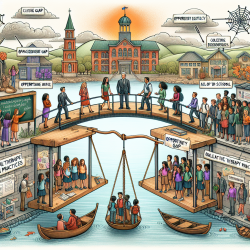

Financial education is increasingly recognized as a foundational life skill, yet many school-based materials unintentionally assume a “typical” student experience—stable income, access to bank accounts, predictable household structures, and familiarity with financial vocabulary. In real classrooms, those assumptions can create a hidden barrier: students may master the testable concepts while feeling that the content does not reflect their lives.
For school leaders and educators, this is not a minor issue of “examples” or “engagement.” When students feel unseen—or worse, pressured to invent a more socially acceptable financial story—financial education can become alienating rather than empowering. For organizations like TinyEYE, which supports schools through online therapy services, this conversation also intersects with student wellbeing: belonging, psychological safety, and participation are prerequisites for learning.
Drawing on insights from master educators and inclusive financial education practices, this article outlines why income bias appears in common curricula and offers practical, classroom-ready strategies to ensure all students can access, relate to, and benefit from financial learning.
The Core Challenge: Income Bias in “Standard” Financial Education
Many financial education resources are written for the largest market segment—often a middle-class audience. As a result, lessons may revolve around experiences such as:
- Choosing items for a gift wish list
- Saving money in a bank account that the student already has
- Using debit and credit cards as default spending tools
- Assuming families have stable income and predictable bills
For students experiencing poverty, housing instability, food insecurity, or underbanking, these examples can feel disconnected—or even painful. Educators have described “aha moments” when they realized students were disengaging not because the topic was too hard, but because the framing required them to pretend their life looked different than it does.
Inclusive financial education begins with a simple premise: differences in financial experience are not deficits. They are contexts. Effective teaching acknowledges those contexts without lowering expectations.
Three Building Blocks for Inclusive Financial Education
1) Build Relationships Before You Teach the Content
Teachers consistently report that relationship-building is the most important factor in reaching students whose lived experiences diverge from the curriculum’s assumptions. Practical approaches include:
- Normalizing that adults make financial mistakes and learn from them
- Sharing age-appropriate personal stories (only when comfortable)
- Inviting students to talk about goals and values, not private family finances
- Setting a tone that avoids judgment about “good” and “bad” spending
When students trust the learning environment, they are more willing to ask questions about unfamiliar systems (banking, credit, investing) and more likely to practice new skills.
2) Teach the Language of Personal Finance Explicitly
Financial vocabulary can feel like a secret code—especially for students who do not hear it modeled at home. Words like “interest,” “overdraft,” “APR,” “credit history,” “fiduciary,” or “portfolio” can intimidate students before learning even begins.
Inclusive instruction treats vocabulary as a gateway skill. Repeated exposure, low-stakes practice, and student-friendly definitions help reduce anxiety and increase confidence.
3) Build an Expectation of Success for Every Student
A critical equity pitfall is assuming that students from low-income households will not need certain knowledge (like credit or investing) because “it won’t apply to them.” That belief can become self-fulfilling.
Inclusive financial education reinforces that financial security is not reserved for one income group. Students should see clear pathways—through education, training, work experience, and informed financial choices—toward the futures they define for themselves.
Inclusive Strategies by Topic Area
Decision-Making: Same Process, Different Criteria
Decision-making models are often taught as universal steps (identify the problem, list alternatives, weigh pros/cons, decide). The inclusive shift is to recognize that criteria vary by lived experience.
For example, “save vs. spend” looks different if saving money is not physically safe at home, if the family is unbanked, or if there is a strong cultural expectation to support relatives when emergencies arise. In those contexts, saving may feel risky or even socially costly.
Classroom strategy: use structured stories with clearly stated options and constraints, then ask students to identify what criteria the character might prioritize. This builds analytical skill without forcing personal disclosure.
Budgeting: Move Beyond the Nuclear-Family Template
Budgeting lessons often assume stable income, two-parent households, and predictable monthly bills. Yet many students live with single parents, grandparents, foster families, or in households with variable income (tips, gig work, seasonal labor).
Inclusive budgeting approaches include:
- Using hypothetical households with diverse family structures and income patterns
- Including variable income scenarios and irregular expenses
- Using “money diary” tracking privately (not shared with classmates)
- Teaching cash-based budgeting tools such as the envelope method
Another high-engagement approach is simulations (often called “reality fairs”) where students manage a role-based budget and experience tradeoffs in real time. These activities can be powerful precisely because they make constraints visible without shaming students who live them.
Banking and Alternative Financial Services: Teach Access, Not Just Features
Many curricula explain checking and savings accounts but underemphasize barriers that students may see in their communities: banking deserts, mistrust of institutions, lack of documentation, or prior negative experiences.
Inclusive instruction can cover:
- What it means to be unbanked or underbanked
- How fees from check cashing, money orders, and prepaid cards add up
- What deposit insurance is (and what it does not cover)
- How to “shop” for accounts the way you shop for products
To build trust, educators often recommend guest speakers and tours—especially when speakers reflect the community. These interactions can demystify “how to open an account” questions students may feel embarrassed to ask.
Credit: Start Early by Teaching Trust
Credit education is frequently postponed until high school, but the concept of credit exists in elementary school: borrowing a pencil, checking out a library book, lending a toy. These experiences teach the foundation of credit—trust and responsibility.
For older students, inclusive credit education should address both formal and informal credit markets. Some families rely on community lending circles or borrowing from relatives because mainstream credit is inaccessible or mistrusted. Students benefit from learning how credit history affects:
- Renting an apartment
- Turning on utilities
- Insurance pricing
- Employment opportunities in certain sectors
High-interest “easy credit” is best taught through topics teens care about—especially cars. Have students compare loan offers and calculate total cost, then expand the lesson to include insurance, fuel, maintenance, and parking.
Earning an Income: Expand the Definition of “College”
Career education becomes more inclusive when it recognizes multiple pathways: apprenticeships, certificates, technical programs, community college, and four-year degrees. Students also need help identifying strengths they may not label as “skills,” such as bilingualism, caregiving responsibilities, technology problem-solving, and perseverance.
Practical classroom tools include:
- Guest speakers and job shadows that do not rely on parents’ availability
- Structured support for resumes and interviewing (templates, peer review, mock interviews)
- Explicit instruction in onboarding paperwork (W-4, I-9), paychecks (gross vs. net), and W-2s
- Activities that elevate soft skills as employability assets
Risk Management and Investing: Make It Relevant, Then Make It Actionable
Risk management resonates when it is personal and real: stepping out of a comfort zone, dealing with emergencies, or understanding how insurance functions as a backup plan. Investing becomes more accessible when framed broadly: investing in education, investing in a home, and investing in financial markets.
Inclusive investing instruction can use:
- Entrepreneurship projects and classroom economies
- Stock market simulations tied to products students recognize
- Discussions of scams and the importance of fiduciary responsibility
- Simple rules of thumb while acknowledging access barriers
The goal is not to turn every student into a day trader. It is to build understanding, confidence, and protective knowledge—especially for students who may be targeted by predatory products or scams.
Why This Matters Now: Inclusion Is Academic and Emotional
When financial education is inclusive, it does more than improve content comprehension. It reduces shame, increases participation, and strengthens students’ sense of belonging. Those outcomes support broader educational goals—attendance, engagement, self-advocacy, and long-term planning.
For schools, inclusive financial education is also a practical equity strategy: it helps ensure that the students who most need access to financial capability are not the ones most likely to disengage from the instruction.
For more information, please follow this link.