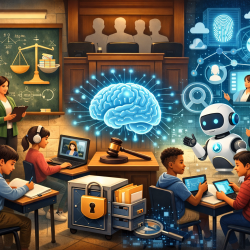
Artificial intelligence (AI) is no longer a “future” topic in K-12 education. It is already here—embedded in learning platforms, online assessment tools, content filters, writing supports, and student monitoring systems. The Pennsylvania Advisory Committee to the U.S. Commission on Civil Rights (December 2024) took a close look at what this rapid growth could mean for students’ civil rights, especially for students in federally protected classes.
As a Special Education Director, I read this report through a practical lens: What helps teachers and students today? What creates new risk? And how do we implement technology in a way that stays compliant with IDEA, Section 504, Title VI, Title IX, FERPA, and state privacy requirements—especially when staffing shortages make it tempting to “automate” services that really require people?
Below is an easy-to-read summary of the report’s key insights, along with concrete questions school leaders can use right now.
Two AI conversations schools must separate
The report repeatedly returns to one helpful distinction: schools need to separate (1) teaching students about AI from (2) using AI to teach, evaluate, or monitor students.
Teaching students how to understand and use AI is increasingly essential for college, careers, and digital citizenship.
Using AI to make decisions about students (placement, grading, discipline, surveillance, “risk” scoring, and sometimes special education-related predictions) must be approached with much more caution.
In other words: accelerate AI literacy; slow down AI decision-making about children.
Where AI can help (if adults stay in charge)
The report acknowledges real potential benefits when AI is used as an assistant rather than a replacement.
AI support for educators
AI tools can help teachers draft lesson ideas, create rubrics, streamline communication, and generate options for differentiation. In theory, that frees time for what matters most: instruction, relationships, and feedback.
The catch is that AI output must be reviewed. The report highlights concerns that AI can:
Generate inaccurate or misleading information
Reward “fancy” language even when it is incorrect
Penalize dialects and culturally rooted language patterns
Encourage over-reliance, where adults defer to the tool instead of professional judgment
AI support for students (including students with disabilities)
AI can support brainstorming, summarizing, outlining, and basic writing mechanics. For students with disabilities, AI-powered assistive features (text-to-speech, speech-to-text, captioning, note supports) can increase access when implemented appropriately.
But the report warns against treating AI as a substitute for human-delivered accommodations and services. Students have reported that some AI accessibility tools are not accurate enough to replace a person, and that matters under FAPE. If a tool is unreliable, it can become a barrier rather than a support.
The biggest civil rights risks: bias, privacy, and surveillance
The report’s core purpose is civil rights impact. The strongest caution is that AI can amplify bias faster and less transparently than older systems.
Bias can show up in multiple places
The report describes bias as entering at different stages:
Problem framing (what the tool is built to do and what it “values”)
Training data (historic data can reflect historic inequities)
Deployment (how a district uses the tool can create disparate impact)
In school terms, that can look like:
Early warning systems that disproportionately flag Black and Hispanic students as “high risk”
AI tutoring pathways that keep students in remedial tracks based on patterns tied to poverty or prior opportunity gaps
E-proctoring and facial recognition that fail more often for darker skin tones and may misread disability-related movement, eye gaze, or communication differences as “suspicious”
From a special education perspective, this is not theoretical. If a system flags or scores students in ways that correlate with disability, race, language status, or gender identity, districts can quickly find themselves facing complaints, corrective action, or litigation.
Privacy and “permanent records” concerns
AI systems thrive on data. The report raises serious concerns about how much data is being collected, how long it is stored, and who can access it. It describes emerging “cradle-to-career” data initiatives and warns that some digital records may be difficult or impossible to delete.
One of the most concerning themes is the link between school data and law enforcement access. The report cites examples and research indicating that monitoring data is sometimes shared with law enforcement, and that students from low-income families may be more exposed because they rely more heavily on school-issued devices.
Content filtering as a “digital book ban”
The report also highlights concerns that internet filtering tools may disproportionately block content related to LGBTQ+ identities and communities of color. When filtering is automated and opaque, it can function like censorship without clear accountability.
Why K-3 deserves special caution
A notable recommendation in the testimony is that districts consider prohibiting or tightly restricting certain AI tools in the youngest grades. The rationale is simple: early learning is built on relationships, play, communication, and social-emotional development.
Technology can support learning, but it cannot replace the human-to-human connection that many students—especially those experiencing trauma, disability-related needs, or social stressors—require to thrive.
Procurement is a powerful lever (and districts should use it)
One of the most practical insights in the report is that districts have leverage through purchasing decisions. If vendors want access to the K-12 market, districts can require clear guardrails.
When I advise teams navigating new tools (including online therapy platforms and related digital supports), I encourage a “show me” approach. Vendors should be prepared to demonstrate:
What data is collected, where it is stored, and how long it is retained
Whether data is used to train models (and whether it can be opted out)
How bias is tested, monitored, and remediated
How the tool performs for students with disabilities, multilingual learners, and diverse cultural/linguistic backgrounds
What human review and appeal options exist when the tool flags a student or generates a high-stakes output
The report also discusses solutions like third-party audits, state templates for contracts, regional purchasing consortiums, and repositories of vendor performance reviews so smaller districts are not left to evaluate complex AI tools alone.
What this means for special education and related services (including teletherapy)
Many districts are facing therapist staffing shortages. Online therapy and telepractice can be a responsible way to expand access—especially in rural areas or where recruitment is difficult—when implemented with strong clinical oversight and privacy protections.
But the report’s warning still applies: AI and automation should augment services, not quietly replace them. For IDEA and Section 504 compliance, districts must ensure:
Services match IEP requirements (frequency, duration, group size, setting)
Assistive technology decisions are individualized, not one-size-fits-all
Any AI-enabled features used in therapy or progress monitoring are transparent, accurate, and clinically appropriate
Parents receive clear notice and meaningful opportunities to ask questions
In parent meetings, the simplest trust-building move is clarity: what tool is being used, why it is being used, what data it touches, and what the family can do if something doesn’t look right.
A practical “AI guardrails” checklist for school leaders
If your district is considering (or already using) AI-enabled tools, here are action steps aligned with the report’s themes:
Create an AI oversight team that includes special education, general education, IT/security, student services, legal counsel, and civil rights/Title staff.
Classify tools by risk: AI for learning about AI is different from AI that scores, tracks, filters, surveils, or predicts student behavior.
Require notice and explanation: families and staff should know when AI is used and how it affects decisions.
Keep a human “fallback”: there must be a clear process to challenge outputs, correct errors, and remedy harm quickly.
Audit for disparate impact: monitor outcomes by race, disability, language status, and other protected characteristics.
Train staff: most harm happens when tools are used without guidance, especially in discipline and academic integrity situations.
Bottom line
AI may help schools personalize learning and reduce administrative burden, but it can also accelerate inequity, widen the digital divide, and create privacy and surveillance harms—especially for students with disabilities and other historically marginalized groups.
The report’s message is not “never use AI.” It is: use it deliberately, measure outcomes, protect civil rights, and ensure humans remain accountable for decisions about children.
For more information, please follow this link.