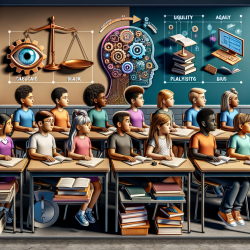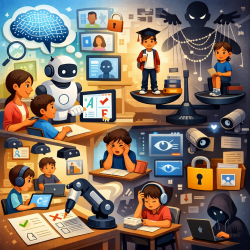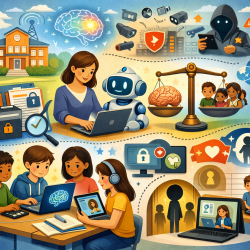
Generative artificial intelligence (GenAI) is moving quickly from “new and optional” to “everywhere and assumed” in K–12 education. Since the public release of ChatGPT in 2022, Ontario educators and school systems have faced an accelerating mix of opportunity, uncertainty, and pressure—pressure to innovate, to respond to student use, and to make decisions before the policy environment is fully ready.
For school leaders, the challenge is not simply whether GenAI belongs in classrooms. The bigger question is how to integrate it responsibly—without undermining teacher professionalism, student learning, privacy, or equity. The Ontario Teachers’ Federation (OTF) discussion paper (January 2026) frames this moment clearly: GenAI may make some tasks easier, but it cannot replace the humanity required for quality teaching and learning.
As TinyEYE partners with schools to provide online therapy services, we see a parallel reality: technology can expand access and reduce barriers, but only when it is deployed with strong safeguards, clear accountability, and a human-centered model of care. The same principle applies to GenAI in education.
Why GenAI policy can’t stop at “student and teacher use”
A key insight from the OTF paper is that K–12 policy conversations often focus too narrowly on “rules for classroom use.” Those rules matter, but they are only one part of the lifecycle. Responsible GenAI requires policy attention to:
Development: how AI systems are designed, trained, and built (including what data they are trained on).
Deployment: how systems are launched, integrated, updated, and supported in real school environments.
Use: how educators, students, and staff adopt tools after deployment.
When development and deployment policies are weak—or missing—schools can end up “using responsibly” tools that were not built or procured responsibly in the first place. That is the policy vacuum problem the paper warns about, and it’s especially risky in K–12 because children and youth require heightened privacy and safety protections.
How GenAI is already being used in Ontario schools
Even without a complete evidence base on system-wide impacts in Ontario, the paper summarizes common use-cases that align with broader international categories (student-facing, teacher-facing, and system-facing). In practice, GenAI is being used for:
1) Classroom instruction and assessment support
Drafting lesson plans and interactive activities tailored to student interests and learning profiles
Creating learning materials (examples, games, exercises)
Generating rubrics and assessment tools
Providing feedback aligned to success criteria
Differentiating text for reading level, vocabulary, and multilingual access
Supporting executive functioning (scheduling, reminders, goal setting)
Supporting social skill development (conversation practice, identifying social cues)
2) Communication and administrative tasks
Drafting and editing emails, letters, and newsletters
Translation between English and home languages used in school communities
Refining report card comments for clarity and precision
3) School and board operations
Summarizing reports and documents to identify trends
Drafting meeting agendas and professional development outlines
Creating public communications
These are real productivity benefits. But the paper’s central message is that productivity is not the same as educational quality—and the risks are not evenly distributed.
Three core concerns schools should plan for now
1) De-professionalization of teaching
The OTF paper highlights a major risk: GenAI can erode teacher autonomy and professional judgment. Professional judgment is not a “nice to have”—it is the informed decision-making process teachers use to advance learning while protecting student well-being. It is grounded in deep contextual knowledge: students’ lived experiences, curriculum expectations, evidence from observation and conversation, and ongoing assessment of progress.
GenAI can support teacher work, but it can also encourage cognitive offloading—shifting thinking tasks to the tool. Unlike calculators (which mainly reduce routine computation), GenAI can replace or weaken core cognitive practices tied to reading comprehension, argumentation, and problem-solving. Over time, that can lead to de-skilling, where essential professional capacities become undervalued or underdeveloped.
For school systems, this is not just a classroom issue. If AI is positioned as a substitute for professional work rather than an assistive tool under educator control, it can contribute to long-term privatization pressures and reduced respect for the teaching profession.
2) Adverse effects on student learning and well-being
GenAI can personalize learning materials, but over-reliance may reduce relationship-based teaching and learning—relationships that are strongly linked to achievement and well-being. The paper also flags emerging concerns about students forming inappropriate social-emotional bonds with AI chatbots, which can blur boundaries and distort social development.
On the learning side, GenAI can generate “finished products” (essays, projects, summaries) so easily that students may practice less independent thinking. If students outsource the struggle that builds skill, they may graduate with weaker critical thinking, writing stamina, and research habits.
On the well-being side, GenAI outputs can expose students to biased or harmful stereotypes because models are trained on imperfect datasets. This can be especially damaging for students from historically marginalized groups—and can amplify prejudice more broadly.
3) Corporate encroachment in public education
As GenAI tools proliferate, schools face an expanding marketplace of education-targeted products promising workload reduction and “revolutionized learning.” The paper warns that profit incentives can outpace evidence of efficacy, while policy guardrails lag behind. A familiar pattern can emerge:
Tools become embedded through a for-profit model
Marketing frames vendors as pedagogical experts
Training and resources are bundled to accelerate adoption
Public systems scramble to catch up with governance
For leaders, the takeaway is not “never buy tools.” It is “procure with rigor, transparency, and educator oversight.”
Six principles that can anchor responsible GenAI decisions
The paper provides a practical set of principles for secure and responsible technology. These are useful as a “decision checklist” when evaluating any GenAI tool, pilot, or policy:
Transparency: clear goals, clear impacts, plain-language explanations, informed consent where appropriate
Accountability: clear ownership and consequences when harms occur
Equity and inclusion: fair outcomes; no reinforcement of bias or barriers to access
Security and safety: privacy protection, risk management, cybersecurity readiness
Prudence: cautious rollout, anticipation of unintended consequences, mitigation plans
Democratic legitimacy: alignment with rule of law, civil rights, social trust, and solidarity
For school decision-makers, these principles are especially helpful because they apply beyond classroom use: they also apply to procurement, vendor relationships, data governance, and system updates.
What “good” GenAI governance looks like at the board and school level
One of the strongest practical messages in the paper is that governance must be multi-level: national, provincial, and board policies should complement each other. At the implementation level, several recommendations stand out for immediate planning.
Procurement guardrails (development and deployment)
Before a tool reaches a classroom, boards can require evidence and safeguards such as:
Evidence-based benefits tied to teaching, learning, and well-being
Privacy-enhancing technologies (e.g., differential privacy, anonymization approaches)
Data minimization and strict retention limits
Youth-friendly transparency (age-appropriate dashboards and alerts)
Cybersecurity and AI safety audits to reduce vulnerability and leakage risk
Algorithmic transparency about what data is collected and how it is processed
Bias testing and discrimination screening, including multilingual performance (with explicit attention to French-language needs)
Interoperability requirements to avoid vendor lock-in
Change control so new features/updates do not silently weaken existing safeguards
Use policies that protect professional judgment
On the “use” side, the paper emphasizes that policies should affirm teacher autonomy. In practice, that means:
Teachers retain authority to decide when and why GenAI is used (or not used) for planning, assessment, and communication
Boards define indicators to track policy effectiveness and gather feedback directly from educators
Guidance is co-developed with teachers, school leaders, students, and unions/federations
Training that is not vendor-driven
Teacher GenAI literacy is essential, but the paper cautions against corporate-led training due to conflicts of interest. Strong training programs should build:
Foundational knowledge (what GenAI is, how models are trained, the role of data and algorithms)
Practical skills (how to use validated tools while strengthening fair assessment practices)
Critical evaluation (bias detection, credibility checks, relevance and accuracy review)
Safe and responsible awareness (human rights, agency, inclusion, linguistic/cultural diversity, sustainability)
Funding matters here: licensing, hardware, IT training, and teacher-led professional learning all require resourcing—especially to address known linguistic and cultural biases affecting French-language contexts.
A practical “next step” mindset for schools
GenAI is not a single tool and not a single decision. It is an evolving category that will keep changing through updates, new vendors, and shifting student behavior. The most resilient approach is to treat GenAI governance as a living system:
Start with clear principles and procurement requirements
Affirm teacher professional judgment and relational learning
Invest in educator capacity to evaluate outputs and risks
Measure impact on learning, well-being, workload, and equity
Adjust policies as the technology—and the evidence—evolves
For more information, please follow this link.