Generative AI Is Trending in Education—And Districts Can’t Afford to “Wait and See”
Generative AI has moved from a curiosity to a daily tool in many classrooms—and the pace is accelerating. A recent survey shared through education channels reported that 64% of teachers plan to implement tools like ChatGPT more often, using them for lesson planning, generating new ideas, and even integrating them into curriculum.
As a Special Education Director, I’m hearing the same thing in conferences, webinars, and networking conversations with district leaders: staff are experimenting, principals are asking for guidance, and families are starting to ask how AI will (and won’t) be used with their children’s work.
The reality is simple: if a district doesn’t define expectations, individual classrooms will. That creates inconsistency, legal exposure, and equity gaps—especially for students with disabilities and multilingual learners.
What Is Generative AI (In Plain Language)?
Generative AI refers to a category of artificial intelligence algorithms that generate new outputs based on the data they have been trained on. Unlike traditional AI systems that focus on recognizing patterns and making predictions, generative AI creates new content—such as text, images, audio, and more. (Definition source referenced by the World Economic Forum in the materials provided.)
In schools, the most visible examples include:
Text generators (e.g., ChatGPT, Google Bard, Microsoft Bing Chat) that can draft, summarize, explain, or rewrite content
Image generators (e.g., DALL·E) that can create images based on a written prompt
What These Tools Do Well—and Where They Can Go Wrong
Educators are drawn to generative AI because it can feel like a “thinking partner.” The provided materials highlight several capabilities and limitations that are especially relevant in K-12:
Key capabilities educators like
Remembers context within a conversation, allowing follow-up questions and refinement
Supports iteration: teachers can correct the tool and ask for a better version
Declines inappropriate requests (though this is not foolproof)
Key limitations districts must plan for
It may generate incorrect information (confidently and convincingly)
It may produce biased or harmful content depending on prompts and training data patterns
It may have knowledge gaps depending on the model/version and its training cutoff
In other words: generative AI can be helpful, but it is not a source of truth. In education—where we’re responsible for safe, accurate instruction and legally compliant decision-making—that distinction matters.
Where Generative AI Fits in K-12: Use-Cases That Actually Make Sense
The materials categorize education use-cases into “people augmentation,” “knowledge augmentation,” and “experience augmentation.” In practice, I see districts getting the most value when they use AI to reduce low-impact workload while keeping humans responsible for professional judgment.
Examples that can be appropriate with the right guardrails:
Lesson planning support: generating a first draft outline, discussion questions, or differentiated activity ideas
Communication drafts: creating a template for a newsletter or classroom update (with human review and editing)
Idea generation: brainstorming engagement strategies or examples aligned to standards
Accessibility supports: rewriting text at different reading levels or generating alternative explanations (with careful accuracy checks)
In special education, the temptation is to use AI to “speed up” documentation. That is exactly where we must slow down and set rules. AI can support drafting, but it should never replace professional analysis, individualized decision-making, or compliance requirements.
What Districts Are Doing Right Now (And Why It Matters)
Across the country, districts are responding in different ways. The examples provided show a range from cautious exploration to blocking tools on school devices, while higher education institutions often encourage clear guidelines rather than outright bans.
One key theme in the referenced GovTech coverage is that educator fear is giving way to cautious optimism—especially when districts shift assignments toward process, critical thinking, and student voice rather than “final product only.”
That’s an important takeaway for K-12 leaders: the question is not whether students will encounter generative AI, but whether schools will teach them to use it responsibly and ethically.
Non-Negotiables: What to Consider Along the Way
The materials outline four major areas districts should plan for:
Policy & disclosure
Emerging risks
Evolving ethics
Emerging regulations
1) Policy & disclosure: consistency protects staff and students
Examples shared include districts requiring permission before classroom use and publishing guidelines emphasizing caution, critical evaluation, and awareness of misleading content.
At the district level, a practical policy approach often includes:
Do not upload sensitive, non-public, internal, or student information into public generative AI tools without explicit authorization
Refrain from uploading personal data to safeguard privacy
Do not rely blindly on outputs; require human review
Avoid using public tools to make decisions with legal, ethical, or financial implications
Clearly disclose when generative AI assisted in creating content (for transparency and trust)
2) Emerging risks: misinformation, cyber threats, and misuse
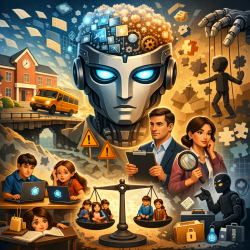
The materials highlight potential uses against educational institutions, including disinformation/misinformation and cyber attacks/social engineering. This is not hypothetical. Generative AI can rapidly produce convincing phishing emails, fake messages, and realistic-sounding narratives.
From an operational standpoint, districts should assume:
Staff will receive more sophisticated phishing attempts
Students may use AI to generate misleading content
Community trust can be harmed quickly if districts are not transparent
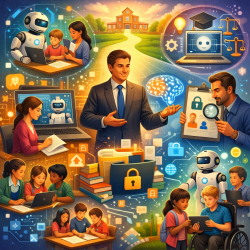
3) Evolving ethics: bias, privacy, transparency, accountability, human oversight, safety
The ethics list provided is a strong “board-level” conversation starter:
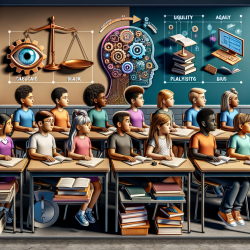
Bias: outputs can reflect inequities in training data
Privacy: tools may require data access—districts must protect it and comply with laws
Transparency: families deserve clear explanations of how tools are used
Accountability: humans remain responsible for decisions and outcomes
Human oversight: AI should not replace professional judgment
Safety: tools must be evaluated before use in critical contexts
4) Emerging regulations: plan now so you’re not scrambling later
Legislators are actively discussing generative AI, and the direction of travel is clear: more guardrails, more documentation, and more scrutiny—especially around privacy, discrimination, and consumer protection.
Where to Start: A District-Ready First Step Plan
The “Where to Start” guidance included in the materials is a solid foundation. Here’s how I’d translate it into immediate next actions a district can take within 30–60 days:
Stand up an AI policy framework: define acceptable use, prohibited use, approval processes, and monitoring. Keep it short, clear, and implementable.
Center ethics and equity: evaluate whether AI use could disadvantage students without access, multilingual learners, or students with disabilities. Build supports to prevent widening gaps.
Protect privacy and data security: align with FERPA and local requirements. Confirm what data can be entered into tools, and what cannot—especially student identifiers, IEP information, evaluation data, and health-related information.
Commit to transparency: communicate to staff and families what tools are used, for what purpose, and what safeguards exist.
Train staff and students: teach prompt basics, verification habits, citation/attribution expectations, and how to spot hallucinations and bias.
A Note for Special Education Leaders (and Therapy Teams)
In special education, we are balancing opportunity with compliance every day—often while managing therapist staffing shortages and service delivery constraints. Tools that reduce administrative burden can be appealing, but we must be disciplined.
Generative AI can support:
Drafting parent-friendly explanations (with careful review)
Generating practice activities aligned to therapy goals (with clinician oversight)
Creating multiple examples and visuals to support instruction
Generative AI should not be used to:
Enter or process identifiable student data in public tools
Make eligibility decisions, placement decisions, or service determinations
Replace clinical judgment, evaluation interpretation, or IEP team decision-making
For organizations like TinyEYE that provide online therapy services to schools, this moment is also an opportunity to partner with districts on responsible innovation—supporting teams with scalable services while reinforcing privacy, documentation integrity, and high-quality, student-centered practice.
For more information, please follow this link.