AI in Special Education: A Tool With Promise—When People Stay in the Driver’s Seat
Schools are navigating a rapidly changing landscape where student needs are rising, staffing is stretched, and expectations for individualized support remain high. In that environment, artificial intelligence (AI) is showing up in classrooms, homes, and planning meetings—sometimes quietly through built-in device features, and sometimes through new tools that promise to “solve” learning challenges.
The truth is more nuanced. AI can be a powerful support for special education when it is used thoughtfully, transparently, and in alignment with student goals. But it also has real limitations—especially when it comes to human judgment, emotional understanding, and legal requirements. For school teams and families, the best approach is neither hype nor fear. It’s informed, practical use.
What Is Artificial Intelligence (AI)?
Artificial intelligence is a broad field of technology focused on creating computer systems that mimic the way people learn, reason, and make decisions. AI is data-driven: it recognizes patterns, analyzes complex information, and adjusts its actions based on what it receives from human input over time.
In schools, that can look like tools that adapt reading passages to a student’s level, predict words as a student types, convert text into speech, or help organize tasks and reminders. AI is not a person, and it doesn’t “understand” a child the way a teacher, therapist, or caregiver does—but it can help make certain tasks more efficient and accessible.
Why AI Is Gaining Attention in Special Education
Special education is built on individualized support. Students may need different pacing, formats, prompts, or communication options to access learning. AI can help deliver that personalization at scale—especially when used as an assistive or instructional support rather than a replacement for professional expertise.
For educators and related service providers, AI can also help surface patterns in performance data and highlight where a student may be struggling, improving, or plateauing. For families, AI-powered supports can reinforce skills at home in ways that feel more immediate and practical.
Benefits of AI in Special Education: Where It Can Help Most
AI offers many benefits for special education when it is used as a tool to support (not replace) instruction and intervention. Below are key areas where AI can make a meaningful difference.
1) Personalizing Instruction
AI can help tailor lessons to a student’s pace and learning style. For example, an adaptive program might provide additional practice when a student needs it or introduce new material when the student is ready. This can be especially helpful in:
- Providing repeated practice without stigma
- Adjusting difficulty levels in real time
- Offering multiple ways to engage with the same concept
2) Strengthening Learning at Home
Families may use AI to reinforce skills in communication, reading, and writing through tools such as:
- Text-to-speech
- Reading assistance supports
- Predictive text
- Apps that generate spoken or written language
These tools can reduce barriers and increase independence—particularly for students who struggle with decoding, written expression, or language formulation.
3) Supporting Organization and Executive Function
Executive function challenges can affect a student’s ability to plan, start tasks, manage time, and remember multi-step directions. AI-supported tools can help by providing:
- Digital planners
- Reminders and alerts
- Task breakdowns and checklists
When used consistently, these supports can help students build routines and reduce missed assignments or avoidable frustration.
4) Building Social-Emotional Learning (SEL) Skills
AI can support social-emotional learning through:
- Virtual social stories
- Interactive problem-solving scenarios
- Guided practice for identifying choices and outcomes
These tools can be helpful for rehearsal and reflection. They work best when paired with real-world coaching from educators, counselors, and therapists who can interpret context and emotions.
5) Reinforcing Subject-Specific Skills
AI can also support learning in core academic areas through adaptive or interactive programs in:
- Math
- Science
- Language and literacy
For some students, interactive practice increases engagement. For others, it reduces cognitive load by offering structured steps and immediate feedback.
6) Tracking Progress and Identifying Patterns
One of AI’s most practical strengths is its ability to track progress, identify patterns, and suggest strategies to address challenges. This can give teachers, related service providers, and families more insight to guide individualized instruction and support.
Used responsibly, pattern recognition can help teams ask better questions, such as:
- Is the student struggling more with certain task types (e.g., multi-step directions vs. single-step)?
- Do errors increase at specific times of day or after transitions?
- Is progress steady, inconsistent, or stalled—and what conditions change that?
Limitations of AI: What It Cannot Do (and Why That Matters)
While AI is a powerful tool, it has important limitations. Understanding these limits protects students, families, and school teams from overreliance and misinformation.
1) AI Does Not Understand Human Emotion or Social Nuance
AI cannot truly understand human emotions, social nuance, or context. It can respond to patterns in language, but it does not “feel” empathy or interpret a student’s lived experience. In special education, that matters because progress is often shaped by:
- Motivation and confidence
- Relationships and trust
- Stress, anxiety, and regulation needs
- Cultural and family context
These are human realities that require human judgment.
2) AI Does Not Think Creatively or Generate Original Ideas Independently
AI can remix and predict based on existing data. It does not create in the way people do, and it does not independently reason like an educator or clinician who can synthesize observations, history, and nuance into an individualized plan.
3) AI Does Not Comprehend Special Education Law or Compliance Requirements
As it relates to special education, AI does not comprehend or fully encompass regulatory requirements such as the Individuals with Disabilities Education Act (IDEA) or N.J.A.C. 6A:14. Even when AI-generated content sounds official, it may not align with legal standards, district policy, or the specific facts of a student’s case.
4) Generative AI Can Sound Confident While Being Wrong
Information produced by generative AI platforms (for example, ChatGPT or Google Gemini) may appear reliable—especially when citations or case law are provided—but those references can contain errors or may be entirely inaccurate. Ultimately, AI does not have the ability to grasp the law, its intent, or how to apply it in specific situations.
That means AI should never be the sole source for:
- Legal guidance
- Interpretation of rights
- Compliance decisions
- High-stakes IEP determinations
A Practical, People-First Framework for Using AI Responsibly
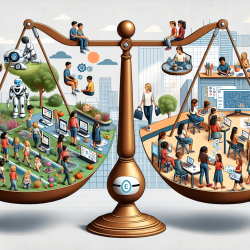
To get the benefits without falling into the common traps, school teams and families can use a simple approach: AI can assist, but humans decide.
- Use AI for access and efficiency: reading supports, writing supports, organization tools, and practice activities.
- Validate outputs: treat AI suggestions as starting points, not final answers.
- Keep goals individualized: align tools with student needs and IEP goals rather than using one-size-fits-all solutions.
- Protect privacy: follow district policies and ensure tools used with students meet required data protections.
- Maintain professional oversight: educators and related service providers should monitor effectiveness and adjust supports based on real performance and observation.
Where TinyEYE Fits: Technology That Supports Services, Not Shortcuts
At TinyEYE, we provide online therapy services to schools. In a world where technology is evolving quickly, it’s important to distinguish between tools that merely automate tasks and services that deliver real, student-centered support.
Online therapy can help schools expand access to qualified providers and maintain consistency for students—especially when staffing shortages or scheduling constraints make in-person services difficult. When paired with responsible use of supportive technology (including AI-powered accessibility features), schools can create a more flexible, responsive system that still centers professional expertise and student relationships.
When You Have Questions: Use Trusted Sources
If you have questions about special education law, rights, or services, you can contact the Office of Special Education (OSE). OSE staff provide information and support to parents, students, and educators to help them understand state and federal laws and access the services they need.
- Phone: 609-376-9060
- Email: OSEinfo@doe.nj.gov
For more information, please follow this link.