Artificial Intelligence (AI) is no longer a futuristic concept in education—it’s already embedded in everyday tools students and educators use. From speech-to-text on a phone to grammar support in writing platforms, AI is shaping how learners access curriculum and demonstrate what they know. For special education, that shift is especially significant because AI can function as a powerful accessibility layer—yet it also introduces serious questions about ethics, privacy, bias, and what “authentic work” means.
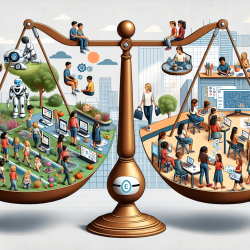
A 2023 article in the Journal of Special Education Technology (“The Future of Artificial Intelligence in Special Education Technology”) frames AI as a disruptive technology with the potential to reshape special education practices. The authors emphasize a balanced stance: AI may be life-changing for students with disabilities, but schools must evaluate its affordances and limitations carefully before rushing to ban it—or adopting it without guardrails.
For school leaders, special education teams, and service providers like TinyEYE supporting students through online therapy, the key question becomes: how do we harness AI to increase access and outcomes while protecting students and preserving ethical practice?
Why AI Matters More in Special Education Than Almost Anywhere Else
AI can be defined as computer systems designed to emulate aspects of human cognition—recognizing patterns, analyzing data, and generating responses. Many students with disabilities already rely on AI-adjacent assistive technologies (like speech recognition) to participate in learning. The difference now is scale and sophistication: modern “generative AI” can produce text, summarize information, generate practice questions, and adapt responses in seconds.
In special education, that creates a unique opportunity: AI can help reduce barriers that are not about intelligence or effort, but about access. Done well, AI can support:
- Communication access (e.g., speech-to-text, text-to-speech, language supports)
- Writing production (e.g., grammar support, planning scaffolds, draft generation with prompts)
- Personalized instruction (e.g., tutoring systems that adjust based on performance data)
- Progress monitoring (e.g., dashboards and analytics that help teams see trends faster)
- Independence (e.g., virtual assistants and reminders that reduce reliance on adult prompting)
At the same time, the stakes are higher because special education involves sensitive data, legal requirements (like IEP compliance), and vulnerable populations who may be disproportionately harmed by biased systems or poor privacy practices.
A Quick (and Useful) Snapshot of How AI Got Here
The article highlights major milestones that explain why AI feels like it “suddenly” became everywhere:
- 1940s–1950s: Early computing and the rise of neural networks (systems modeled after the human brain).
- 1997: IBM’s Deep Blue defeats world chess champion Garry Kasparov.
- 2011: IBM Watson wins against top Jeopardy! champions.
- 2017: Google AlphaGo defeats the world’s best “Go” player, a landmark for complex strategy.
These breakthroughs were fueled by machine learning and deep learning—approaches that improve performance using large datasets. In education, that translates into tools that can respond to student inputs, generate feedback, and increasingly mimic human-like language.
AI and Writing: Support Tool, “Cheating,” or a New Kind of Accommodation?
Writing is a helpful example because it shows both the promise and the controversy. Traditional writing instruction often emphasizes a process: planning, drafting, revising, editing, and publishing. Special education has long used technology-enhanced scaffolds—such as graphic organizers—to support that process.
The article contrasts structured tools (like digital organizers that guide students through claims, facts, elaborations, and transitions) with generative AI tools that can produce a full essay in seconds. That speed can be shocking—and it immediately raises questions educators are already debating:
- If a student uses AI to generate text, what skill is being measured: writing, editing, critical thinking, or prompt creation?
- Is AI support comparable to other accommodations (calculator use, text-to-speech, audiobooks), or is it fundamentally different?
- How do we preserve instruction in writing while also providing equitable access for students who cannot physically produce text or organize ideas even with intensive intervention?
The authors suggest an important reframing: AI may allow some students to begin at the “editing” phase and work backward—checking clarity, verifying facts, improving transitions, and aligning conclusions to evidence. That doesn’t eliminate the need for writing instruction, but it may change what instruction looks like and where teachers focus their time.
AI as a “Cognitive Prosthesis”: A Powerful Lens for IEP Teams
One of the most practical concepts in the article is the idea of AI as a cognitive prosthesis—a tool that compensates for an impaired function and expands what a learner can do. This matters because special education has a long history of using compensatory strategies to increase independence and access.
Examples of AI-as-prosthesis in real life are already common:
- A student with limited fine-motor ability uses speech-to-text to produce written work.
- A student with a visual impairment uses text-to-speech to access grade-level content.
- A student with executive function challenges uses AI reminders and structured prompts to plan tasks.
- A student with communication needs benefits from language supports that reduce barriers to participation.
This framing can help IEP teams focus on function and outcomes rather than fear. The central question becomes: Does this tool increase access, equity, and meaningful participation while aligning with the student’s goals and services?
The Ethical Issues Schools Cannot Ignore (Especially in Special Education)
The article emphasizes that ethical concerns are not side issues—they are core implementation issues. In K–12 settings, AI raises risks around:
- Privacy: Student data may be collected, stored, or analyzed in ways families do not understand.
- Consent and understanding: Students may not grasp what the tool is capturing, who owns the data, or how it’s used.
- Bias and discrimination: AI systems can reflect biased datasets and produce unfair outcomes or narrow perceptions of a student’s ability.
- Surveillance and autonomy: Monitoring tools can become intrusive, especially for students with disabilities who already experience heightened scrutiny.
- Disability disclosure risks: Data tied to disability status can increase vulnerability if mishandled.
For special education leaders, a practical takeaway is that AI decisions should not be made solely by technology departments. They require collaboration among administrators, special educators, related service providers, families, and (when appropriate) students.
Policy and Practice: Don’t Ban First—Build Guardrails First
The authors argue that calls to ban AI are often misguided—especially if bans remove tools that could be transformative for students with disabilities. They compare today’s AI moment to earlier disruptions like calculators and automobiles: society didn’t start with perfect rules; it learned through adoption, reflection, and policy development (think seatbelts, speed limits, and privacy laws).
Schools can take action now by establishing clear AI use parameters. Consider building guidance around:
- Acceptable use by task type (brainstorming vs. final drafts vs. assessments)
- Disclosure expectations (when students should cite or note AI assistance)
- Data governance (what data is collected, where it’s stored, retention timelines, vendor agreements)
- IEP alignment (how AI supports accommodations, modifications, and goals)
- Equity of access (ensuring AI doesn’t widen gaps between students who have tools at home and those who don’t)
What This Means for Online Therapy and Related Services (Where TinyEYE Fits In)
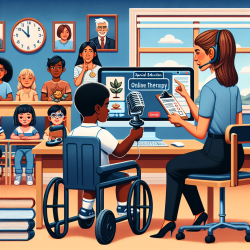
AI’s growth will affect not only classrooms, but also how schools deliver related services—especially in remote and hybrid models. For providers like TinyEYE delivering online therapy to schools, the AI conversation intersects with three real needs districts face:
- Capacity challenges: Special education shortages and high caseloads increase pressure to find efficient, scalable supports.
- Data-informed decisions: Teams want faster insight into student performance and progress without increasing paperwork burdens.
- Consistency and access: Students need reliable services regardless of geography, staffing gaps, or scheduling constraints.
AI is not a replacement for specialized clinical judgment, relationship-based therapy, or individualized goal-setting. But it may become a meaningful support for documentation workflows, practice activities, accessibility features, and communication supports—if implemented with privacy protections and ethical clarity.
Key Questions School Teams Should Be Asking Right Now
The article ultimately leaves readers with more questions than answers—because the field is still early in understanding outcomes. That said, schools can move forward responsibly by asking strong questions before adopting (or banning) tools:
- How does this AI tool increase access and equity for students with disabilities?
- What student data does it collect, and does it introduce new privacy or consent risks?
- Could the system produce biased outputs for certain disability categories, cultures, or language backgrounds?
- Does it support the intent of the IEP, or does it unintentionally change what is being measured?
- How will staff be trained so implementation is consistent, ethical, and instructionally sound?
Bottom Line: AI Is Coming Either Way—Special Education Must Lead the Conversation
AI is already influencing how students write, study, communicate, and demonstrate learning. The most important message from this research-informed discussion is not that AI is “good” or “bad,” but that special education must be central in shaping how AI is used. If decisions are made without disability expertise, schools risk excluding the very learners who may benefit most.
For more information, please follow this link.