
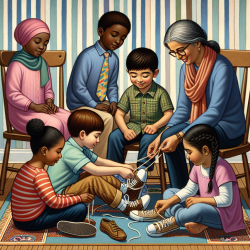
Shoe tying is one of those everyday skills that can look “simple” to adults, yet it represents a complex blend of fine motor coordination, bilateral integration, visual-motor skills, attention, and persistence. In school settings, difficulty tying shoes can show up in very real ways: missed recess time, frustration during transitions, reduced independence in the hallway or on the playground, and even safety concerns when laces come undone.
As a Special Education Director, I often hear from teams and families that shoe tying becomes a recurring challenge—especially for students who have fine motor delays, sensory processing needs, attention differences, or motor planning difficulties. The good news is that occupational therapy (OT) offers practical, structured approaches that can make this skill more accessible. With consistent instruction and the right supports, many students can learn to tie their shoes and maintain that skill over time.
Why Shoe Tying Can Be Hard: The OT Lens
Tying shoes is a self-care task (activities of daily living) that requires multiple foundational skills working together. When a student struggles, it’s rarely about “not trying.” It’s usually about missing building blocks.
- Fine motor strength and dexterity: Pinching, pulling, and stabilizing laces requires hand strength and finger control.
- Bilateral coordination: Both hands must work together with different roles (one stabilizes while the other manipulates).
- Motor planning: Sequencing steps and coordinating movements in the right order.
- Visual-motor integration: Watching the lace movements and matching what the eyes see to what the hands do.
- Working memory and attention: Holding steps in mind long enough to complete the sequence.
- Sensory factors: Some students dislike the feel of laces, pressure across the foot, or the frustration of repeated attempts.
When we understand the “why,” we can choose strategies that fit the student instead of repeating the same instruction louder or longer.
Start with Readiness: Pre-Tying Skills That Matter
Before expecting a student to master shoe tying, OT teams often check whether the student has the prerequisite skills. If shoe tying is consistently unsuccessful, it may be more effective to build readiness first.
- Hand strength: Squeezing putty, using clothespins, hole punching, or building with resistive toys.
- Finger isolation: “Spider push-ups,” finger taps, or games that require using one finger at a time.
- Bilateral hand use: Beading, tearing paper, opening containers, or lacing cards.
- Crossing midline: Activities that encourage one hand to reach across the body, supporting smoother coordination.
In schools, these can be embedded into centers, morning work bins, or brief OT consult strategies in the classroom.
Choose the Right Shoe and Lace Setup
Sometimes we unintentionally make shoe tying harder by starting with the wrong materials. An OT-informed setup can reduce frustration and speed up learning.
- Use two-color laces: Different colors make it easier to track “which lace goes where.”
- Pick thicker laces: They are easier to grip than thin, slippery laces.
- Practice on a stable surface: A shoe-tying board, a shoe on the table, or the student’s foot propped on a step can help.
- Check lace length: Laces that are too short increase difficulty; laces that are too long can become distracting and unsafe.
When students are first learning, it’s reasonable to practice on a shoe that is not being worn. Once the steps are more consistent, we shift practice to the student’s own shoe for real-world generalization.
Break the Task into Teachable Steps
One of the most effective OT strategies is task analysis: breaking the skill into small, teachable steps and practicing systematically. Many students benefit from learning one “anchor routine” and sticking with it until it becomes automatic.
Here is a common step sequence (one of several acceptable methods):
- Cross the laces to make an “X.”
- Tuck one lace under and pull tight (the “first knot”).
- Make one “bunny ear” loop.
- Wrap the other lace around the loop.
- Push a second loop through the opening.
- Pull both loops to tighten.
Consistency matters. If adults are teaching different methods at home and school, the student may struggle to build muscle memory. When possible, align on one method across settings.
Use Evidence-Informed Teaching Supports
In both in-person and online therapy models, structured supports can make shoe tying more learnable and less stressful.
- Backward chaining: The adult completes most steps, and the student finishes the last step (often the “pull loops tight” step). As mastery improves, the student completes more steps. This builds success quickly.
- Visual supports: A simple picture sequence or cue card can reduce working memory demands.
- Video modeling: Short, repeatable clips showing the exact method can be powerful, especially for students who learn well visually.
- Hand-over-hand with fade: Provide physical guidance only as needed, then gradually reduce support to promote independence.
- Verbal scripts: Simple phrases like “cross, tuck, pull” or “ear, around, through, pull” can cue sequencing.
For students who become easily frustrated, we also consider emotional regulation supports: brief practice sessions, clear start/stop points, and immediate reinforcement for effort—not just perfect performance.
Common Challenges and OT Solutions
Laces won’t stay tied
- Teach “double knot” once the student can tie a basic bow.
- Check lace type; some laces are too slippery.
- Ensure the first knot is pulled tight before making loops.
Student can do it in therapy but not in real life
- Practice during real school routines (before recess, after PE).
- Use the student’s actual shoes as soon as possible.
- Fade prompts intentionally and track independence.
Motor planning breakdown (steps get mixed up)
- Use two-color laces and a consistent method.
- Reduce language and use a picture sequence.
- Teach one step at a time with repetition and predictable cues.
Low frustration tolerance
- Use short practice bursts (2–5 minutes) rather than long sessions.
- Celebrate partial progress (e.g., “You made the first knot independently”).
- Offer a temporary accommodation (elastic laces or toggle) while continuing instruction.
School-Based Considerations: Independence, Access, and IEP Alignment
In schools, shoe tying can be addressed through OT services when it impacts educational access, safety, or participation. Teams may consider:
- IEP goals: A measurable self-care goal can be appropriate if the skill affects independence during the school day.
- Accommodations: Elastic laces, Velcro shoes, or alternative fasteners can reduce barriers during transitions.
- Data collection: Track which steps are independent, which require prompts, and whether the skill generalizes across settings.
- Collaboration: Consistent language and method across OT, classroom staff, and family improves outcomes.
It’s also important to acknowledge staffing realities. Many districts face OT shortages, and service delivery models must be flexible. Online therapy can support continuity of care, provide consistent coaching to staff and families, and help districts maintain compliance and progress monitoring when in-person staffing is limited.
How Online Occupational Therapy Can Support Shoe-Tying Instruction
When delivered thoughtfully, online OT can be effective for functional skills like shoe tying—especially when the therapist coaches an adult facilitator (school staff or family member) and uses clear visuals and structured practice.
- Therapists can demonstrate steps with a model shoe and visual cues.
- Students can practice with real-time feedback and repetition.
- Staff and families can receive coaching on prompts, fading, and home carryover.
- Progress can be tracked consistently, supporting IEP documentation and team communication.
The goal is not just tying a bow once, but building a reliable, independent routine that holds up during busy school transitions.
Practical Takeaways for Teams and Families
- Assume shoe tying is a complex motor task and teach it explicitly.
- Build readiness skills if the student is not yet successful.
- Use the right materials: thicker, two-color laces and stable practice positions.
- Stick to one method and align language across school and home.
- Use OT strategies like backward chaining, visuals, and prompt fading.
- Consider temporary accommodations while instruction continues.
For more information, please follow this link.