Walk into almost any classroom and you’ll see it: students drafting stories on laptops, completing assignments in Google Docs, and submitting work with a click. At the same time, many teachers still rely on handwritten work for spelling tests, note-taking, math practice, and early literacy. This has sparked a common question from educators and families alike: should kids focus on typing or handwriting?
The most useful answer isn’t “one or the other.” It’s understanding what each skill uniquely supports in a child’s development—and how schools can intentionally teach both so students don’t fall behind academically or functionally.
Why this debate matters more than ever
Typing is now a life skill. Many standardized tests are digital, classroom materials are online, and assistive technology is more accessible than ever. But handwriting is still a foundational school skill, especially in early grades where writing by hand supports letter learning, spelling, and the physical mechanics of producing written language.
When schools treat typing as a replacement for handwriting (or handwriting as the only “real” writing), students can end up with gaps that show up in surprising ways:
- Slow written output that limits how much a student can show what they know
- Messy or illegible handwriting that affects grading and confidence
- Weak spelling or letter formation that impacts reading and writing
- Typing that is hunt-and-peck, slow, and mentally exhausting
- Reduced ability to take notes effectively in later grades
What handwriting helps kids learn (beyond “neat writing”)
Handwriting is not just a method of recording ideas—it’s a learning process. In early development, writing letters by hand can reinforce how letters are formed and recognized. The act of producing letters requires coordinated fine-motor control, visual-motor integration, and sustained attention.
Key benefits of handwriting
- Letter knowledge and early literacy: Forming letters can strengthen recognition and recall, supporting reading and spelling development.
- Fine-motor development: Pencil control, grip strength, and hand endurance build through repeated practice.
- Visual-motor integration: Kids learn to coordinate what they see with what their hand does—important for copying, spacing, and alignment.
- Memory and learning: Many students remember information better when they write it by hand, especially when summarizing or organizing ideas.
- Independence in school routines: Completing worksheets, filling out forms, writing short answers, and showing math work still commonly require handwriting.
In practice, handwriting can be especially important in kindergarten through grade 3, when students are building the foundations of literacy and written expression.
What typing helps kids do (and why it’s not “cheating”)
Typing is often faster than handwriting once a student becomes proficient. It can reduce the physical effort of writing, freeing up brainpower for idea generation, organization, and revision. It also aligns with how students will communicate in higher education and the workplace.
Key benefits of typing
- Writing volume and stamina: Students who fatigue quickly with handwriting may produce longer, more complex writing when typing.
- Editing and revising: Digital writing makes it easier to reorganize paragraphs, correct errors, and refine ideas.
- Accessibility: For students with motor challenges, learning differences, or injuries, typing can be a critical pathway to participation.
- Digital readiness: Keyboarding is essential for online learning, digital assessments, and modern classroom workflows.
- Confidence: Students who struggle with handwriting may feel more willing to write when the barrier is reduced.
Typing becomes increasingly important in grades 4 and up, when writing demands expand and students are expected to produce longer assignments across subjects.
So… which one is better for learning?
It depends on the goal.
- If the goal is learning letters, building fine-motor skills, and strengthening early literacy, handwriting has unique benefits.
- If the goal is producing longer work, revising efficiently, and accessing curriculum with fewer physical barriers, typing can be the better tool.
Most schools benefit from a “both/and” approach: teach handwriting explicitly in the early years, introduce keyboarding intentionally (not incidentally), and allow students to use the tool that best matches the task and their needs.
Common signs a student may need extra support
Some students pick up handwriting and typing naturally. Others need targeted instruction or therapeutic support. Here are practical signs educators can watch for:
Handwriting red flags
- Illegible writing that does not improve with typical classroom practice
- Very slow writing speed compared to peers
- Complaints of hand pain or extreme fatigue
- Difficulty with spacing, sizing, or staying on the line
- Frequent letter reversals beyond expected developmental timelines
- Avoidance of writing tasks
Typing/keyboard red flags
- Hunt-and-peck typing that remains very slow over time
- Difficulty locating keys or using both hands
- Frequent accidental key presses or poor control of the trackpad/mouse
- Inability to use basic functions (shift, backspace, punctuation) efficiently
- Typing that is so effortful it reduces focus on content
When these challenges interfere with academic performance, it may be time for a more structured plan—whether that’s skill-building, accommodations, or therapy support.
What schools can do: practical strategies that work
Schools don’t need to choose sides. They need a plan. Here are strategies that support students across grade levels:
1) Teach handwriting explicitly (especially early on)
- Use consistent letter formation language (start point, direction, sequence)
- Provide short, frequent practice rather than long drills
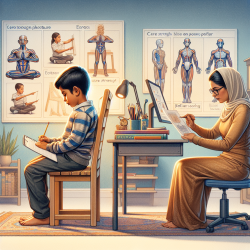
- Build in posture and pencil grasp checks
- Teach spacing strategies (finger spacing, visual cues, highlighted margins)
2) Teach keyboarding like a real skill
- Schedule regular keyboarding practice (10–15 minutes, several times a week)
- Focus on accuracy first, then speed
- Teach home row and two-hand use systematically
- Include functional typing tasks (sentences, summaries, short responses)
3) Match the tool to the task
- Handwriting may be best for quick math work, diagrams, and early literacy practice
- Typing may be best for longer writing assignments, research projects, and revisions
- Offer choices when the goal is demonstrating knowledge, not practicing handwriting
4) Use accommodations thoughtfully
Accommodations are not shortcuts—they are access. Depending on student needs, schools may consider:
- Allowing typed assignments for students with significant handwriting barriers
- Providing speech-to-text for students with complex motor or language needs
- Reducing copying demands (provide notes or templates)
- Offering extra time when writing speed is the limiting factor
Where online therapy can fit in
Students who struggle with handwriting or written output may benefit from targeted support that addresses the underlying skills. In school settings, this can include fine-motor development, visual-motor integration, writing mechanics, and strategies to improve functional participation in classroom tasks.
Online therapy services can help schools expand access to specialized support—especially when staffing shortages or scheduling challenges make in-person services difficult. With the right collaboration between therapists and educators, students can receive consistent, goal-driven intervention that connects directly to classroom expectations.
A balanced takeaway for educators and families
Typing and handwriting are not competing skills. They are complementary tools that support different aspects of learning and participation. The most effective approach is to:
- Build strong handwriting foundations early
- Introduce keyboarding intentionally and practice it consistently
- Use accommodations when a student’s output barrier hides their true ability
- Seek support when challenges persist and impact learning
When schools take this balanced approach, students gain something powerful: the ability to communicate their ideas clearly—no matter the medium.
For more information, please follow this link.